Log-Perplexity: OpenAI's New Yardstick for AI Progress
OpenAI wants every frontier lab to report log-perplexity as a shared progress measure. Here's what the number means, why it matters, and its limits.
On November 22, 2026, OpenAI's chief scientist, Jakub Pachocki, published a six-page note. For the first time, it put OpenAI's own internal pretraining scores in public. The note also asks every frontier AI lab to agree on one number for measuring progress, and on limits for that number. The number has an odd name: log-perplexity.
Log-perplexity measures how hard a model finds it to guess the next token of text; lower is better. OpenAI wants every lab to report it as a shared progress measure. It tracks pretraining progress only. It does not tell you what a model can do for your project.
What OpenAI published on November 22, 2026
Jakub Pachocki's post on OpenAI's site proposes perplexity, also called cross-entropy loss or log-perplexity, as the shared metric for comparing model developers and setting common safety limits. It went up on November 22, 2026, under his title as OpenAI's Chief Scientist. TechCrunch covered it the same day and reported that Sam Altman called it "the most important thing OpenAI has published in a while."
One naming note. "Perplexity" here is a maths term. It has nothing to do with the AI search company called Perplexity, a point TechCrunch also makes.
If you first want a map of OpenAI's current models, read my GPT-6.2 Astra Pro explainer before going further.
Log-perplexity is the model's average surprise at the next token
Log-perplexity is the average difficulty the model has predicting the next token in real text, so a lower score means fewer wrong guesses. OpenAI's note uses it as a single reading of how well pretraining went. Pretraining is the first and longest training stage. The model reads a huge amount of text and practises this guessing game over and over.
Say you type "I will call you after" into your phone. The keyboard suggests "class". If you meant "class" and the model gave that word a high chance, it was barely surprised. If it gave "class" a tiny chance, it was very surprised.
Each guess gets a surprise score: the negative logarithm of the chance the model gave the right token. A confident, correct guess scores close to zero. A shocked guess scores high. Average those scores over a very large pile of text and you get the number OpenAI is talking about.
Four terms show up around this idea:
- Token: a small piece of text a model reads, often a whole word or part of one.
- Log-perplexity: the average surprise score per token, kept on the log scale.
- Cross-entropy loss: the name engineers use for that same number while training a model.
- Perplexity: e raised to the log-perplexity. Roughly, how many equally likely tokens the model feels it is choosing between at each step.
OpenAI's own scores: GPT-3.5, GPT-4 and now below 0.8
OpenAI's internal scores fell from about 0.99 for GPT-3.5 to about 0.91 for GPT-4 and are now below 0.8, according to Pachocki's note, which reads the larger recent drop as faster progress. The note does not state the time gaps between those models, so treat that reading as the note's claim, not a settled fact. These are OpenAI's own measurements. No other lab has published matching figures, so there is nothing yet to line them up against.
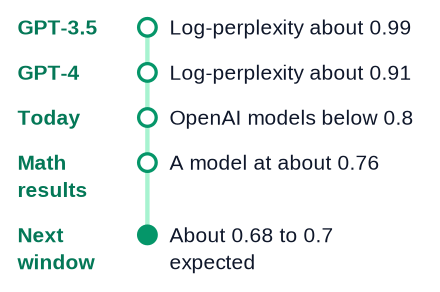
| Model | Log-perplexity | What the note says about it | Source |
|---|---|---|---|
| GPT-3.5 | about 0.99 | Earlier baseline | OpenAI |
| GPT-4 | about 0.91 | Next big step | OpenAI |
| Current OpenAI models | below 0.8 | Where OpenAI is now | OpenAI |
| Model behind the maths results | about 0.76 | Produced OpenAI's groundbreaking maths results | OpenAI |
| Expected next window | about 0.68 to 0.7 | Pachocki expects further transformative capabilities here | OpenAI |
Small decimals matter on a log scale. Here is my own calculation from OpenAI's figures, using perplexity as e raised to the log-perplexity: e^0.99 is about 2.69, e^0.91 is about 2.48, and e^0.8 is about 2.23, with the current score below that. Each drop means the model is choosing between fewer equally likely tokens. That is a large change for a model that has already read most of the public internet.
The maths-results model in that table connects to a bigger trend: AI that can check its own proofs. My post on AlphaProof and formal verification explains why that matters for programmers.
Why labs want one shared metric now
Benchmark tests keep filling up near their top scores, so labs lack a common yardstick, and the proposal pairs one with limits developers agree not to cross until monitoring catches up, as TechCrunch reports. A benchmark is a fixed set of test questions, like a coding exam. Once every top model scores near full marks, the exam stops telling them apart.
Log-perplexity has no such ceiling in sight. Any lab can measure it on fresh text. It keeps moving as models improve, which makes it a dial that written rules can point to.
Pachocki calls his version a "first limit on development". Labs would agree on a score they will not cross until tools for watching model behaviour catch up. The note does not ask anyone to stop building. It asks labs to agree on the line before they reach it.
Other voices are in the room too. TechCrunch places the idea next to Anthropic CEO Dario Amodei's "pace the frontier" plan and a growing number of calls for speed limits on AI. For a student, the useful part is this: the biggest labs now argue in public about how fast to go, and this note gives that argument a number.
The catch: a low score is not a skill score
The proposal itself lists problems: comparing labs is hard, perplexity detaches from real tasks, chain-of-thought reasoning adds capability without lowering perplexity, and the lowest possible score is unknown. Chain-of-thought means the model writes out its working step by step before answering, like showing working in a maths exam.
Comparing labs is hard because each lab trains on different text and cuts words into tokens differently. A score on one lab's test text does not line up neatly with a score on another's.
The unknown floor matters too. Human writing has some built-in randomness, so no model can predict it perfectly. Nobody knows how close today's scores sit to that floor.
Pros
- Works on any text a lab can test
- Keeps moving after benchmark exams fill up
- One number is easy to set a shared limit on
Cons
- Scores from different labs may not compare cleanly
- A lower score does not promise better code
- Gains from reasoning at answer time stay invisible
So do not pick a model on perplexity alone. Say two models differ by a few hundredths. The one with the worse score might still fix your React bug faster, because it thinks longer before answering.
How to read 'perplexity' in a model card
Treat a perplexity figure as a progress reading on pretraining, then test the model on your own task before trusting it. A model card is the short document a lab publishes with each model. The check below takes one evening.
Check who reported it
A lab's score for its own model is a claim, not an independent result. OpenAI's numbers came from OpenAI.
Check the test text
Find out what text the score was measured on. Code, English news and Hindi text each give different scores.
Check it is the same measure
Perplexity and log-perplexity sit on different scales. Compare like with like, or do not compare at all.
Run your own small test
Give two models the same task from your own project, such as a bug from your college assignment or a feature from your side project. Judge the output yourself.
Pachocki's full note on OpenAI's site is short enough to read in one sitting. Its list of open problems is the most honest part. If cost decides which two models you try, my breakdown of GPT-6.2 Astra Sol pricing for students helps you choose.
Next time a model card cites perplexity, note which lab reported it, then run two models on one small task of your own and compare the results yourself.


