AlphaProof Code Proved Signal's Code Secure: What Students Should Learn
Google DeepMind's AlphaProof Code formally verified key security properties of Signal's protocol implementation in four weeks, a task that historically takes expert teams years. For students, understanding formal proof and Lean is becoming a valuable skill.
On November 10, 2026, Google DeepMind announced that its AI system, AlphaProof Code, had mathematically proven key security properties of Signal's protocol implementation. This is the first time any method, human or AI, has machine-checked a widely deployed protocol's actual implementation at this depth.
AlphaProof Code is an AI framework that uses multiple LLMs to produce formal proofs of code security. It proved key security properties of Signal's protocol implementation in four weeks, a task that historically takes expert teams years. This matters for students because it signals a new skill: understanding and using formal proof.
What AlphaProof Code proved and how
AlphaProof Code proved with math the actual compiled code of Signal's cryptographic protocol, proving it satisfies a defined set of security properties. This is not a toy example. The system checked the exact code that runs on devices, not a simplified model of it. The DeepMind announcement describes how human experts and AI decided what properties to prove, and then AI agents did the proving.
The verification ran for four weeks. Historically, expert teams have spent years on similar tasks. DeepMind's blog post also reports a critical test: the team reintroduced two real bugs, ones that had been found and fixed in Signal's past, into isolated code. The system produced a machine-checked proof that the buggy version failed to satisfy the security properties.
The significance is that it verified the compiled code. Many verification efforts check a specification or a model. AlphaProof Code checked the actual bytes running on your phone.
How formal proof works
Formal proof means writing code and a mathematical specification in a language like Lean, then using machine-checkable steps to prove the code matches the spec. A formal proof is like a math proof, but for a program. Machine-checkable means the computer checks each step, not a human. Every step must be a rule of logic, so there is no room to skim past an error.
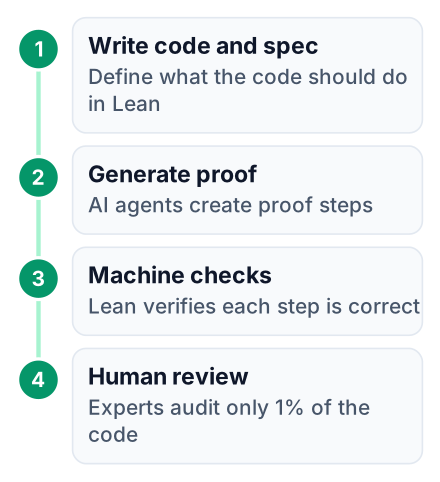
Lean is the language DeepMind used. It is a proof assistant: a system where you write both a theorem and its proof, and the computer confirms the proof is valid. The DeepMind post says the agents generated over six million lines of Lean code. That is not a human typing line by line. The framework used multiple LLMs working as agents, each with a role, to search and write the proofs.
Here is the mental model. Regular code tells a computer what to do. Lean code also tells a computer why a program is correct. The "why" comes as a machine-checkable proof.
Write the spec
Define what correctness means in logic, for example "an attacker who sees the ciphertext learns nothing about the message."
Write the code
Write or take the actual implementation you want to verify.
Write the proof
Produce a series of logical steps showing the code satisfies the spec.
Run the checker
Lean mechanically verifies every step. If one step is wrong, the whole proof fails.
Review what remains
AI agents flagged only a small part for human experts to read.
What this means for AI-generated code
AlphaProof Code shows that AI can both generate code and verify it, which starts to address the worry that AI output is too fragile to trust. Many developers worry that AI writes code that looks fine but breaks in edge cases. This launch is the first strong sign that AI can do the checking itself, not just the writing.
The DeepMind blog post notes that only 1% of the codebase was flagged for human review. That is a small part for people to read, compared to the whole protocol. The other 99% was proven correct by machine-checked logic. WIRED also reports that the analysis did not find new vulnerabilities.
This does not mean every AI-generated program is safe tomorrow. It means the method now exists. The path from "AI wrote this" to "AI proved this is correct" is no longer theoretical. For a field that fears AI hallucination in code, this is the first practical counter-example at scale.
The skill edge for students
Learning even a working vocabulary of formal proof and Lean separates students who just prompt AI from those who can reason about whether AI output is correct. The ability to ask "is this proof valid?" is becoming a real job skill, especially in cybersecurity and correctness-focused roles.
Try Lean yourself
Start with the Natural Number Game at adam.math.hhu.de, an interactive tutorial that teaches Lean by proving simple theorems like 1 + 1 = 2. For example, in Lean you write the theorem example : 1 + 1 = 2 := by simp and the computer checks the proof. It is a small, concrete step that works without any math degree.
After that, move to Lean's official Functional Programming in Lean tutorial to build a working vocabulary. A good first project is proving a simple property of a small function you write yourself—for example, that reversing a list twice returns the original list.
DeepMind has open-sourced its formal verification artifacts and published a technical paper. That means the study material is free. There is no subscription to AlphaProof Code, no paywall for the paper. A student anywhere, in Kolkata or in San Francisco, can read how the system worked and look at the Lean files.
For careers, the edge is clear. A developer who can write a proof in Lean is rare. A developer who can read a proof and discuss its limits is uncommon. A developer who has only prompted a chatbot is common. The DeepMind announcement calls the framework agentic and multi-LLM, which points to a future where verification is a standard step.
A unit test can miss a bug like an integer overflow that only appears with one specific input. A formal proof could prove the code always satisfies the spec, so that overflow is ruled out for every input. Note that formal proofs only verify against the spec, not against every possible bug—the WIRED article notes the analysis did not verify the entire Signal app.
Related reading on this shift: OpenAI's GPT-6 and what a security-focused model means for students and whether Claude Code should ask before touching files. For context on how AI models are priced and what that means for your access, see the Gemini 4 Carbon launch and its student pricing.


