How to Become a Data Scientist After BSc CS: A Practical Roadmap
Your BSc CS degree is enough to start a data science career. You need to close four specific gaps: statistics, pandas and SQL, causal inference, and portfolio projects. This roadmap shows what to learn and how long it takes.
Say you finish a BSc in Computer Science and open Naukri to search "data scientist". In a sample of 100 Naukri postings collected on October 6, 2026, only 5 accepted 0 years of experience. That is Simplilearn's own small sample, so read it as a hint, not a law. Most of the other postings want some experience, and the plan below is built to give you proof of it through projects and an analyst first job.
A BSc CS degree is enough to start a data science career, and you do not need a master's first. You need to close four gaps the degree usually leaves: statistics depth, pandas and SQL fluency, causal inference, and portfolio projects that pass resume filters. Simplilearn's roadmap says to plan on 8 to 12 months of part-time study.
Check what your BSc CS already gives you
Your degree already covers programming and data structures, plus some maths, so you are not starting from zero. The Simplilearn data scientist roadmap for India asks for skills that sit right next to a CS syllabus. Only four of them are usually missing.
Each gap has a simple cause. Most CS programs give you one probability course, squeezed between compilers and networks. Your databases course taught you how to design tables. It did not teach you how to answer business questions with them. Causal inference is rarely on the syllabus at all. Your final-year project was built to impress examiners, and recruiters read projects differently.
The same audit also answers the common search for career options after BSc computer science. Data scientist is one door. Data analyst is a second, and it often takes freshers more readily. The post on fresher data analyst hiring has the real numbers. ML engineer is a third, closer to software engineering. All three use the same four skills in different amounts.
Learn probability and statistics before any machine learning
Statistics is the first gap because employers list it in the job post itself, and the IIT Madras BS in Data Science opens with Mathematics and Statistics for Data Science. The same Simplilearn page shows a Meesho Data Scientist III posting that asks for statistics and linear algebra by name.
Study these topics in this order:
- Probability: conditional probability, Bayes' rule, expected value.
- Distributions: normal, binomial and Poisson, and what kind of data each one describes.
- Hypothesis testing: null hypothesis, p-values, confidence intervals, t-tests.
- Linear algebra basics: vectors, matrix multiplication, and why linear regression is a matrix problem.
Khan Academy's statistics and probability course is free and covers most of this list.
Use one self-check before you move on. Explain a p-value to a friend in two plain sentences. Here is a good answer: "If nothing real were going on, how often would I see a result this extreme just by chance? A small p-value means that would be rare." If you can only recite a formula, you are not done yet.
Get fluent in pandas and SQL on messy data
Most entry-level work is cleaning and querying tables. Practise on real messy datasets until joins and group-bys feel routine and missing values stop surprising you.
Pick one dataset from each country. The New York City taxi trip records are large and full of odd values. India's Open Government Data platform has state-level tables with gaps and inconsistent names. Both teach you the same lesson: real data is never clean.
Practise each question twice, once in pandas and once in SQL. Here is the same question in both tools: what is the average fare per pickup zone, ignoring rows with no fare?
# pandas
trips = trips.dropna(subset=["fare"])
avg_fare = (
    trips.groupby("pickup_zone")["fare"]
         .mean()
         .sort_values(ascending=False)
)
-- SQL
SELECT pickup_zone, AVG(fare) AS avg_fare
FROM trips
WHERE fare IS NOT NULL
GROUP BY pickup_zone
ORDER BY avg_fare DESC;Once that feels easy, add the harder pieces. Use merge in pandas and the matching JOIN in SQL. Then learn window functions like ROW_NUMBER() and running totals, which interviewers love. The official pandas group-by guide is the best reference when you get stuck.
Learn basic machine learning with scikit-learn
Once pandas and SQL feel routine, learn the core of machine learning with the scikit-learn library and its free user guide. Cover five topics in this order: train/test split, linear regression, logistic regression for classification, cross-validation, and evaluation metrics such as accuracy, precision, recall and RMSE. At about 10 hours a week, plan on 8 to 10 weeks. You need this before the prediction project below.
Add causal inference to separate your profile
Causal inference lets you say whether a change caused a result, which most fresher candidates cannot do. In one sentence, it is the set of methods for telling "X caused Y" apart from "X and Y happened together".
Here is an example that works in both countries. An online store changes its checkout button from grey to orange, and sales go up that week. Did the button do it? Maybe. Maybe it was also payday, or a festival sale, or a holiday weekend. Correlation shows the two moved together. Only a proper test tells you the button was the reason.
Learn these three ideas, then practise on one public A/B test dataset, following any free beginner A/B testing course:
- Randomized experiment (A/B test)
- Show half your users the old button and half the new one, chosen at random. Any difference in sales then comes from the button.
- Confounder
- A hidden third factor that moves both things you are measuring, like payday driving both site visits and sales.
- Difference-in-differences
- When you cannot randomize, compare how a changed group and an unchanged group moved over the same period. The difference between their changes is your estimate of the effect.
Build three portfolio projects in order
Build one analysis project, one prediction project and one experiment project, each with a clear business question and a short write-up. The order matters because each one uses the skills from the step before.
Analysis project
Take a messy public dataset and answer a business question with SQL and pandas. Example: which pickup zones bring in the most revenue per trip?
Prediction project
Build a simple model, such as linear or logistic regression, and explain which features matter and why. Report accuracy honestly, including where the model fails.
Experiment project
Analyse a public A/B test dataset, or simulate one. State the hypothesis, run the test, and say what decision a manager should make.
If you need starting ideas, the Python project ideas for college students post has several you can turn into data projects.
Resume filters reward clarity, not tricks. Follow these rules:
- Use the plain words from the job post: "SQL", "pandas", "A/B testing", "regression".
- Put a GitHub link next to each project, and a short README in each repo.
- Give each project one line with its result, such as "found that a handful of zones produce most of the revenue".
- Do not stuff keywords in white text or long skill lists. Recruiters read the resume after the filter does.
Simplilearn's timeline assumes you are a B.Tech or B.Sc graduate with college maths and some Python. The same page breaks the first four roadmap stages into 39 to 62 weeks of part-time study at about 10 hours a week, which is roughly 9 to 14 months, so read the 8 to 12 month figure as the middle of that range. That pace fits around a final year or a first job.
India vs US: what to expect in pay and hiring
The two markets differ in pay and in who gets hired, and each needs a different push after the four gaps. LPA means lakh rupees per year. Each country's figures come from its own sources and are never converted.
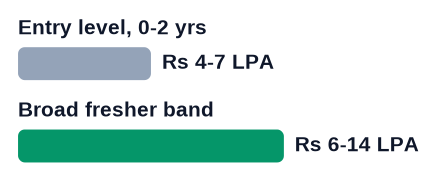
| Measure | India | United States |
|---|---|---|
| Entry-level pay | ₹4–7 LPA for 0–2 years (Glassdoor, via upGrad) | All-experience average for bachelor's holders: $101,455, not an entry-level figure (Zippia, via Coursera) |
| Broad fresher band | ₹6–14 LPA (Glassdoor, via upGrad) | All-experience median for all data scientists: $112,590 as of May 2024 (BLS, via Coursera) |
| Average across levels | About ₹16.1 LPA for 1–8 years, middle half ₹7.6L–₹17.6L (AmbitionBox, via Simplilearn) | Not a pay figure: US job growth is 34% from 2024 to 2034, about 23,400 openings a year (no India counterpart found) (BLS, via Coursera) |
| Fresher access | 5 of 100 Naukri postings accepted 0 years (Simplilearn) | 51% hold a bachelor's, 34% a master's, 13% a PhD (Zippia, via Coursera) |
Both Indian fresher bands come from different samples, so they disagree. Treat the lower one as a safe planning number. The US cells in the table are not fresher figures: $101,455 is an average for bachelor's holders at all experience levels and $112,590 is the median for all data scientists. In the US, Zippia's data via Coursera puts master's holders at $109,454. That gap is small next to the cost of two more years of study.
When you search for jobs after BSc computer science in India, look beyond the exact title "Data Scientist". Search for data analyst, business analyst, junior data scientist and analytics engineer too. For a wider view of tech pay in both countries, see the software engineer salary statistics for India and the US.
Extra steps if you are targeting the US
For US roles, add work authorization planning, a stronger public portfolio, and internship or remote experience. US employers often cannot see your college's reputation, so your public work carries more weight.
- Check work authorization first. Read the rules on official government pages, starting with USCIS: Working in the United States. Do not rely on forum posts for visa decisions.
- Target internships. If you are studying in the US, an internship is the most direct route to a full-time offer.
- Apply to remote roles. Remote data scientists in the US average $122,738, per ZipRecruiter data cited by Coursera. Check each posting for location and authorization limits, and expect most remote roles to ask for experience. Entry-level data science roles are rare for people who need sponsorship, so analyst roles or a US master's are the realistic routes.
- Publish your work. Keep a public GitHub, and write a short blog post for each of your three projects. A hiring manager abroad can read those in minutes.
Common mistakes after a BSc CS
The most common mistakes are jumping to deep learning before statistics, copying tutorial projects, and applying only to roles that ask for 0 years. Each one wastes months.
Do
- Finish probability and hypothesis testing before neural networks.
- Pick your own business question for each project.
- Practise SQL every week, not just pandas.
- Apply to analyst roles as a way in, then move up.
Don't
- Start with deep learning because it looks impressive.
- Copy a popular Kaggle notebook and call it your project.
- Skip SQL because Python feels more like real programming.
- Search only for the exact title "Data Scientist".
Interviews will test whether you understand your own work. The ML interview questions for data analysts post shows what you will be asked.
This week, take a free statistics course or textbook chapter on probability and write down the three terms you cannot yet explain in plain words. Then pick one messy public dataset and answer three questions about it using only SQL.


