AI Engineer Salary in India 2026: Real CTC Bands by Experience
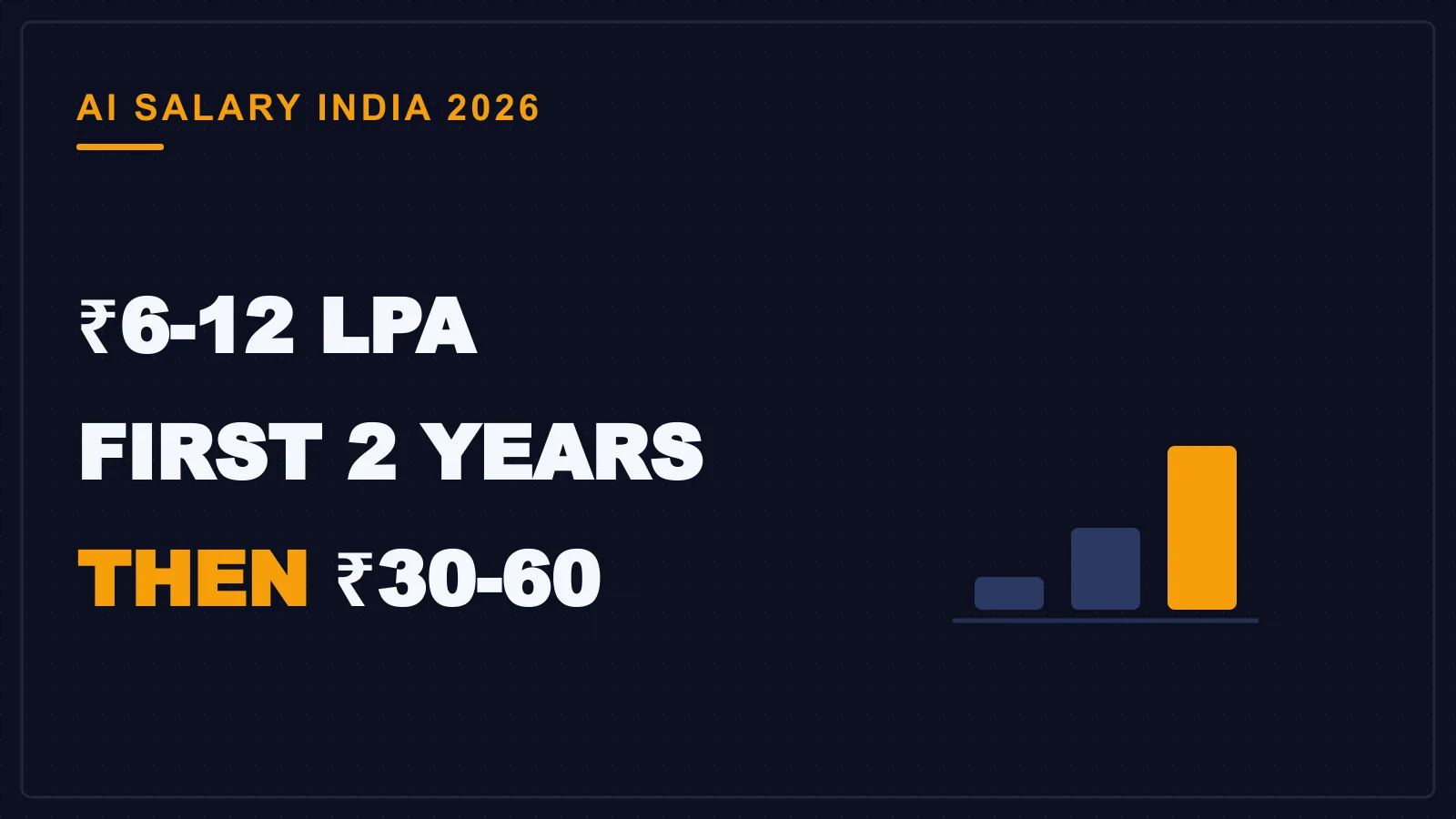
Most AI engineers in India earn ₹6-12 LPA in their first two years, rising to ₹15-30 LPA at 2-5 years and ₹30-60 LPA after five. Company type moves your CTC more than any skill or city, with GCCs and product companies paying 60-150% more than IT services.
Say you are a final-year student in Pune. Every week your feed shows another "fifty lakh AI engineer" post. Your campus offer letter says about six and a half lakh a year. Both can be real. They describe very different jobs. I checked three 2026 salary guides to find out which band each number belongs to. LPA means lakhs per annum (₹1 lakh = ₹100,000). CTC is the total yearly cost to the company, so your monthly take-home pay is lower.
Most AI engineers in India earn ₹6-12 LPA in their first two years, ₹15-30 LPA at 2-5 years, and ₹30-60 LPA after 5. Those ranges come from a 2026 salary guide by ShiftToTech. The ₹50 LPA posts mostly describe senior people at product companies and GCCs (global capability centres, the India offices of big foreign firms), not freshers. Treat every figure here as an estimate from salary and recruiting sites, not official data, and cross-check your target company on AmbitionBox or Glassdoor before you negotiate. If you want the freshers-only view, see my post on AI engineer starting salary in India vs the US.
AI engineer salary in India by experience band
The ShiftToTech bands of ₹6-12, ₹15-30 and ₹30-60 LPA cover 0-2, 2-5 and 5+ years, and a second guide from Recrew puts the average at ₹10, ₹22 and ₹38 LPA for those stages.
Each ShiftToTech band is wide because it mixes many kinds of employers. An IT services offer sits near the bottom of a band. A product company offer sits near the top. The guide builds its numbers from AmbitionBox and Glassdoor India user reports, plus 6figr and Scaler data, with NASSCOM figures.
Recrew shows how far the top of each band sits above the average. The top 10% of freshers earn ₹22 LPA. At 2-5 years the top 10% reach ₹40 LPA, and at 5-8 years they reach ₹60 LPA (Recrew). Even the top quarter of freshers sits at ₹15 LPA, well below that top tenth.
Two warnings before you use any of this. A range is not an offer. It tells you what exists in the market, not what one company will pay you. An average is also not what most people get. A small group of very high salaries pulls the average up, so a typical offer often lands below it.
AI engineer vs ML engineer vs software engineer pay
At the same experience, AI engineering pays more than general software work at mid-level, though the guides give no fresher software figure (ShiftToTech), and ML engineers sit at the top of the entry-level range in ResumeVera's ML engineer guide.
| Role | Fresher | Mid (3-5 yr) | Senior (5+ yr) | Source |
|---|---|---|---|---|
| AI engineer | ₹6-12 LPA | ₹15-30 LPA | ₹30-60 LPA | ShiftToTech |
| ML engineer | ₹8-18 LPA | ₹18-40 LPA | ₹40-80 LPA | ResumeVera |
| Software engineer | Not given | ₹12-16 LPA | Not given | ShiftToTech |
My software row has only one figure because none of the three guides gives a fresher or senior software number. I left those cells blank rather than guess. A blank cell is more honest than a number I cannot point you to.
The guides also cut experience slightly differently. ShiftToTech uses 0-2, 2-5 and 5+ years. ResumeVera uses 0-2, 3-5 and 6+ years. Treat each cell as a rough band, not a precise line.
Fresher roles: which job title pays what
Among freshers, GenAI/LLM roles start highest at ₹10-15 LPA, while a plain AI engineer or data scientist role starts at ₹6-10 LPA, according to ShiftToTech's role table.
- AI Engineer: ₹6-10 LPA (ShiftToTech)
- Data Scientist: ₹6-10 LPA (ShiftToTech)
- ML Engineer: ₹8-12 LPA (ShiftToTech)
- MLOps Engineer: ₹8-12 LPA (ShiftToTech)
- AI Researcher: ₹10-15 LPA (ShiftToTech)
- LLM/GenAI Engineer: ₹10-15 LPA (ShiftToTech)
ResumeVera is more generous at the top. It puts freshers with real LLM skills at ₹15-25 LPA. It also finds that ML engineers earn 30-50% more than data scientists (ResumeVera). My guess, not from the guides: ML engineers ship models into products, while many data scientist roles stop at analysis.
Want the starting-salary view in two countries? My post on AI engineer starting salary in India vs the US covers only freshers. If data science is your route in, read the real hiring numbers for fresher data analysts too.
Company type moves CTC more than anything else
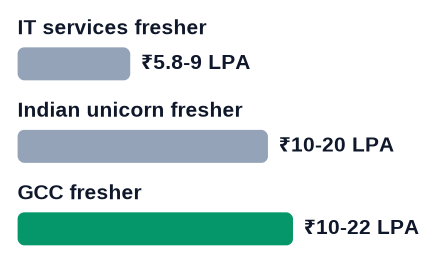
Moving from an IT services company to a product company or GCC pays 60-150% more at the same experience, which is bigger than any skill or city effect (ShiftToTech).
| Company type | Fresher | Mid | Senior |
|---|---|---|---|
| IT services | ₹5.8-9 LPA | ₹12-18 LPA | ₹20-28 LPA |
| Indian unicorns | ₹10-20 LPA | ₹20-40 LPA | ₹35-60 LPA |
| GCCs (Microsoft, Google, Amazon India) | ₹10-22 LPA | ₹22-45 LPA | ₹40-80 LPA |
| AI-first startups | ₹12+ LPA plus ESOPs | Not given | Not given |
| Source: ShiftToTech company-type table | |||
Your ₹6.5 LPA campus offer sits inside the normal IT services fresher band of ₹5.8-9 LPA. Look at the senior column. A senior at an IT services firm tops out below where a senior at a GCC starts. ESOPs (employee stock options, shares you can buy later at a fixed price) at startups may be worth a lot or nothing.
Recrew sees the same gap from another side. It puts IT services about 20% below the national average. SaaS and product companies sit 25% above it, and fintech 20% above. FAANG and unicorn employers pay 2-3x what IT services pay for identical years (Recrew).
Here is what that means in practice. Say two engineers in Hyderabad each have three years of experience and similar skills. One works at an IT services firm, the other at a GCC. Using the mid-level row above, the GCC range starts above where the services range ends. Neither one is better at the job. They sit in different pay systems.
My reading of why: a services firm bills a client for your time, so your pay is limited by that bill. A product company or GCC earns from the software you help build, so it can pay more for the same skill.
What actually moves CTC, ranked
In ShiftToTech's own order, after company type (+60-150%) the next levers are GenAI/MLOps skills (+20-40%), a premium city (+20-40%), a public GitHub portfolio (no figure given), cloud certificates (+₹1-2 LPA), and negotiating with market data (+15-25%). These effects overlap, so you cannot add them together. The source is ShiftToTech's ranked list.
- Switch company type. Move from IT services to a product company or GCC, the lever from the section above (ShiftToTech).
- Specialise in GenAI, LLMs or MLOps. Worth about +20-40% over a generalist, based on Scaler data (ShiftToTech).
- Target a premium city. Bangalore and Hyderabad lead, worth about +20-40% in this ranking (ShiftToTech).
- Build a public GitHub portfolio. No percentage is given for this one. It helps you get the offer more than it raises the offer (ShiftToTech).
- Earn a cloud ML certificate. AWS ML, GCP ML or Azure AI, worth about +₹1-2 LPA on your yearly pay (ShiftToTech).
- Negotiate with market data. Worth about +15-25% in this ranking. Bring the published bands for your role and city to the HR call (ShiftToTech).
The guides disagree on the skill premium. ShiftToTech and Recrew agree on +20-40%, with Recrew naming LLM fine-tuning and RAG, plus LLMOps work (Recrew). ResumeVera claims +60-120% for LLM fine-tuning plus RAG, +40-70% for MLOps, and +50-80% for GPU infrastructure (ResumeVera). I treat the higher figures as the top of the range, not the usual result. Plan around the lower one and be pleased if you beat it.
Read the GitHub item carefully, because its effect is easy to misread. Its largest effect is on offer conversion, meaning the chance an interview turns into an offer. It does not lift the number on the letter by itself. If you have never set one up, a public repository with a clear README and one working project takes a few minutes. For which skills pay most at each level, see my skills-vs-salary matrix for AI engineers in India.
City premium: Bangalore and Hyderabad against the rest
Bangalore pays about 25% above the national average, Hyderabad 15-18%, Mumbai 10-15%, Delhi NCR 5-8%, Pune around the average, and Chennai 5% below, across Recrew and ShiftToTech.
| City | ShiftToTech | Recrew |
|---|---|---|
| Bangalore | +25% | +25% |
| Hyderabad | +15% | +18% |
| Mumbai | +10% | +15% |
| Delhi NCR | +5% | +8% |
| Pune | +10% | At average |
| Chennai | Not given | -5% |
| Sources: ShiftToTech, Recrew | ||
The two guides agree on Bangalore and differ by a few points elsewhere. Pune shows the biggest split. If your offer is in Pune, compare it against both columns.
One warning that is mine, not the guides'. Part of a Bangalore premium goes straight to rent and commute, and to everyday food costs. Before you call a Bangalore offer bigger, subtract your likely monthly costs in both cities. Then compare what is left.
Which band does a ₹50 LPA offer fall in?
A ₹50 LPA offer is a senior salary. Only the top 10% of people with 5-8 years of experience reach ₹60 LPA (Recrew). The top 10% of freshers earn ₹22 LPA, so a fresher offer near ₹50 LPA is rare.
That leaves the real choice a fresher faces: chase a product or GCC offer now, or take the services offer you already have.
Pros
- A services offer is stable and arrives early, often through campus placement.
- It is a way in: real projects, a real employer name, and time to build skills on the side.
Cons
- The base salary starts lower.
- Raises inside services firms tend to be slower, so the switch later has to do most of the work.
My view: take the services offer if it is the only one, and plan the switch from day one. Waiting a year with no job to chase a product offer is a bigger risk.
Now the ceiling you can plan for. A senior engineer at a mid-sized Bangalore product company can reach ₹40-60 LPA at 8-10 years. The ₹80 LPA to ₹1.2 crore figures belong to principal or research roles at Google, Microsoft or late-stage unicorns (ShiftToTech). Those are a handful of people, not a career average.
College matters less than you fear. IIT and IISc graduates start 15-25% higher, but the gap narrows after three years with a strong portfolio (Recrew).
Do AI engineers earn more than software engineers?
In one source, yes at mid-level: AI pays ₹15-30 LPA against ₹12-16 LPA for software, which is one band against one band and not a general finding (ShiftToTech), but the gap depends on company type as much as on the job title.
An AI title at a services firm can still pay less than a strong software role at a product company. If you are choosing between two offers, check the employer type first and the title second. For the software side in one city, see median fresher offers for full-stack developers in Bangalore.
Take the offer you have, or the one you want, and place it in one row of the comparison table. Then pick the biggest lever you can act on this month: list five product companies or GCCs hiring in your city and apply to them this week. As a second step, build a public GitHub project around RAG (letting an AI model look up your documents before it answers), since it helps you win the offer more than it raises the number.


