Cyber Security Analyst Roadmap 2026: Certs, Labs, and Salaries
Most cyber security roadmaps list a dozen certifications and stop there. This one tells you which entry-level cert a SOC hiring manager checks for, what it costs, and what a fresher can earn in India and the US in 2026.
Most cyber security roadmaps list a dozen certifications and stop there. They never tell you which one a hiring manager in a SOC actually checks for, what it costs, or what a fresher salary looks like in India. This one does.
Start with a free or low-cost entry-level certification, pair it with hands-on labs, then apply for SOC analyst roles. In 2026, the fastest path is ISC2 CC (if you have an exam code) or CompTIA Security+, plus a SIEM lab you can talk about in an interview.
The 2026 certification map, from entry to red team
Choose a certification by the job level you want, not by what is popular. The 2026 roadmap by level, published by Pasquale Pillitteri, groups certifications into four tiers: entry-level, offensive, red team, and defensive. Each tier serves a different role, and the cost climbs steeply as you move up.
This table shows the entry-level options most relevant to a SOC analyst fresher track.
| Certification | Level | Best for |
|---|---|---|
| ISC2 CC | Entry | SOC / GRC roles |
| CompTIA Security+ | Entry | SOC analyst (most recognized) |
| CompTIA Network+ | Entry | Networking fundamentals |
| Google Cybersecurity Certificate | Entry | Absolute beginners |
| HTB CWES (formerly CBBH) | Entry | Web security basics |
| eJPT | Offensive | Penetration testing |
| OSCP | Offensive | Pentesting, advanced |
| CRTO | Red team | Adversary simulation |
| OSEP | Red team | Evasion and bypass |
| BTL1 | Defensive | Blue team / SOC |
| CySA+ | Defensive | SOC analyst, mid-level |
| SC-200 | Defensive | Microsoft Sentinel |
The full list, including intermediate and advanced levels, comes from the 2026 certification roadmap by level. Notice that neither OSCP nor CRTO appears in the entry column. Those are post-SOC goals, not job requirements for a fresher.
ISC2 CC and Security+: your first two moves
ISC2 CC is free if you already have an exam code, and Security+ is the one employers recognize most. These two are the realistic starting points for a 2026 fresher.
ISC2 ran the One Million Certified in Cybersecurity program to give away free exam codes. New enrollments are closed. If you hold an exam code, you must sit the exam by December 31, 2026. If you enrolled in the program before May 20, 2026, you can still take the course, though completing it is not required to sit for the CC exam. These dates come from the ISC2 One Million CC page.
CompTIA Security+ is the more widely known credential. The exam cost is about $392, and it covers network security, threats, and risk management. If you cannot get an ISC2 code, this is the certification that survives resume screens.
Build a SOC lab before you apply
A home lab where you investigate a fake alert beats any certificate on a resume. Employers want people who have touched logs and SIEM dashboards, not just people who passed a multiple-choice test.
Set up a virtual machine
Set up VirtualBox and a Linux VM (Ubuntu or Kali) as your target machine.
Install a free SIEM
Choose Wazuh or Splunk Free, both of which run on a single machine.
Generate logs
Run simple commands to create logs, such as
sudo apt-get update. This generates network and package manager logs that a SIEM can collect.Create an alert
Set a rule that fires when a specific log pattern appears, for example a Wazuh rule that triggers on failed SSH login attempts by watching
/var/log/auth.logfor "Failed password".Write a report
Explain the alert, what caused it, and how you would respond.
This lab directly answers the questions a SOC interviewer will ask. They want to know how you read logs, spot anomalies, and follow a process. A lab report is proof you can do it.
The 8 skills employers actually check for
Employers look for networking fundamentals, OS basics, log reading, and clear writing, not obscure tools. The 2026 SOC analyst salary guide for India lists exactly what employers expect from freshers: networking fundamentals, Windows/Linux basics, logs/alerts, basic SIEM, phishing investigation, incident-response lifecycle, clear writing, and rotational shift willingness. That list comes from CybersecurityTrain's SOC analyst salary guide.
Do
- Build a home lab with a SIEM
- Practice writing an incident report
- Learn the incident-response lifecycle
Don't
- Skip networking fundamentals
- Ignore Windows basics
- Memorize tool names without using them
Notice the pattern: the list is heavy on fundamentals and light on fancy tooling. A candidate who explains a phishing investigation clearly will beat one who lists ten tools they have never opened.
Salary reality: what freshers earn in India
In India a fresher SOC analyst earns roughly ₹3.5–₹5.5 LPA. The verified salary guide only covers India, so no US band appears here. If you are in the US, check job boards like Glassdoor for current ranges. The numbers below are for India only, from the same SOC analyst salary guide.
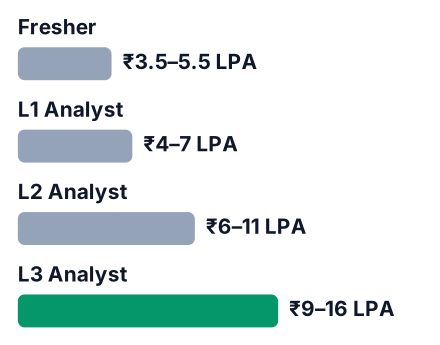
India SOC analyst salary bands (2026)
Fresher: ₹3.5–₹5.5 LPA
L1: ₹4–₹7 LPA
L2: ₹6–₹11 LPA
L3: ₹9–₹16 LPA
Average: ~₹4.9 LPA
In India, the average SOC analyst salary is about ₹4.9 LPA, and the typical range runs ₹3.6–₹7 LPA. Your salary grows with your ability to handle L2 and L3 duties, which involve deeper analysis and more complex incidents.
See the dedicated post on cyber security analyst salary in India.
How to apply for SOC analyst roles in 2026
Apply with a one-page resume that leads with your lab project, and mention shift flexibility. SOC teams run 24/7, so rotational shifts are the norm, and saying you accept them removes a screening objection.
Tailor your resume to the 8 skills listed above: put "SIEM lab" and "incident report" near the top, not your school projects. Once you have finished the lab above, write a short cover letter that names the SIEM you used and one alert you created. If you are a fresher without a security background, the skills for a fresher resume post covers how to frame what you have.
The wider security path also branches early. If you discover you prefer breaking systems over defending them, the penetration tester roadmap shows the offensive route. The cyber security salary per month post compares pay across roles if you want to plan further ahead.
Common mistakes that waste months of effort
A common mistake is chasing a red-team certification before you have any SOC experience. OSCP and CRTO look impressive, but they do not match the job you are applying for.
Other common errors: skipping networking fundamentals, buying expensive certifications without a lab, ignoring writing skills, and refusing to apply until you feel ready. Break each into a separate short sentence for readability. The first SOC job is a learning role, not a final destination. The market needs people: the European Union alone needs over 883,000 additional cybersecurity professionals, per the ENISA analysis cited in the 2026 certification roadmap. The same skills gap exists in the US and India.
Your next step: start the ISC2 CC or Security+ track this week
Pick one entry-level certification, book the exam date now, and build a small lab in parallel. If you have an ISC2 code, sit the exam before December 31, 2026, as the ISC2 page requires. If not, register for Security+ and pay the ~$392 exam fee.
Give yourself a four-week plan: weeks one and two for study, week three for the lab, week four for the exam and the incident report. The certification gets you past the resume filter. The lab gets you past the interviewer.
Decide by this week, then set the exam date. The lab can wait for week three, but the exam date cannot.


