Data Engineer Fresher Salary in Chennai (2026): CTC, In-Hand & Savings
Chennai fresher data engineer CTC ranges from TCS's ₹3.36 LPA in services to ₹15 LPA in product companies, with lower living costs than Hyderabad or Bengaluru. For service offers, Chennai can yield higher first-year savings in some scenarios, but product-role savings depend on the offer.
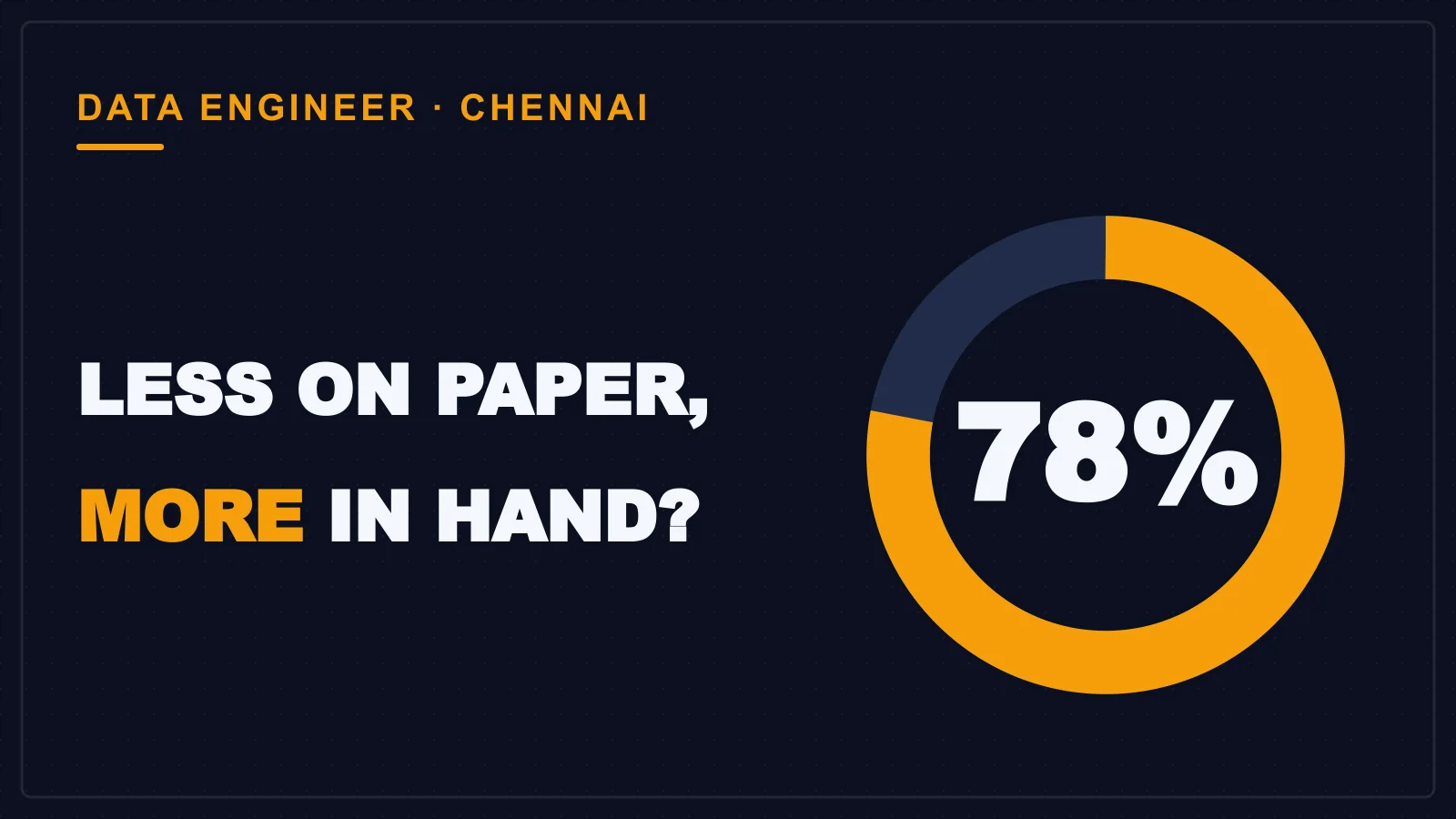
For a fresher, Chennai offers ₹3.36-4.6 LPA in IT services, ₹4.2-8.5 LPA in startups, and ₹6.5-15 LPA in product companies. That may look lower than Hyderabad and Bengaluru on paper, but when you run the in-hand math with living costs, the city that pays the least on paper can often save the most in the first year — worst case, Chennai's annual savings are −₹132k vs Bengaluru's −₹252k, a ₹120k difference before you negotiate.
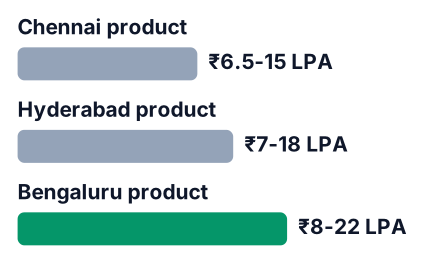
For a fresher data engineer in 2026, Chennai's CTC is lower than Hyderabad or Bengaluru, but you keep more of it. Product-company freshers in Chennai get ₹6.5-15 LPA CTC from JobRise, against ₹7-18 in Hyderabad and ₹8-22 in Bengaluru. Yet after rent and living costs, Chennai's lower expenses can flip first-year savings in its favor. Check the numbers yourself in the sources linked throughout this article, or open the JobRise city-wise breakdown and compare the bands directly.
Data engineer fresher salary in Chennai by company type
Chennai fresher data engineer pay splits sharply by employer: IT services ₹3.36-4.6 LPA, startups ₹4.2-8.5 LPA, product companies and GCCs ₹6.5-15 LPA, according to the JobRise city-wise breakdown. The same source's company snapshot puts the services floor at TCS's ₹3.36-3.6 LPA and Infosys at ₹3.6-4.5 LPA.
If you have a data-engineer-specific offer, use SkillsetMaster's ₹5-8 LPA fresher band for IT services. If you are looking at a generic IT-services offer, use JobRise's ₹3.36-4.6 LPA band. JobRise covers generic IT-service offers; SkillsetMaster covers data-engineer-specific roles, which pay more because they require SQL and Python. Startups sit in the middle at ₹4.2-8.5 LPA, though the actual number depends on the company's funding stage and how badly it needs a data engineer right now.
Product companies and global capability centers (GCCs) pay the top band of ₹6.5-15 LPA. This is where Chennai's "IT hub" reputation actually shows up, since many global banks and product firms run their data teams from the city.
How much of the CTC you actually keep in Chennai
For a 4 LPA CTC, the in-hand works out to about ₹24.5-26.5k per month, calculated from the JobRise in-hand ranges (for example, TCS at ₹3.36-3.6 LPA gives ₹21k-25k in hand). Living costs for a shared setup range from ₹21k-33k in Chennai, per the same city table.
The gap between the CTC headline and your bank account comes from deductions. Provident fund, professional tax, and health insurance can eat roughly 12-15% before you see the money (this varies by company and city; check your offer letter's CTC breakdown, for example the ExcelGoodies breakdown of in-hand vs CTC). On a 4 LPA offer, that means your monthly take-home could land at ₹24.5-26.5k, not the ₹33k the LPA number suggests.
Rent is the biggest fixed cost. JobRise's Chennai breakdown puts a shared room or PG at ₹7k-12k, food and groceries at ₹5k-8k, and commute plus other costs at ₹3k-6k — together ₹15k-26k. Its city table puts the typical shared-setup total at ₹21k-33k a month, so budget near that higher range.
That leaves a narrow margin. At ₹26.5k in-hand and ₹21k costs, you save ₹5.5k per month; at ₹24.5k in-hand and ₹33k costs, you are ₹8.5k short. Using the ₹21k-33k budget, realistic monthly savings range from a shortfall of ₹8.5k to savings of ₹5.5k for a 4 LPA offer, not a guaranteed ₹7k.
The calculation rewards you for keeping rent cheap and using the train instead of a cab.
Chennai vs Hyderabad vs Bengaluru: the savings table
When you adjust for living costs and in-hand pay, Chennai's lower CTC often yields better first-year savings than Bengaluru or Hyderabad, using the bands from JobRise.
| City | Services band (LPA) | Startup band (LPA) | Product band (LPA) | In-hand range (service fresher) | Typical monthly cost | Estimated first-year savings (service fresher) |
|---|---|---|---|---|---|---|
| Chennai | ₹3.36-4.6 | ₹4.2-8.5 | ₹6.5-15 | ₹22k-30k | ₹21k-33k | −₹132k to ₹108k |
| Hyderabad | ₹3.4-4.8 | ₹4.5-10 | ₹7-18 | ₹23k-31k | ₹22k-35k | −₹144k to ₹108k |
| Bengaluru | ₹3.5-5.0 | ₹5-12 | ₹8-22 | ₹24k-33k | ₹28k-45k | −₹252k to ₹60k |
Savings estimated as (in-hand monthly − typical monthly cost) × 12 at the lowest and highest ends of each range. For Chennai that is (₹22k − ₹33k) × 12 = −₹132k a year at worst and (₹30k − ₹21k) × 12 = ₹108k at best.
The best case uses JobRise's ₹30k in-hand top end and ₹21k cost bottom end; the worst case uses the reverse. The in-hand column uses JobRise's service-fresher ranges; startup and product offers pay more in hand (see below), so these savings cover service offers.
Across the range, Chennai's lower cost base gives it the smaller shortfall and the larger surplus: its worst case is −₹132k a year against Bengaluru's −₹252k, and its best case is ₹108k against ₹60k.
Consider a product role in each city. The savings column above covers service offers, because JobRise publishes in-hand ranges for service freshers, not for product hires. Product-company offers pay more in hand: JobRise's city table puts Chennai product CTC at ₹6.5-15 LPA and Bengaluru at ₹8-22 LPA. The company table pairs product CTC with an in-hand range of ₹55k–1.4L; the city table gives no city-specific product in-hand figure, so the savings column does not apply to those offers.
That is the limit of the table: it can tell you which city keeps more of a service salary, but it cannot price a product offer beyond the CTC bands and the published in-hand range (₹55k–1.4L). Use the CTC bands and that in-hand range for the employer decision, then compare take-home on your own offer letters.
Why employer type matters more than city
A GCC or product-company role in Chennai can pay more than an IT-services role in Bengaluru, so the city decision is secondary to the employer decision. The bands differ by employer type, as shown in the JobRise city-wise breakdown and SkillsetMaster's Chennai page.
The comparison is stark: Chennai product roles at ₹6.5-15 LPA from JobRise versus Bengaluru services roles at ₹3.5-5.0 LPA. A fresher picking the "cheaper" city for the wrong employer loses several LPA in CTC before accounting for anything else.
A Chennai product role and a Bengaluru startup role sit in different bands, and both pay more in hand than the service ranges in the table. JobRise does not publish product-role in-hand figures; it also does not give separate in-hand figures for startups, so compare the take-home on your own offers rather than assuming the table's savings column applies.
On the service bands above, Chennai saves more than Hyderabad or Bengaluru. A product offer can change that, but JobRise does not publish product-role in-hand figures, so compare your own offers against the CTC bands and ask HR for the in-hand breakdown. A GCC or product firm in Chennai can pay more than a mid-tier services firm in any city. The employer decision largely determines your first-year earnings; the city decides how much of it you keep after paying rent.
Skills that lift your offer beyond the base band
SQL is non-negotiable for every data engineer fresher.
The differentiator is your Spark and ETL pipeline experience: SkillsetMaster lists Spark as worth +₹3–6 LPA on top of its ₹5–8 LPA fresher band — so a Chennai fresher with Spark can target ₹8–14 LPA, but that's an estimate, not a guarantee, and not a promise.
The candidates who clear the ₹10 LPA mark in Chennai are the ones who can write a Spark job that actually runs, not just recite DataFrames and transformations in an interview.
Master SQL joins and window functions
These show up in every first-round data engineering screen.
Build one real batch pipeline
Load a public dataset, clean it, and write it to a database or warehouse.
Learn Spark's core transformations
The ₹3-6 LPA premium (per SkillsetMaster, an estimate) goes to people who can run a distributed job end to end.
Practice the cost question
Interviewers ask how you would handle a slowly growing dataset — i.e., the cost of storage and compute. Rehearse your answer out loud.
Is Chennai the right first job for you?
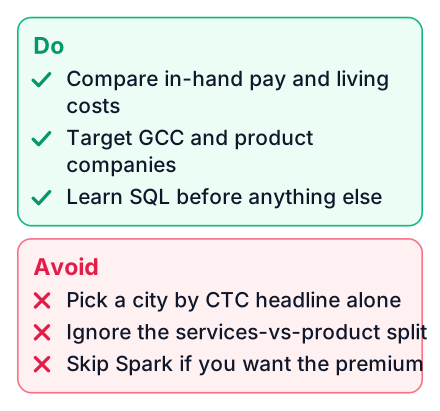
If you are still deciding between cities, open the JobRise city-wise breakdown and the SkillsetMaster Chennai page, and build your own savings table with the numbers you will actually get. The India-wide bands give you a starting point, but the in-hand math for your specific offer is the only figure that pays your bills.
If you have a service offer, take Chennai — the savings math favors it. If you have a product offer, the CTC gap swamps the rent difference: ₹6.5-15 in Chennai vs ₹8-22 in Bengaluru is a ₹1.5-7 LPA difference that no PG rent can beat.
For a service offer, Chennai saves more; for a product offer, the employer decision dominates. Decide on employer first, city second. If you are also weighing a DevOps path, that salary follows a similar city-versus-employer pattern — see the DevOps fresher salary in Chennai.


