How to Become an ML Engineer After 12th: India vs US Paths
Both Indian and US students can become ML engineers after 12th, but the routes differ: B.Tech CSE via JEE in India, CS bachelor's with SAT in the US. This guide breaks down exams, costs, skills, and salaries for both pathways in 2026.
Students in Pune and Chicago both want the same job: machine learning engineer. One studies for the JEE, the other fills out the Common App. Both can get there. The roadmaps look nothing alike, and most guides only show you one side.
After 12th, the safest path to a machine learning engineer role is a 4-year B.Tech in computer science with an AI/ML specialization in India, or a bachelor's in computer science with AI coursework in the US, plus Python, math, and one or two real ML projects. Each route has its own exams, costs, and timelines. Here is how both work in 2026.
Start with the destination: what ML engineers actually do
Machine learning engineers build and ship models that make predictions, not just research them, so you need software engineering skills plus math (source: roadmap.sh). The role sits between data science and software engineering. You train a model, then you turn it into an API that other applications call.
An AI engineer is a different role. AI engineers use pre-trained models and existing AI tools to build products, while ML engineers build the models themselves (roadmap.sh). This matters for your degree choice: an ML track needs heavier math, while an AI track can lean more on applied tools.
Both India and the US hire for the same core skills, but they weigh credentials differently. If you want to build models from scratch, choose the ML track with heavy math. If you want to build products using existing models, the AI track is lighter on math. Indian employers lean on your degree and exam scores through campus placements. US employers read your project history and internships first. Plan your degree around the market you want to enter.
Compare the two 4-year routes: Indian B.Tech vs US bachelor's
India's B.Tech in CSE (AI/ML) goes through JEE or state exams; the US route is a computer science bachelor's with AI electives, entered via SAT/ACT and application essays (source: admissiondrive.com).
| Dimension | India (B.Tech CSE AI/ML) | US (CS bachelor's) |
|---|---|---|
| Entry exam | JEE Main, JEE Advanced, or state exams (MHT-CET, WBJEE, KEA) | SAT or ACT, plus application essays |
| Typical duration | 4 years | 4 years |
| Focus | AI/ML specialization built into the degree | CS core with AI/ML electives |
| Cost range | ~₹1.5L per year at many colleges | Varies widely; financial aid available |
| Job market signal | Degree + campus placement | Portfolio + internships |
The Indian admission flow looks like this:
Pass 12th
Eligibility for B.Tech CSE (AI/ML) is a 12th pass, typically with physics, chemistry, and mathematics (source: admissiondrive.com).
Take JEE Main
JEE Main opens NITs and many private colleges; top scorers qualify for JEE Advanced.
Take JEE Advanced or a state exam
Advanced leads to IITs; MHT-CET, WBJEE, and KEA lead to state colleges (source: admissiondrive.com).
Get a college allotment
Counseling rounds assign seats based on rank and preference.
For the US:
Prepare for SAT or ACT
Most CS programs ask for one of these scores, though more colleges are going test-optional.
Write applications
Essays and recommendation letters carry real weight at US colleges.
Apply for financial aid
FAFSA and college scholarships can cut the cost of a US degree significantly.
Choose the Indian B.Tech route: JEE Main, Advanced, and state exams
Indian B.Tech admission runs through JEE Main for NITs and many private colleges, JEE Advanced for IITs, and state exams like MHT-CET and WBJEE for state colleges (source: admissiondrive.com).
You qualify with a 12th pass, then compete on exam rank. Top colleges for AI/ML include IIT Hyderabad (which offers a B.Tech in AI), IIIT Hyderabad, DTU Delhi, VIT, and SRM. Fees run around ₹1.5L per year at many institutions, making this a far cheaper route than studying abroad (admissiondrive.com).
Some private colleges admit students directly on 12th marks, skipping entrance exams entirely. This is the right call if you missed the JEE window but still want a structured degree. Your college brand matters less than your projects and skills, but campus placement lists are easier to break into from well-known institutions.
Choose the US pathway: bachelor's in computer science with AI coursework
In the US, you pick a computer science major and add AI/ML coursework and internships, while building a portfolio that matters more than your major's name (source: aifwd.com).
Your degree is a checkbox. What gets you hired is the work you can show. US employers rarely probe your exam scores; they ask what you have built, what dataset you trained on, and what happened when your model hit production.
Plan your electives around ML: machine learning, deep learning, natural language processing, and distributed systems. Line up summer internships from your second year onward. A US CS degree with two solid internships beats the same degree with a perfect GPA and no industry exposure.
Master the math and programming that every ML job requires
You need probability, statistics, linear algebra, and Python, plus a second language like C++ or R, to pass technical interviews (source: aifwd.com).
- Probability and statistics — distributions, hypothesis testing, and Bayesian thinking. These come up in every model evaluation.
- Linear algebra — matrices and vectors are the language of neural networks.
- Python — the default language for ML libraries like PyTorch and scikit-learn.
- A second language — C++ or Java for performance-critical work, R for statistical analysis.
Skills that boost your pay are measurable. GenAI and LLM skills add roughly ₹7L to an Indian ML engineer's salary and appear in 42% of job descriptions (ownyourcareer.in). PyTorch adds about ₹4.5L and shows up in 58% of JDs. MLOps skills add ₹5.5L (ownyourcareer.in).
Pros: Learn Python first
- Fastest start on real ML projects
- Most tutorials and libraries target Python
Cons: Skip the second language early
- Limits you from production systems work
- Harder to switch later under deadline pressure
Build a portfolio that proves you can ship models
Real projects on GitHub and Kaggle outperform grades, because hiring managers look for proof you can code, train, and deploy (source: aifwd.com).
Pick a problem
Choose something narrow, like predicting house prices in your city, not "solve AI."
Collect data
Find a public dataset or scrape your own. Messy data is realistic data.
Train a model
Start with a simple baseline, then improve it.
Deploy an API
Put the model behind a web endpoint. This is what separates ML engineers from notebook coders.
Show the code
Document it on GitHub with a clear README, and link it in your resume.
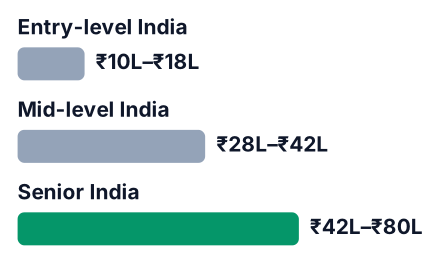
Entry-level ML engineer salaries in India start around ₹10L per year (ownyourcareer.in). A portfolio with two or three deployed projects is what moves you from the bottom of that band to the top.
Salary reality check: entry-level ML pay in India and the US
Entry-level ML engineers in India make ₹10L–₹18L per year, while US entry-level pay typically ranges from $90,000 to $140,000 per year, so choose your market with open eyes (source: ownyourcareer.in). The median salary across all ML engineer levels in India sits at ₹35L, which pulls the average up because senior roles pay heavily.
US entry-level pay is substantially higher, but you pay more for the degree and face a competitive visa process. The exact US figure varies by city and company, so do not compare a converted rupee number to a US dollar salary without adjusting for cost of living and taxes. The range of $90,000–$140,000 is a common estimate from industry sources, but individual offers may differ.
Skill premiums apply on top of any base. A GenAI/LLM skill adds ₹7L in India, PyTorch adds ₹4.5L, and MLOps adds ₹5.5L (ownyourcareer.in). Learning these skills during your degree, not after, compounds into your first salary offer.
Avoid these 5 mistakes students make on the ML path
Skipping math for tutorials, chasing every new tool, and ignoring projects are the top ways to stall your ML career before it starts.
These mistakes share one root: they put activity ahead of proof. Employers cannot see that you watched a 12-hour course. They can see a GitHub repo with a working model.
Your next step: pick a pathway and start your first project
Choose India or US, then spend this semester on math and Python, and finish with a small ML project you can show.
Decide based on budget and goals. If you want the cheapest structured path into the field, the Indian B.Tech via JEE or state exams costs around ₹1.5L per year (admissiondrive.com). If you want the US job market and can manage tuition, the CS bachelor's route opens that door.
This month, decide on one pathway and write a 3-month plan: math (linear algebra) + Python + one small ML project. Then read the detailed guide on becoming an ML engineer after 12th in India for the exact course list. For a sense of what the career pays at later stages, check the 2026 India salary data, and if you want to see how the AI side differs, the open-weight model coverage shows what tools are changing the field.


