SDE-1 vs SDE-2 vs SDE-3: Experience, Scope, Salaries and the Promotion Path in 2026
SDE-1 is your first 0-2 years, SDE-2 covers 2-5 years, and SDE-3 is 5-8+ years. Each level changes your scope and pay band from ₹3.5 LPA to over ₹1.3 crore. Promotion requires acting at the next level before the title arrives, not just good reviews.
Every few months a layoff headline lands in my feed, and a student asks the same anxious question: is the ladder to SDE-3 still there, or is it being removed? The news makes it easy to believe the answer is no, so let me show you what the level codes actually mean in 2026, and how the promotion path works when the market is panicking.
SDE-1 is your first 0–2 years, SDE-2 covers 2–5 years, and SDE-3 is 5–8+ years. Each step changes your scope and your pay band, but the rule that drives promotion is the same everywhere: you have to already be working at the next level before the letter arrives.
What SDE-1, SDE-2 and SDE-3 mean at Amazon, Google and Microsoft
The three levels describe how much you build on your own: SDE-1 builds with guidance, SDE-2 owns components independently, and SDE-3 drives complex systems, according to Masai School's breakdown of SDE levels. The years attached to each level are a rough guide: SDE-1 is 0–2 years of experience, SDE-2 is 2–5 years, and SDE-3 is 5–8+ years.
Each company calls these levels by its own codes. Amazon uses L4 for SDE-1, L5 for SDE-2 and L6 for SDE-3. Google uses L3, L4 and L5. Microsoft uses 59, 61 and 63. The name differs, but the scope grows the same way at every company.
| Level | Amazon | Microsoft | Experience | |
|---|---|---|---|---|
| SDE-1 | L4 | L3 | 59 | 0–2 years |
| SDE-2 | L5 | L4 | 61 | 2–5 years |
| SDE-3 | L6 | L5 | 63 | 5–8+ years |
What changes between SDE-1, SDE-2 and SDE-3
The biggest change is scope: you move from completing assigned tasks to owning entire components to driving technical strategy across teams. Masai School names the two keywords of progression as scope and impact, and Scaler's comparison phrases it as building with guidance, owning independently, then driving complex systems.
At SDE-1, your day is about assigned tickets. Someone tells you what to build, you build it, and a senior reviews your pull request. The decisions you make are small: which function to use, how to name a variable, how to structure one file.
The assignments stop at SDE-2. You own a component end-to-end, which means you decide the design, you split the work, and you answer for the result. You influence your immediate team, and you are expected to catch problems before they reach production.
At SDE-3, you cross team boundaries. You propose the architecture that two or three teams will build against, you resolve the technical disagreements between them, and your influence reaches people who do not report to you. This is the level where the title "engineer" starts to mean "technical leader."
How much SDE-1, SDE-2 and SDE-3 earn in India
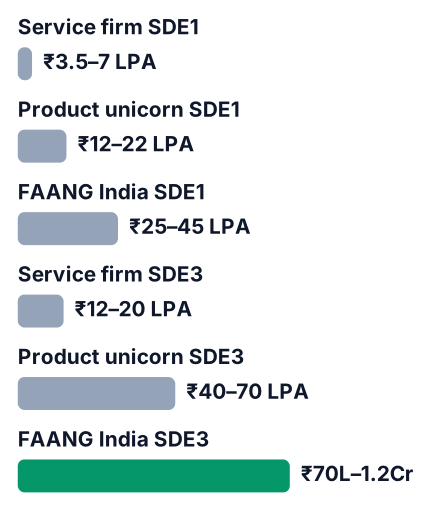
Pay rises sharply with the level and even more sharply with the company tier, from ₹3.5 LPA at a service firm to over ₹1.3 crore at Amazon India. The table below, built from Prepflix's 2026 salary guide and Scaler's level breakdown, shows India's bands by tier.
| Tier | SDE-1 | SDE-2 | SDE-3 |
|---|---|---|---|
| Service (TCS, Infosys) | ₹3.5–7 LPA | ₹6–12 LPA | ₹12–20 LPA |
| Product / Unicorn | ₹12–22 LPA | ₹22–40 LPA | ₹40–70 LPA |
| FAANG India | ₹25–45 LPA | ₹40–80 LPA | ₹70 LPA–1.2 Cr |
Product-company base bands sit a little tighter: SDE-1 at ₹8–18 LPA, SDE-2 at ₹17–34 LPA and SDE-3 at ₹23–44+ LPA, per Scaler. One figure you must read correctly: the take-home is only 60–70% of the CTC number Prepflix reports, so a ₹20 LPA offer lands around ₹13–14 LPA in your bank account.
For the US, Masai School's levels.fyi data puts Amazon India at roughly ₹30 lakh for L4, ₹65 lakh for L5 and ₹1.33 crore for L6. Google India runs about ₹41 lakh at L3, ₹75 lakh at L4 and ₹1.24 crore at L5. Microsoft India sits at ₹27 lakh for level 59, ₹43 lakh for 61 and ₹72 lakh for 63. As of 2026, a TCS SDE-1 with 18 months of experience switching to a product startup can expect a 40–60% jump, per Prepflix, but the startup will expect you to own a component within 6 months, not 2 years. These are self-reported, not official, figures from user-submitted data. They are not directly comparable to US salaries, which run higher; the point is the jump between levels, not the absolute numbers.
How long promotion to SDE-2 and SDE-3 takes
Expect 18–30 months to reach SDE-2 and 24–42 months more to reach SDE-3, but the fastest path is often switching companies, not waiting for an internal promotion. Prepflix's timeline makes the internal route a 3–4 year grind from SDE-1 to SDE-3.
The alternative is a jump. Staying about 2 years at SDE-2 and switching companies can give a 40–60% CTC jump, Prepflix reports. That is how many engineers reach SDE-3 faster: they take the title and band from a new employer rather than waiting for a vacancy in their current one.
Internal promotion
- No interview risk
- You know the codebase and the people
- Steady 3–4 year timeline
Switching companies
- 40–60% CTC jump at once
- Faster path to the SDE-3 title
- New codebase, new politics, new risk
High performance reviews do not guarantee the promotion. Scaler notes it depends on level vacancies and business needs: there has to be an open seat at the next level, and the company has to need someone in it.
Why high performance alone does not get you promoted
Promotion depends on level vacancies, business needs and a manager who advocates for you, not just your review score. Scaler's analysis names the specific blockers at each step.
Say you have sent 60 applications and heard nothing back. The SDE-1→2 blocker is not showing scope beyond assigned tasks. You finish everything on time, your code is clean, but you never take on work that was not handed to you. That looks like a reliable junior, not a candidate for SDE-2.
The SDE-2→3 blocker is not stepping into architecture or leadership. You own your component perfectly, but you never propose the cross-team design, and you never lead the technical discussion. That looks like a strong SDE-2, not an SDE-3.
Add the Masai School rule: you get promoted in a job, not into a job. The promotion letter is recognition of work you already did, not an assignment to start doing it. If you are not doing the next level's work today, no review score will unlock the title.
The rule that unlocks SDE-3: act like the next level today
You do not get promoted into a job; you get promoted in a job, which means you must already be doing the next level's work. Masai School's framing turns promotion from a mystery into a checklist: close the gap between your current scope and the next level's scope, and the title follows.
Pick one component to own
Ask your manager for one piece of the system that is yours end-to-end, from design to deployment.
Write the design doc
Put your proposed architecture on paper and share it with your team for feedback before you build.
Lead one technical discussion
Volunteer to drive the next design meeting and resolve the disagreements that come up.
Unblock someone else
Find a teammate who is stuck and help them ship, which is the SDE-3 definition of impact.
Ask for the scope in writing
Tell your manager you are working toward SDE-2 or SDE-3 and ask what evidence they need.
This works for the interview path too. The Amazon SysDE interview experience shows that even a specialized role at one company rewards the same thing: evidence of scope you already handled, not potential you promise.
The market noise does not change this math. Layoffs hit every level, but companies still need engineers who can own components and drive systems. The 2026 salary guide for India shows the same pattern across titles, and the Python developer and AI engineer comparisons confirm that scope, not the job market, sets your ceiling.
Write down the one piece of SDE-2 scope you can take on this week, and ask your manager to let you own it.


