How to Stay Ahead of AI as an Early-Career Engineer in 2026
AI is changing what junior engineers do, not removing the need for them. Learn to check and shape AI output by owning the decisions it cannot make.
Say you are three months into your first engineering job. You ask an AI tool for a REST endpoint, paste what it gives you, and the tests pass. Two days later a teammate finds it skips an ownership check, so any logged-in user can create orders for someone else. That "almost right" code is where freshers fall behind.
Stay ahead of AI by owning the decisions it cannot make. Learn how systems fit together, set the constraints before you prompt, and review every line the tool writes. AI is moving entry-level work up a level, so judgment matters more than typing speed.
Know what AI is actually changing for freshers
AI is changing which tasks juniors do. The U.S. Bureau of Labor Statistics projected 17% growth in software developer jobs through 2033, as Hackr.io reports. That figure covers all developers, not entry-level roles. I could not find a reliable current number for fresher hiring in India or the US, so no honest figure exists here. Treat the junior hiring picture as unclear, and plan around skills you control.
What shrinks is the boilerplate. Freshers used to spend their first months on CRUD screens, simple tests and config files. A tool now drafts those in seconds. Someone still has to decide whether the draft is safe and fits the codebase, and that checking is the new entry-level work. The tool proposes; you accept, reject or change. A junior who only pastes is easy to replace, while a junior who catches the missing check is not.
If you want the India hiring side of this debate, I covered it in whether software engineering is dead for freshers in 2026.
Learn system thinking before more syntax
System thinking means knowing how the parts of an app (API, database, auth, deployment) connect, which is what you need to judge code you did not write.
You do not need a diagram to start. You need a habit of asking the same questions about every endpoint you touch:
- Who calls this, and what are they allowed to do?
- What data does it read or change?
- What happens if the database is slow or down?
- What does it return when the input is wrong?
- What breaks if two requests arrive at the same moment?
An AI tool can answer these if you ask. It will not ask them for you. That gap is how to stay ahead of AI as a software engineer: you bring the questions, and the tool fills in the parts you already know to look for.
Pair this with one small writing habit. Julien Avezou's plan to stay ahead of AI uses Architecture Decision Records (ADRs). An ADR is a short note saying what you decided, what else you considered, and why you chose this one. For a fresher, one paragraph in the pull request description is enough. Six months later, that note tells your team why the code looks the way it does.
Go deep in one domain, stay broad elsewhere
Spending most of your learning time on one domain, with light knowledge of the rest, gives you something to judge AI output against.
If I had to pick one habit for a first job, it would be the line-by-line review, because it works from day one without a domain. Depth comes second. A fresher with three months of experience has no domain yet, so start with the area your first project touches and let it grow. Everything nearby gets a working idea, no more. This is often called a T-shaped plan, and it is a direction to move in, not a fixed split of your hours.
Take backend payments as an example that works in both countries. Whether your users pay through UPI in Bengaluru or a card in Ohio, the hard parts are similar. A payment request can arrive twice. A refund can fail halfway. Money must never be rounded the wrong way. Once you know these traps, you notice when generated code ignores them.
Avezou's other line is worth copying: be AI-native, not AI-dependent. Use the tools every day, but make sure you could still build the feature with only the docs, more slowly. If you cannot, you are not checking the tool. You are trusting it.
Pros
- Going deep lets you catch domain mistakes a tool makes confidently.
- Teams tend to value the junior who understands one area well, such as payments, frontend accessibility or data pipelines, over one who "knows a bit of everything".
Cons
- Picking a domain too early can feel like a bet you might lose.
- Staying only broad makes interviews easier at first, but leaves nothing to judge output against.
If the domain you want to go deep in is AI itself, here is the path to becoming an AI/ML engineer in India or the US.
Define constraints before you write a prompt
A prompt with your stack, auth rules, error format and data limits written first gets code you can check against a list.
Back to that orders endpoint. Here is the prompt most freshers write:
write me an orders endpoint in expressThe tool has to guess your auth setup, your database and your error format. It guesses something reasonable, and reasonable is how the ownership bug got in. Here is the constraint-first version:
Context: Express + TypeScript API. Postgres through our existing db.query helper.
Task: POST /orders creates an order for the logged-in user.
Constraints:
- Auth: req.user is set by our auth middleware. If missing, return 401.
- Never trust a userId from the request body. Use req.user.id.
- Validate the body with our existing zod setup. Quantities are positive integers.
- Errors use our format: { error: { code, message } }.
- Status codes: 201 created, 400 bad input, 401 no user, 404 unknown product.
- No new dependencies.
Act as the architect first. Propose the design, list your assumptions,
and name the edge cases. Do not write code until I approve.
That final line does the most work. Asking for a design first means you review a short plan, not a hundred lines of code. You can say "no, check stock inside the transaction" before anything is written. Every constraint also becomes a line on your review checklist.
Generate, then review every line
Treat AI output as a pull request from a stranger: read each line and test the edge cases before it goes anywhere.
Developers already feel why. In the 2025 Stack Overflow Developer Survey, 66% named "AI solutions that are almost right, but not quite" as their top frustration. Another 45% of respondents said debugging AI-generated code takes more time than writing it from scratch.
Here is what the weak prompt might return:
app.post('/orders', async (req, res) => {
  const { userId, items } = req.body;
  const order = await db.query(
    'INSERT INTO orders (user_id, items) VALUES ($1, $2) RETURNING *',
    [userId, JSON.stringify(items)]
  );
  res.status(200).json(order.rows[0]);
});
It runs, and a quick test passes. A line-by-line read finds the problems:
- Ownership:
userIdcomes from the body, so anyone can place an order as anyone. - Input:
itemsis never validated. A negative quantity or a fake product goes straight into the database. - Status code: creating a resource should return 201, not 200.
After you fix these, flip the roles. Paste your version back and ask: "Review this as a senior engineer. List bugs and security issues only. Do not rewrite it." The tool is now a second reader, and you stay the author.
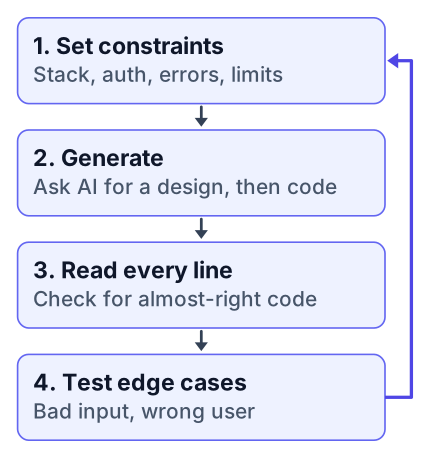
Constraints
Write the rules your code must follow before you open the tool.
Generate
Ask for a design, approve it, then ask for code.
Read
Go line by line against your constraint list.
Test
Try the bad cases: no login, wrong user, empty body, unknown product.
Critique
Ask the tool to review your fixed version for bugs only.
Decide
Accept or change each suggestion, and note why in the PR.
Build the judgment AI cannot produce
Review, architecture choices and understanding what stakeholders actually need are the skills that grow in value as code gets cheaper to write.
Stakeholder understanding (knowing what the person who asked for the feature actually needs) sounds like a manager's job. It starts with one question before you build: what problem does this feature solve? In your next sprint, ask the product owner, the person who decides what gets built, whether guests can order, and what happens if stock runs out during checkout. A tool cannot ask your client in Pune or Austin what they meant.
People stay part of the job for another reason. In the same Stack Overflow survey, 75.3% of developers said they would still ask a person when they do not trust an AI answer. The junior who explains things clearly to teammates becomes that person.
Add human checkpoints as a final habit: before any AI output leaves your hands, you check it yourself. That covers a pull request, a design doc and a message to a client. This is how to stay on top of AI as a software engineer. The tool can be fast, but nothing reaches another person without your name on the review.
Common mistakes freshers make with AI tools
The usual mistakes are pasting code you cannot explain, skipping tests because the output looks clean, and using AI so much that you stop practising the basics.
Most developers already keep their distance. The 2025 survey found only about 33% of developers trust the accuracy of AI tools, while about 46% say they distrust it. Here is how that caution looks as daily habits:
- Instead of pasting a function you cannot explain, explain each line out loud before you commit it.
- Instead of trusting clean formatting, run the bad-input cases yourself.
- Instead of prompting for every small task, write one small feature a week by hand.
- Instead of accepting new libraries the tool adds, check whether your project already solves it.
- Instead of hiding that you used AI, say so in the PR and show what you checked.
Do I need to worry about AI taking my first job?
Worry less about being replaced and more about being the junior who cannot explain their own code in an interview or code review.
In my view, interviewers increasingly expect candidates to know AI tools, and what they probe is whether you can defend the result. A follow-up like "Why did you return 404 here, and what would you change if the product was only out of stock?" is one only you can answer. The habits above, from system questions to the review pass, are what make that answer easy.
This week, pick one small endpoint you would normally ask AI to write. Write five constraints first, generate the code, review every line, and add one note on why you accepted or changed each choice.