What Are Your Strengths and Weaknesses? 20 Fresher Answers for 2026
The strongest answer pairs a real strength with a short example, and an honest weakness with a concrete fix. Here are 10 strengths and 10 weaknesses with sample answers every fresher can adapt, plus what never to say.
As of the 2026 placement season, HR managers at IT services firms say they hear "hardworking" 20 times a day. The HR manager asks, "What are your strengths and weaknesses?" Your mind goes blank. You say "I'm hardworking and punctual." The room goes silent. That answer told the interviewer you cannot think deeper than a school report card.
The strongest answer pairs a real strength with a short college, internship, or project example, and an honest weakness with a concrete action you are taking to fix it. Avoid clichés like "hardworking", "punctual", or "perfectionist" because they reveal nothing about you. Use the formula: Strength = skill + one-sentence example; Weakness = real growth area + clear fix.
Why 'hardworking and punctual' fails in 2026 interviews
Novoresume says "hard worker" and "punctual" are merely responsibilities, not strengths. They fail to show what makes you different. These are bare-minimum expectations for any employee. Every candidate at the table shows up on time and does their work. When you say these words, the interviewer learns nothing about how you think, solve problems, or work with others.
Hardworking, punctual, and perfectionist fail for the same reason: they are generic scripts that reveal nothing about you. MyVoiceCoach warns "perfectionist" is overused and sounds fake, and HR managers hear it dozens of times in a single placement drive.
| Cliché answer | Why it fails | Strong replacement |
|---|---|---|
| "I'm hardworking" | A responsibility, not a strength | "I debugged a payment retry bug that was failing daily" |
| "I'm punctual" | Bare minimum for any job | "I led my college fest team of 15 people" |
| "I'm a perfectionist" | Overused and sounds fake | "I set my own deadlines to stop overthinking" |
| "I have no weaknesses" | Shows low self-awareness | "I get nervous speaking in groups, so I joined a debate club" |
The formula behind every good answer
Every answer follows the same formula: a real strength or weakness, a short example, and for weaknesses, a clear action. Wisdomland gives the fresher formula as "Strength = real skill + short example from college/internship/project" and "Weakness = honest area for growth + clear action". The whole answer should stay within 40 to 45 seconds, which is roughly four to five sentences spoken at a normal pace.
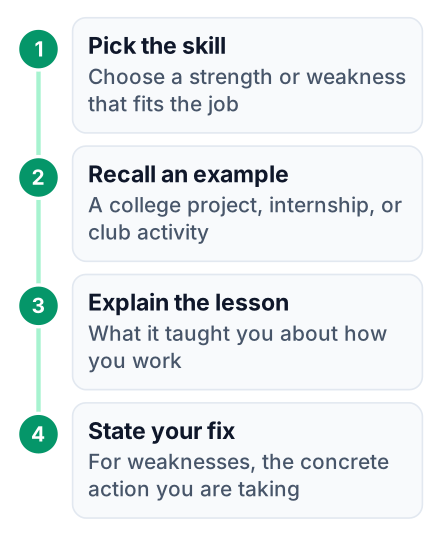
Pick one skill
Choose a single strength or weakness. Do not list three at once.
Add one example
Use a real moment from a project, internship, or college event.
State the action
For weaknesses, say exactly what you are doing to improve.
Keep it under 45 seconds
Practise until the answer fits the time limit.
Two candidates can both say "I solve problems well". Only one can say "I found a bug in the payment retry logic that was causing failed transactions". MyVoiceCoach shows this exact example, where a fresher identified a bug causing ₹2 lakh in daily failed transactions. That one sentence proves the skill. The other candidate just claims it.
10 strengths you can use, with sample answers
The strongest strengths for freshers include problem-solving, collaboration, attention to detail, quick learning, communication, adaptability, leadership, analytical thinking, creativity and responsibility. Each needs a college or internship example. Coursera lists collaborative, detail-oriented, and problem-solver as strong strengths to present. MyAMCAT advises choosing one or two strengths and explaining why they matter for the role. Do not list ten. Pick the two that fit the job description.
1. Problem-solving. "In my final year project, I built an inventory system and found a bug where stock counts went negative. I traced it to a missing validation check and fixed it within a day."
2. Collaboration. "I was part of a five-person team for our college hackathon. I handled the frontend while others did the backend, and we coordinated through daily standups."
3. Attention to detail. "During my internship, I was asked to check a data entry sheet with a few thousand rows. I spotted duplicate entries that no one else had noticed."
4. Quick learning. "My internship required me to learn a new testing tool in one week. I followed the official documentation and wrote my first test cases by Friday. When a test failed unexpectedly, I traced it to a missing environment variable and fixed the setup."
5. Communication. "I presented my project at the college tech fest and explained the technical parts to a non-technical audience. The judges asked follow-up questions and I could answer them clearly."
6. Adaptability. "My team changed our project stack from Java to Python halfway through. I picked up the new syntax over a weekend and delivered my module on time. When our build broke, I debugged the migration script and got it running again."
7. Leadership. "I led a team of 15 students for our college fest. I divided the work, set deadlines, and handled two members who were not contributing."
8. Analytical thinking. "In a data analysis assignment, I had to clean a messy dataset. I wrote a script to find missing values and outliers before starting the analysis."
9. Creativity. "For a marketing internship, I suggested a social media campaign idea that increased engagement on the company page. My manager used it for the next month."
10. Responsibility. "I was the class representative for two years. I collected assignments, shared notes, and made sure everyone knew the exam schedule."
10 weaknesses you can admit, with sample answers
The acceptable weaknesses are procrastination, self-criticism, fear of public speaking, overthinking, difficulty saying no, impatience, perfectionism (when paired with action), lack of experience with certain tools, trouble delegating, and getting nervous under pressure. Coursera lists procrastination, self-criticism, and fear of public speaking as acceptable weaknesses when paired with an improvement action. The action is the part that matters. A weakness without a fix tells the interviewer you are not working on yourself.
1. Procrastination. "I used to delay starting assignments until the last week. Now I break every task into small pieces and start the first piece on the day I receive it. For my final project, I finished the code two days before deadline, which never happened before."
2. Self-criticism. "I am too hard on myself when my code does not work. I have started keeping a log of what I learned from each mistake instead of just feeling bad about it."
3. Fear of public speaking. "I get nervous speaking in front of a group. I joined a weekly discussion group in college and now I can present my ideas without my voice shaking."
4. Overthinking. "I used to overthink decisions and waste time. MyVoiceCoach recommends setting personal deadlines and a 'good enough' threshold. I now give myself a time limit for each decision and move forward once I meet it. For a recent group project, I chose the tech stack in one day instead of a week."
5. Difficulty saying no. "I used to take on every task people gave me, which hurt my own work. I am learning to check my own workload first and politely decline when I cannot deliver quality."
6. Impatience. "I want results quickly and get frustrated when things take time. I have started setting realistic timelines for my tasks and reminding myself that good work takes time."
7. Perfectionism. "I used to spend too long polishing small details. I now set a 'good enough' standard for each task and only go back to refine it if there is time left."
8. Lack of experience with certain tools. "I have not used cloud deployment tools before. I have enrolled in a short course and I am building a small project to practise on my own."
9. Trouble delegating. "In group projects, I used to do everything myself because I trusted my own work. I am learning to assign tasks to teammates and review their work instead of redoing it."
10. Nervous under pressure. "I get anxious during timed tests. I have started practising with a timer at home so the pressure feels familiar during the real interview. I also take mock tests in a noisy room, so the interview room feels quiet by comparison."
What never to say as a weakness
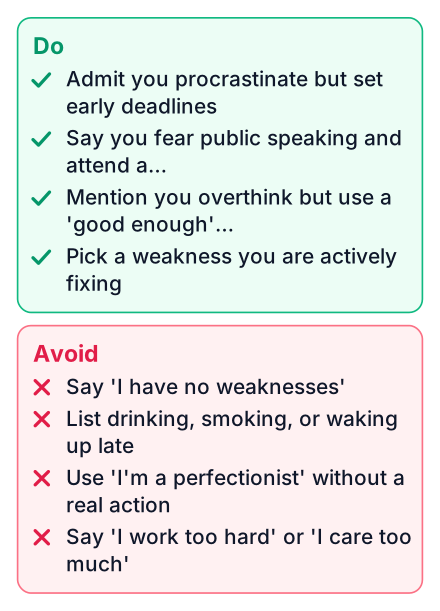
Never say you have no weaknesses, never list drinking, smoking, or waking up late, and never use the "perfectionist" cliché because it sounds fake and shows low self-awareness. MyAMCAT warns against all three, and the reason is simple: they are lifestyle habits, not professional growth areas. They make you sound like you do not understand what the interviewer is asking.
Novoresume adds that claiming you have no weaknesses reads as low self-awareness. Every human has areas to improve. Saying you have none tells the interviewer you cannot reflect on yourself, which is a skill every job needs.
Safe to say
- Procrastination, with a clear fix
- Fear of public speaking, with practice steps
- Overthinking, with a deadline system
- Lack of experience with a specific tool
Never say
- "I have no weaknesses"
- "I work too hard" or "I care too much"
- "I'm a perfectionist"
- Drinking, smoking, or waking up late
How to adapt your answer to the job role
Pick 2-3 strengths that match the job description. Tailor your example to that role. A coding job wants problem-solving, a customer-facing role wants communication. MyVoiceCoach advises choosing strengths relevant to the job and backing each with a one-sentence example. MyAMCAT adds that you should explain why you chose those strengths, not just list them.
Same skill, different proof. A coding role wants problem-solving, a customer-facing role wants communication. Read the job description before the interview. If it mentions teamwork, your collaboration example goes first. If it mentions deadlines, your responsibility example fits better. The same strength can sound different depending on the example you attach to it. For a coding role, say "I debugged a payment retry bug". For a customer-facing role, say "I explained technical issues to non-technical users".
The weakness should also match the role. A fresher applying for a data analyst role can admit limited experience with a specific analytics tool, as long as they show they are learning it. A fresher applying for a sales role should not lead with fear of public speaking, because that is the core of the job. Pick a weakness that does not block the role you want.
Practise your answer in 5 minutes today
Practise your answer out loud, keep it under 45 seconds, and record yourself on your phone to check your tone and confidence. Wisdomland sets the answer length at 40 to 45 seconds. That is short enough to hold attention and long enough to include one example and one action.
Start with your phone timer. Say your strength answer once, then your weakness answer once. Watch the recording. Notice where you pause, where you rush, and whether you believe what you are saying. Then do it again with a different example. Repeat until the answer feels natural, not memorised.
If you are preparing for a technical role, also review the advanced JavaScript interview questions or the Excel questions for data analyst roles so your technical answers match the quality of your strengths answer. And if the interview process feels overwhelming, read about managing AI fatigue. Understanding the SDE role levels can also help you frame your strengths toward the level you are applying for.
Frequently Asked Questions
Can I say I have no weaknesses? No. Novoresume says claiming you have no weaknesses reads as low self-awareness. Every human has areas to improve.
Is it safe to admit a real weakness like nervousness? Yes, if you pair it with a concrete action. Coursera lists nervousness as acceptable when you show how you manage it.
How long should my answer be? Keep it under 45 seconds, about four to five sentences, as Wisdomland advises.
Count your sentences. If your answer is longer than 5 sentences, cut the example. Record a 45-second video, then watch it. If you used any cliché like "hardworking" or "punctual", redo it with one of the 20 examples above.