The Best Free Python Courses That Build Job-Ready Projects
Free Python courses are everywhere, but most only train you to watch videos, not to build. This ranking shows which free courses actually submit working code and give certificates for free.
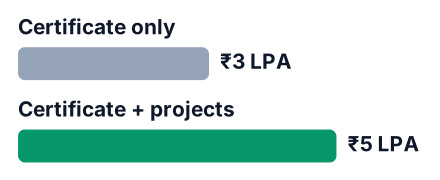
Pick any free Python course in 2026 and you will see hundreds of hours of syntax videos. Recruiters do not check your watch time. They check your projects. According to upGrad, the average Python fresher salary in India is ₹3.5 LPA, and employers pay more to candidates who show practical coding beyond academics (upGrad). If you are aiming for a data engineer role, our fresher salary guide for data engineers explains how Python projects fit into that career path.
The best free Python course for job-ready projects is Harvard's CS50P because it makes you submit working programs every week, gives a free certificate, and ends with real problem sets. For India, pairing any course with Django or Pandas projects is what moves you to the top of the fresher salary band. If you are new to Python, our 90-day Python learning plan can keep you on track.
What makes a Python course job-ready
A job-ready course makes you submit working code, not just watch videos. That is the single filter that separates a course worth your time from one that just fills your weekends.
Every course in this list is ranked on three questions. First, how much working code do you actually submit? Second, is the certificate genuinely free, with no paywall at the end? Third, how long does it take to finish? These three questions map directly to what Indian employers reward. upGrad's 2026 salary report says freshers who add certifications or projects in frameworks like Django or Flask land at the higher end of the salary band (upGrad). The certificate alone is not what pays. The projects are.
Harvard CS50P: the project-heavy pick
CS50P is 10 weeks of problem sets you submit with check50, and the certificate is free (cs50.harvard.edu). That is the whole pitch in one sentence.
The course covers functions, loops, libraries, and object-oriented programming. Each week ends with problem sets that run through an automated checker called check50. You get instant feedback on whether your code passes. That submission loop is exactly what a recruiter means by "practical coding experience."
Two practical details matter. The current run has a deadline of June 30, 2027, so you have time but not forever (Boot.dev). And the free certificate comes from completing the course on OpenCourseWare. The edX verified certificate costs $299, but it is optional. The free CS50 certificate is enough to prove you finished.
For your first course, the structure is the gift. You do not have to decide what to study next. The syllabus decides for you.
freeCodeCamp's Python certification: five real projects
freeCodeCamp's free Python certification builds five real projects, and the certificate is free after an exam (Boot.dev). freeCodeCamp's certification currently requires five projects and an exam. The shape is stable: five projects, an exam, a free certificate.
What matters for your job search is that these five projects are portfolio pieces. One involves building something like a budget app. Another is a polygon area calculator. These are not toy exercises. They are small applications you can push to GitHub and show a recruiter.
The catch is the exam. You do not get the certificate for finishing the lessons. You have to pass a certification exam at the end. That gate is actually good news for you: it means the certificate signals something real to an employer.
freeCodeCamp also publishes everything on its own site, so you can start today without creating an account.
University of Helsinki Python MOOC: hundreds of auto-graded exercises
Helsinki's Python MOOC gives you hundreds of auto-graded exercises and a free certificate—if you finish by December 31, 2026 (Boot.dev). The current edition closes December 31, 2026, so this is a now-or-never option.
The course splits into 14 parts. The first seven are Introduction to Programming, worth 5 ECTS credits. Parts 8 through 14 are Advanced Course in Programming, also 5 ECTS. Both halves combine text lessons with exercises that check your answer the moment you submit.
This is the highest-practice-volume option on this list. You will write more lines of Python here than in any other free course. Every exercise gives instant feedback, which means you learn by fixing mistakes immediately, not by watching someone else fix theirs.
If your weakness is that you can follow tutorials but freeze on a blank editor, this course is the cure.
Python for Everybody: free course, but the certificate is not
Python for Everybody is free on py4e.com, but the free certificate is only for U Michigan students (Boot.dev). Dr. Chuck's course is excellent teaching. The credential is the problem.
The course itself is free and open to anyone. You learn programming fundamentals through the lens of data, which makes it a favorite for people headed toward analytics. But if you want a certificate, you need Coursera Plus at $59 per month or $399 per year (Boot.dev). That monthly subscription is not free, and the certificate is the main reason most people take a course.
So where does this leave you? If you just want to learn, this is a solid choice. If you want a free credential for your resume, pick CS50P or freeCodeCamp instead. The teaching is not the issue. The certificate model is.
Automate the Boring Stuff: learn by building tools
Automate the Boring Stuff is free and teaches Python through automation projects that double as portfolio pieces (Scrimba). You learn by building tools that actually do things: renaming hundreds of files, scraping websites, sending emails.
The 3rd edition is free online under a Creative Commons license, so you can read the whole book without paying. A word of caution: the Udemy videos follow the 1st edition, which is outdated (Boot.dev). Stick with the online book, not the video series.
The projects here are different from CS50P's problem sets. They are tools you will actually use. A file-renamer script that renames 100 photos in one command is a project a recruiter can understand in ten seconds. Each one is working code you can show a recruiter and say, "I built this to solve a real problem."
For India's job market, these automation projects pair naturally with the Django or Pandas angle that upGrad says employers reward (upGrad). A scraper that collects data into a Pandas dataframe is a two-in-one portfolio piece.
Kaggle Learn Python: only for beginners who know some code
Kaggle's free Python course is a 5-hour refresher, not a starting point if you have never programmed (Boot.dev). Kaggle itself says the course builds on its Intro to Programming course, so total beginners should start elsewhere.
The course has 7 lessons and takes about 5 hours. It covers syntax, functions, and common data structures. You get a free certificate at the end, and the exercises run in the browser, so there is nothing to install.
Who is this for? Someone who already knows loops and conditionals from another language, or from a first Python course, and wants to confirm the basics before diving into data science. It is not a first course. It is a checkpoint.
If you have finished one of the earlier courses on this list and you are headed toward data work, Kaggle is a fast way to validate what you know.
The official Python tutorial: for programmers, not beginners
The official Python tutorial assumes you already know programming, so skip it if you are completely new (docs.python.org). The documentation says it plainly: it is designed for programmers who are new to Python, not beginners who are new to programming.
That distinction matters. The tutorial moves fast, skips hand-holding, and expects you to know what a loop is and why you would use one. For a total beginner, it reads like a textbook written for someone who already passed the course.
But once you finish CS50P or freeCodeCamp, this tutorial becomes a reference. You look up a function, check a syntax detail, or confirm how a library works. It is the official source, which means it is always current. The version available now is Python 3.15.2 (docs.python.org).
Bookmark it after your first course. Do not start with it.
Which course should you pick?
Pick CS50P for structure, freeCodeCamp for portfolio projects, Helsinki for practice volume—and pair any with Django or Pandas for India's job market.
| Course | Time | Free certificate | Projects submitted |
|---|---|---|---|
| Harvard CS50P | 10 weeks | Yes | Weekly problem sets |
| freeCodeCamp | ~300 hours | Yes, after exam | Five projects |
| Helsinki MOOC | 14 parts | Yes | Hundreds of exercises |
| Python for Everybody | Self-paced | No (Coursera Plus) | Quizzes |
| Automate the Boring Stuff | Self-paced | No | Automation tools |
| Kaggle Learn Python | ~5 hours | Yes | In-browser exercises |
One reality check before you start. Boot.dev tracked 325,348 people who began its free Python course between July 2025 and March 2026. Only 26.3% finished the 44 free lessons (Boot.dev). Three out of four people quit. The course is not the bottleneck. Finishing is.
So the choice is less about which course is best and more about which one you will actually complete. CS50P gives you a weekly deadline. freeCodeCamp gives you a portfolio. Helsinki gives you practice volume. Pick the one that matches how you work, then do not switch.
Your next step is simple. Start tonight: open the CS50P page, create your GitHub account, and submit your first "Hello, world" problem set. That working project is the first thing a recruiter will ask to see.


