Java Developer Skills in 2026: What Freshers Must Learn First
Fresher Java roles keep asking for Spring Boot, SQL, Docker and microservices. But you do not need all of them this month. Learn Java developer skills in four layers, starting with Core Java and SQL, and finish with one project you can explain line by line.
Say you have just finished a Java course and open three fresher job listings. Each one names Spring Boot, SQL, Git, Docker and microservices. Everyone online says AI is shrinking fresher jobs, so it feels like you must learn all of it this month. You do not, and trying to is the quickest way to learn none of these java developer skills well.
Learn Java developer skills in three tiers: first Core Java, OOP, collections, exceptions, SQL and Git; next multithreading, DSA, JDBC with Hibernate, Spring Boot, REST APIs and Maven or Gradle; and last, as nice to have, JUnit testing, then microservices and Docker with cloud basics. Start with the first tier and move down only when it feels solid. This order follows the roadmap on the NareshIT Java backend roadmap for freshers, a training institute's view of what recruiters test in fresher rounds.
Core Java and OOP basics
Syntax, data types, loops, methods and the four OOP pillars (encapsulation, inheritance, polymorphism, abstraction) are the first thing every fresher round checks, according to the NareshIT list of what recruiters test in 2026. That page names Java fundamentals, OOP concepts, logical thinking and debugging as the skills interviewers look for. All of them sit in this first layer.
Core Java and OOP are what every other skill runs on. A Spring Boot controller is a class. A Hibernate entity is a class with fields that obey encapsulation. If you cannot explain why a field is private, Spring Boot's behaviour will be hard to understand and fix when something goes wrong.
Say the interviewer shows you a short class and asks what prints. They are not testing memory. They want to see if you can trace a loop and a method call in your head without running it.
Two topics trip freshers up more than the rest. One is how strings behave, which I cover in String vs StringBuilder vs StringBuffer in Java. The other is the static keyword, explained in static vs non-static in Java.
Priority: Learn first. Do not touch a framework until you can write a small class hierarchy from a blank file.
Collections, exceptions and multithreading
ArrayList, HashMap, HashSet and LinkedList show up in almost every coding question, while exception handling and threads separate people who read about Java from people who ran it. The NareshIT backend roadmap puts all of these inside Core Java, next to arrays. This post disagrees on threads: filing multithreading under Learn next is the author's own ordering, not NareshIT's.
Picking the right collection is a question you will be asked out loud. Use an ArrayList when order matters and you read by position. Use a HashMap when you look things up by a key. A HashSet is for "have I seen this before?" checks, and a LinkedList is for adding and removing at the ends often.
Exceptions are the second half. Learn try, catch and finally, then write one custom exception of your own, like TaskNotFoundException. Here is a word count with a HashMap and a caught error in one small program:
import java.util.HashMap;
import java.util.Map;
public class WordCount {
    public static void main(String[] args) {
        String text = "java is fun and java is everywhere";
        Map<String, Integer> counts = new HashMap<>();
        for (String word : text.split(" ")) {
            counts.put(word, counts.getOrDefault(word, 0) + 1);
        }
        System.out.println(counts);
        try {
            int pages = Integer.parseInt("ten");
        } catch (NumberFormatException e) {
            System.out.println("Not a number: " + e.getMessage());
        } finally {
            System.out.println("Done counting");
        }
    }
}
Multithreading means your program does more than one thing at a time. For a fresher, the goal is small. Know what a thread is, why two threads changing one variable can break it, and what synchronized does about that.
Priority: collections and exceptions are Learn first. Multithreading is Learn next.
Data structures and algorithms for interviews
DSA matters most for product-company interviews, so practise it on the side from day one but do not let it block your project work. The NareshIT roadmap FAQ makes that same split between product companies and the rest.
Start with arrays and strings, then linked lists, sorting and basic recursion. These map to problem-solving ability and coding confidence, the first two items on most fresher scorecards. A focused question bank is in DSA interview questions for freshers.
The weekly split is where most students go wrong. They spend a month only on problems and have nothing to show on GitHub. A safer split, as my own suggestion: Monday to Friday, 1 hour on the project each day; Tuesday, Thursday and Saturday, 2 easy practice problems each.
Priority: Learn next. Go deeper if you are aiming at product companies rather than service companies.
SQL with MySQL or PostgreSQL
Pick MySQL or PostgreSQL, and learn joins, GROUP BY, indexes and basic table design, because almost every Java backend job reads from a database. The NareshIT roadmap names those two as the best starter databases.
Recruiters check database basics by asking you to write a join by hand, on paper or in a shared editor. No autocomplete, no ORM. Here is the tasks table I use for the worked example later in the Spring Boot section:
CREATE TABLE users (
  id   INT AUTO_INCREMENT PRIMARY KEY,  -- PostgreSQL: SERIAL
  name VARCHAR(100) NOT NULL
);
CREATE TABLE tasks (
  id       INT AUTO_INCREMENT PRIMARY KEY,  -- PostgreSQL: SERIAL
  title    VARCHAR(200) NOT NULL,
  done     BOOLEAN DEFAULT FALSE,
  owner_id INT REFERENCES users(id)
);
CREATE INDEX idx_tasks_owner ON tasks(owner_id);
-- Open tasks per person
SELECT u.name, COUNT(t.id) AS open_tasks
FROM users u
JOIN tasks t ON t.owner_id = u.id
WHERE t.done = FALSE
GROUP BY u.name;
If you can explain why the index is on owner_id and not on title, you already answer better than many candidates. Hint: the join looks up rows by owner.
Priority: Learn first, right after core Java.
JDBC and Hibernate connect Java to the database
JDBC is the plain way Java talks to a database, and Hibernate hides most of that work behind objects, so learn JDBC once to understand what Hibernate does for you. The roadmap.sh Java path describes backend developers using Spring Boot and Hibernate together to build RESTful APIs.
With JDBC you open a Connection, prepare a PreparedStatement with ? placeholders, and walk through a ResultSet row by row. It is tedious. That tedium is the point: after one afternoon of it, you see why Hibernate exists.
Hibernate lets you mark a class as an @Entity and map its fields to columns. You save a Task object, and Hibernate writes the SQL. When an interviewer asks how your project stores data, you can describe both layers instead of saying "Spring does it".
Priority: Learn next.
Spring Boot and REST APIs
Spring Boot is the framework most Java backend jobs expect, and a REST endpoint you built and can explain is the strongest fresher proof. On the NareshIT freshers page, API understanding and real-time project understanding both sit on the list of what recruiters test.
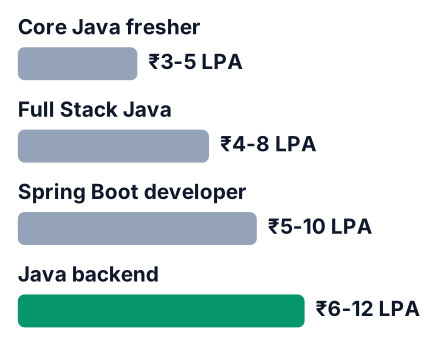
The same page lists fresher pay bands that rise as you move up this stack: Core Java fresher ₹3–5 LPA, Full Stack Java ₹4–8 LPA, Spring Boot developer ₹5–10 LPA, and Java backend ₹6–12 LPA (NareshIT). LPA means lakh rupees per year. These are estimates from one training institute, not a promise. The bands overlap heavily and depend on the type of company, so treat them as rough.
A Spring Boot app has three layers you should name in an interview. The controller receives the HTTP request. The service holds the business rules. The repository talks to the database. Learn the HTTP verbs (GET reads, POST creates, PUT updates, DELETE removes), what a status code tells the caller, and how Java objects turn into JSON.
Below is one endpoint that pulls the earlier sections together. It uses a collection, a Spring Boot REST controller and a SQL query on the tasks table. Multithreading is better practised in a separate small example, so it is left out here. You need the spring-boot-starter-web and spring-boot-starter-jdbc dependencies in your pom.xml, plus spring.datasource.url, spring.datasource.username and spring.datasource.password in application.properties. A GET request to /tasks/open returns JSON such as [{"id":1,"title":"Write tests"}]:
@RestController
@RequestMapping("/tasks")
public class TaskController {
    private final JdbcTemplate jdbc;
    // Datasource settings live in application.properties, see the text above
    public TaskController(JdbcTemplate jdbc) {
        this.jdbc = jdbc;
    }
    // Collection + SQL: each row comes back as a Map inside a List
    @GetMapping("/open")
    public List<Map<String, Object>> openTasks() {
        return jdbc.queryForList("SELECT id, title FROM tasks WHERE done = FALSE");
    }
    // Update: mark the task done, or return 404 if the id does not exist
    @PostMapping("/{id}/done")
    public ResponseEntity<String> markDone(@PathVariable int id) {
        int rows = jdbc.update("UPDATE tasks SET done = TRUE WHERE id = ?", id);
        if (rows == 0) {
            return ResponseEntity.notFound().build();
        }
        // A real project would log this change with a logger here, not stdout
        return ResponseEntity.ok("done");
    }
}
Build this, then swap JdbcTemplate for a Hibernate repository and notice what disappears. The official Spring guide to building a REST service is a good first walkthrough. For full projects to study, see full stack projects with source code.
Priority: Learn next. This is the biggest hiring signal on the list.
Git, GitHub and Maven or Gradle
Git history and a working Maven or Gradle build take the least time to learn, and they are the easiest way to make a project look like real work. The NareshIT roadmap calls both expected, and says a GitHub portfolio improves a fresher's job chances.
Recruiters test one thing here: can you set up a project and share it? A repository with one giant "final commit" says no. A history of small, clearly named commits says yes. These are the first five Git commands to learn, in this order:
git init
Turn your project folder into a repository.
git add
Choose which changed files go into the next save point.
git commit -m
Save those changes with a message that says what you did, like "Add open tasks endpoint".
git switch -c
Make a branch for a new feature so your working code stays safe.
git push
Send your commits to GitHub, then open a pull request to merge the branch.
The free Pro Git book covers each of these properly. For build tools, learn what goes in a pom.xml or build.gradle: the project name, the Java version, and the dependencies such as Spring Boot. Then add the repository link to your resume, as shown in skills for a fresher resume.
Priority: Git is Learn first. Maven or Gradle is Learn next.
JUnit and Mockito for testing
Writing even three unit tests per project tells a recruiter you check your own work, which many fresher portfolios skip. Testing with JUnit and Mockito comes after the main skills and is a nice extra for a first job, as listed on the NareshIT roadmap.
A JUnit test calls your code and uses an assertion to check the result, such as assertEquals. Name each test after the behaviour it checks: markDone_returnsNotFound_whenTaskMissing reads like a sentence. Mockito lets you replace the real repository with a fake one, so the test runs without a database.
In an interview, testing questions often turn into debugging questions. "Your test fails; what do you check first?" is a fair one. A good answer starts with reading the assertion message, not changing code at random. The JUnit 5 user guide has short examples for each assertion.
Priority: Nice to have for the first offer, and expected soon after you join.
Microservices, Docker and cloud awareness
Know what a microservice, a container and a cloud deployment are in plain words, but build them only after your first Spring Boot project works. These sit near the end of the upGrad Java full stack roadmap, after the frontend and backend basics.
For freshers, these come up as awareness questions, not hands-on tasks. Have one clear sentence ready for each:
- Microservice: a small app that does one job, like payments, and talks to other small apps over APIs.
- Docker container: your app packed with everything it needs to run, so it behaves the same on any machine.
- Kubernetes: a tool that starts, stops and restarts many containers for you.
- Cloud deployment: running your app on someone else's servers, such as AWS, instead of your laptop.
Now the AI worry. This post has no fresher hiring data on it, so treat the rest as my opinion, not a finding: AI tools write code fast, but someone still has to read it, test it and explain it in an interview, and pay figures for experienced hires say little about fresher offers. The order you learn in decides whether that someone is you, far more than how many tools you can name.
Here is every skill in one place, with its purpose, what gets tested and its priority tier:
| Skill | What it is for | What recruiters actually test | Priority |
|---|---|---|---|
| Core Java basics | Writing any Java program | Fundamentals, tracing output | Learn first |
| OOP | Designing classes that make sense | The four pillars, explained with your own example | Learn first |
| Collections | Storing and finding data in memory | Picking the right one and saying why | Learn first |
| Exception handling | Failing safely | try/catch/finally, custom exceptions | Learn first |
| SQL | Storing and querying app data | Joins and GROUP BY written by hand | Learn first |
| Git and GitHub | Saving and sharing your work | A clean commit history | Learn first |
| Multithreading | Doing several things at once | What a thread is, shared-data problems | Learn next |
| DSA | Solving problems efficiently | Problem-solving, coding confidence | Learn next |
| JDBC and Hibernate | Connecting Java to the database | How your project stores data | Learn next |
| Spring Boot | Building backend apps quickly | Controller, service and repository layers | Learn next |
| REST APIs | Letting other apps use yours | HTTP verbs, status codes, JSON | Learn next |
| Maven or Gradle | Building and managing dependencies | Setting up a project that runs | Learn next |
| JUnit and Mockito | Checking your own code | Testing habits, debugging | Nice to have |
| Microservices | Splitting big apps into small ones | Plain-words definition | Nice to have |
| Docker and cloud | Running your app anywhere | Plain-words definition | Nice to have |
Follow this four-week plan, with a Git commit after every session. Weeks 1 and 2: Core Java, OOP and collections, with one small program each pushed to GitHub. Week 3: SQL, using the tasks table above. Week 4: build the tasks endpoint above in Spring Boot. If Core Java feels weak, spend week 4 on it before moving on.


