Agents Start 40% of Pull Requests: What Students Should Learn Now
GitHub's Octoverse 2026 report shows agents now start over 40% of pull requests, up from 17% in March. For students, this doesn't mean jobs are gone; it means the skills that pay are reviewing and directing agent-generated code, not just writing it.
If you are in your final year and reading that agents start 40% of pull requests, your first thought is: my job is gone. I get it. It isn't. GitHub published its Octoverse 2026 report on October 28, and the headline number is hard to ignore: agents now start more than 40% of all pull requests, up from 17% in March. Here's what the numbers actually say about the skills that pay in 2026.
Agents starting 40% of pull requests does not mean your job is gone; it means the work changed. Human developers still review, direct and decide what ships. The skills that now matter are reviewing agent-generated code, orchestrating agents across your repo, and moving fast. Companies reward those with the 8x commit velocity that agent-setup repos show.
What the Octoverse numbers actually say
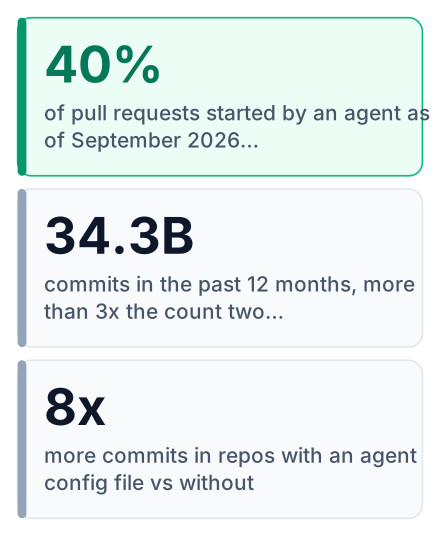
GitHub's 2026 Octoverse report shows that developer activity grew to record levels, not a decline: pushes hit 17.9 billion in the past 12 months, commits climbed to 34.3 billion, and merged pull requests more than tripled to 1.3 billion, per the GitHub blog. The agent story is a big part of that growth. As of September 2026, developers start more than 40% of pull requests with an agent, up from 17% in March. September alone saw 110 million agent-started pull requests, roughly six times the March total. Repositories with an agent config file logged eight times more commits than those without.
What agents starting 40% of PRs means for you
For a student, agents starting 40% of PRs doesn't mean your future job is automated; it means your first job now involves reviewing and directing the agent's work, according to the Octoverse report. The role shifts from writing every line from scratch to guiding and approving agent output.
What the agent does
- Writes the first draft of the code
- Handles boilerplate and repetitive edits
- Makes multi-file changes quickly
What you do
- Decide what the agent should build
- Review the diff line by line
- Approve what ships to production
Agent-started pull requests more often change multiple files, around 87% versus 79% for human-started ones, and roughly 90% of agent-involved PRs merge within two weeks, the GitHub blog reports. A human still decides what is good enough to merge. That decision is the job.
The skill that pays: review, not just writing code
The skill companies pay for in 2026 is reviewing and directing agent-generated code, not just producing code yourself, as the Octoverse data suggests. Because agent PRs touch more files, the reviewer must understand how changes ripple across a codebase.
Read the diff first, not the summary
Open every changed file. The agent's description may say one thing; the code may do another.
Run the tests yourself
Do not trust the green checkmark. Execute the test suite and see what passes on your machine.
Check the edge cases
Ask what happens with empty input, wrong types, or a slow network. Agents often miss these.
Ask why
If a change looks odd, dig into the reason before approving. That question is where you learn.
Start practicing on your own pull requests. Read every diff as if you were the senior reviewer. Spot the subtle bugs an agent would not catch, like an off-by-one error or a missing null check.
Build with agents on your own repos
The best way to prepare is to build with agents on your own repositories now, using free tools like Copilot's free tier, so you learn the 8x commit velocity that companies expect, per the Octoverse report. Set up an agent config file in a personal project and let it start pull requests.
# .github/agents.yml
agent:
  enabled: true
  model: auto
  auto_review: true
Copilot adoption reflects this shift. According to the GitHub Universe 2026 blog post, 55% of monthly active Copilot users now use agentic features, up from 35% a year ago. Most paying developers, 63%, use auto model selection rather than picking a model themselves. No model licensing cost stands in your way for personal use.
Which languages agents are best at checking
Java and C++ are still everywhere in Indian colleges, but Octoverse shows they are not where agent assistance is growing fastest. That does not make them useless — it makes TypeScript or Python a smarter pick if you are starting fresh. TypeScript, Python, and Rust have the highest AI involvement, at 40-44% of merged PRs, so choosing one of those languages makes your work easier for agents to assist with, according to the Octoverse report and corroborated by TechGig.
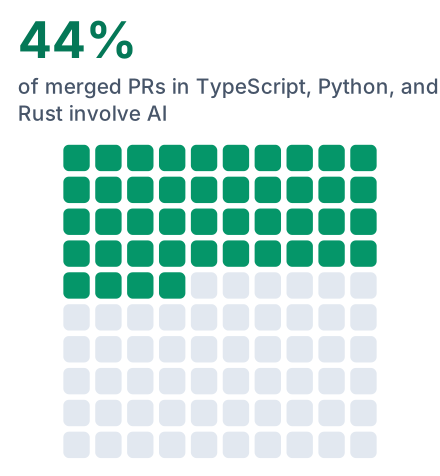
| Language | AI involvement in merged PRs | Growth | Typical use |
|---|---|---|---|
| TypeScript | ~44% | Fastest-growing, #1 language | Web apps, full-stack |
| Python | ~40%+ | #2 language | AI, data, backend |
| Rust | ~40%+ | Doubled, fastest riser | Systems, performance |
TypeScript is the primary language in 35% of repos with agent signals versus 24% without, the GitHub blog notes. Rust doubled the fastest of any language. Picking a language that agents handle well is a real 2026 decision, because the tooling and reviewer expectations already assume it.
What 32 million Indian developers means for competition
With India adding 10 million developers this year to reach 32 million, competition is the steepest ever, but the differentiator is being the person who directs the agent, not the one it replaces, as TechGig reports. The US now has 38.3 million developers, also adding more than 10 million this year, per the same report. India closed 28.3% of the distance to the projected 57.5 million developers by 2030.
- India: 32 million developers, 10 million added this year (TechGig)
- US: 38.3 million developers, 10+ million added this year (GitHub blog)
- Global: GitHub now serves 225M+ developers (GitHub blog)
Sitting in a crowd of millions, the one who can review an agent's multi-file PR and catch the subtle bug stands out. The one who only writes code from scratch competes with the agent itself.
How to start today: a 7-day plan
Start today by setting up an agent on a personal project, committing daily, and reviewing the agent's PRs critically, so you build the velocity and review skills that 2026 jobs expect, per the GitHub Octoverse report.
Days 1-2: Set up
Create a GitHub repo, enable Copilot free tier, and add an agent config file. Make your first commit.
Days 3-4: Assign a small feature
Tell the agent to build something simple, like a login form. Review the PR it opens, line by line.
Days 5-6: Try a multi-file change
Ask for a refactor across several files. Check the diffs carefully and watch for missed edge cases.
Day 7: Reflect
Write down what the agent did well and where it failed. That list is your skill map.
For the emotional side of keeping up with AI changes, read what to do when AI fatigue hits. To see how mobile agents fit into the picture, check Cursor's mobile coding agent. And for a concrete project you can build with an agent today, see how to build projects with Gemini 4 Argon.
Set up Copilot on a personal repo today and let an agent start a pull request. Then review it line by line. That 30 minutes is the first step toward becoming the developer who directs agents, not the one they replace.