GPT-6 designed proteins that bind drug targets: what students should learn from it
OpenAI reports that GPT-6 models designed proteins with lab-confirmed binding to drug targets, using only reasoning and code. For students, the lesson isn't the biology: the same loop of prompting, running code, and checking output now reaches into science.
A general-purpose AI model, working from plain English and Python with help from older biology tools for sequence suggestions and ranking, designed small proteins that stuck to cancer and inflammation targets in a real lab. OpenAI published the result on 24 November 2026. The part that matters for students is not the proteins, it is how the work was done.
OpenAI says its GPT-6 models can design proteins using reasoning and general coding tools, without a purpose-built biology model, though older biology tools still suggested sequences and ranked candidates. In lab tests, 35 of 322 designed minibinders (small designed proteins that stick to a target) bound their targets. Older biology programs still helped with parts of the pipeline. For a student, it means prompting, reading output and running code now reach into biology too. Specialists still choose the final candidates.
What OpenAI announced about GPT-6 protein design
The preprint, tested in the lab with Onava, reported new shapes and sequences, with evidence of binding across five targets.
The preprint carries the title "GPT-6 as a Universal Foundation Model for Protein Biology: Beyond Specialized Models", which tells you what claim the team is making. If you have been following OpenAI's push into the life sciences, this sits next to its drug-discovery benchmark work from earlier in the year. The difference here is that someone made the molecules and tested them.
Proteins in plain terms: a chain that folds
A protein is a chain of amino acids that folds into a 3D shape, and the order of the chain decides the shape, which decides what the protein can stick to.
Think of a long strip of paper that always folds itself the same way once you write a particular pattern on it. Change the pattern and you get a different folded object. One pattern gives you a hook, another gives you a flat paddle.
Two words show up again and again in this work. A binder is a small protein designed to stick to something else, and the thing it sticks to is the drug target, usually a protein on a cell that is involved in a disease. Medicines often work by sticking to a target and blocking it, so designing a reliable binder is a real step toward a drug rather than a classroom exercise.
The two lab experiments, step by step
There were three tests. The first tested designed minibinders against five targets, the second asked the model to write sequences for requested shapes, and the third tested redesigned antibody loops that mostly kept binding.
In the first, the model produced 322 minibinders and the lab found that 35 of them, or 10.9%, tested positive for binding, according to OpenAI's write-up. The hits were not spread evenly.
| Target | Binders found |
|---|---|
| IL-17A | 18 |
| VEGF-A | 8 |
| PD-L1 | 5 |
| IL-7Rα | 3 |
| TrkA | 1 |
The second experiment handed the model a 3D structure and asked it to write a sequence that would fold into that shape. Here "working" means the designed sequence folded into the requested shape and bound its target. OpenAI reports 75 of 88 working for MDM2, 26 of 42 for VEGF-A and 8 of 59 for PD-1, so the hit rate varies a lot by target. That works out to about 85% for MDM2, 62% for VEGF-A and 14% for PD-1.
| Test | Target | Task | Hits | Total | Percent |
|---|---|---|---|---|---|
| Second | MDM2 | Sequence for a requested shape | 75 | 88 | 85% |
| Second | VEGF-A | Sequence for a requested shape | 26 | 42 | 62% |
| Second | PD-1 | Sequence for a requested shape | 8 | 59 | 14% |
| Third | IL-4Rα | Redesigned antibody loops | 128 | 182 | 70% |
| Third | PD-1 or PD-L1 | Fragments from five therapeutic antibodies | 179 | 272 | 66% |
A third test rewrote the loops of antibodies, the parts that do the gripping. OpenAI's figures show 128 of 182 redesigned loops still bound IL-4Rα, and 179 of 272 fragments drawn from five therapeutic antibodies still bound PD-1 or PD-L1. Put simply, about 70% of the rewritten loops and about 66% of the antibody fragments kept their grip, by OpenAI's count.
How GPT-6 compares with specialized biology tools
On two of the three design benchmarks the GPT-6 results beat dedicated tools by a clear margin, and on the third the gap is too small to call a win, though specialized models still did parts of the work.
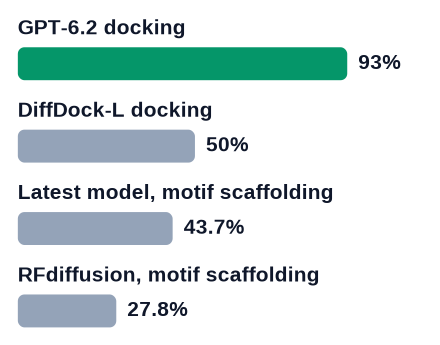
Each benchmark asks a different question, so here is what the three mean in plain words, with OpenAI's reported scores beside them.
| Benchmark | What it asks | OpenAI model | Specialized tool |
|---|---|---|---|
| Motif scaffolding | Build a protein around a small working part that must be kept intact | 43.7% (OpenAI's latest internal model, version not named) | 27.8% (RFdiffusion) |
| Fold design | Produce a protein that folds into a requested overall shape | 18.9% (OpenAI model not specified for this row) | 17.1% (Proteina) |
| Docking (PoseBusters) | Predict how a small molecule sits against a protein | 93% (GPT-6.2) | 50% (DiffDock-L) |
PoseBusters is a docking test: the model proposes where a small molecule sits in a protein, and a result counts as matched when the predicted pose lines up with the experimentally known structure. The rows also use different OpenAI models, so they are not one head-to-head contest, and the fold-design gap of 18.9% against 17.1% is too small to call a win. Read these as the vendor's own numbers, measured by the team with an interest in the answer. That is not an accusation, it is how benchmark pages work, and it is why the link is there. Open the page and look at how each score was counted before you repeat it to anyone.
What this means if you are learning to code
The wall between AI for coding and AI for science is coming down, so prompting, reading output and writing and running code now transfer into biology.
Between the plain English request and the molecule that went to the lab, the model did the general-purpose part of the work, while older biology tools handled sequence suggestions and ranking, as the limits section explains. That general-purpose part looked like this: the model reasoned, wrote Python, ran it, looked at what came back and adjusted. That is the same loop you run when you ask a model to parse a messy CSV.
Describe the problem in plain English
State what you want and what counts as a correct answer, in ordinary words.
Let the model write the code
Ask for Python you can read, not a one-line trick.
Run it yourself
Execute it and watch what it prints, including the errors.
Read the output
Decide whether the numbers make sense before you decide whether the code is right.
Check it against reality
Find one external thing, a known value or a second method, that agrees or disagrees.
Here is the loop on a tiny scale. This script counts the amino acids in a 30-letter sequence and checks its own total against a known value:
from collections import Counter
seq = "MKTAYIAKQRQISFVKSHFSRQLEERLGLI"
counts = Counter(seq)
for letter, n in sorted(counts.items()):
    print(letter, n)
print("total", sum(counts.values()))
print("length", len(seq))
Real output: A 2, E 2, F 2, G 1, H 1, I 3, K 3, L 3, M 1, Q 3, R 3, S 3, T 1, V 1, Y 1, then total 30 and length 30. The two matching 30s are the check against a known value. Two skills to practise from here: reading a paper's methods section to see how its authors counted, and writing a check like that one before you trust any result.
Say you are a computer science student in Pune or in Austin who has never taken a biology class. Trying this kind of work no longer starts with a specialist course: the entry cost is the loop above plus the willingness to read a field's papers carefully, and one preprint does not change what a lab needs from trained biologists. My opinion, stated plainly: the skill worth building is not knowing biology, it is being the person who can turn a vague scientific question into code that runs and then judge the result honestly. That person is a useful addition to a research group, though one preprint does not prove it.
Limits: specialists still pick the winners
The work was not fully hands-off. Older biology programs (ProteinMPNN, SolubleMPNN and ESMFold) still suggested sequences and picked candidates. OpenAI's own page also calls predicting a complete protein structure a clear weakness.
What the result shows
- A general model reached a hard wet-lab task without a biology-specific architecture.
- Real molecules were made and measured, not simulated.
- Redesigned antibody grips survived the rewrite often enough to be useful.
Still not shown by this result
- Most designs failed, since the 10.9% hit rate means roughly nine in ten did nothing.
- Binding is not a medicine, because specificity, stability and biological activity are separate problems.
- Nobody has peer-reviewed this yet, as it is a preprint.
The independent write-up at Blockchain.News makes the same point about the remaining dependence on specialist tools for those three properties. Treat the headline as a capability signal, not as a replacement announcement.
What to do this week
Ask a model to write Python that counts the amino acids in a 50-letter protein sequence, run it, and check three of the counts by hand. It should take about 30 minutes, and the hand check is the part that matters. Then read OpenAI's page to see how its team checked theirs. What is the first field outside your degree you would point this loop at, and what would convince you the answer was right?


