GLM-5.4 Launches Without Benchmarks: Loop Transformer Explained
Zhipu launched GLM-5.4 on November 23, 2026, with vision and a 1M-token context, but published no official benchmarks. The loop transformer reuses 28 layers twice to approximate a 2T-parameter model, and one unofficial test ranked it 7th of 19.

As of November 23, 2026, the Hugging Face page for Z.ai (zai-org) does not list GLM-5.4. Zhipu has published no benchmark scores for it either. Yet the model is already live in its Coding Plan.
GLM-5.4 is Zhipu's first flagship that runs the same 28 layers twice. Zhipu says this lets a 750B-parameter model match a model near 2T parameters, but it has published no scores to prove it. For now it runs only inside Zhipu's own products, per TechNode's launch report, with no API or downloadable weights yet.
Where you can use GLM-5.4 today, and what is still closed
Zhipu (Z.ai) runs GLM-5.4 in three of its own products. You can use it today in the GLM Coding Plan and in Z.ai Chat, and ZCode carries it too, as TechNode reports. Vision means you can give it an image, such as a screenshot of a broken layout. The large context means it can read a big codebase in one go.
Two doors are still closed. The developer API is "coming soon" and waits on a safety evaluation, according to MLQ. Open weights are planned, but Zhipu gave no date. That pattern of launching inside an app first is common now; Alibaba did something similar, as I covered in the post on Qwen4 Max and its API-only release.
A loop transformer reuses the same layers twice
Instead of stacking more new layers, a loop transformer sends the data through the same block of layers a second time. A layer is one processing stage that transforms the text the model is reading. A parameter is one learned number inside those layers, and a model has billions of them.
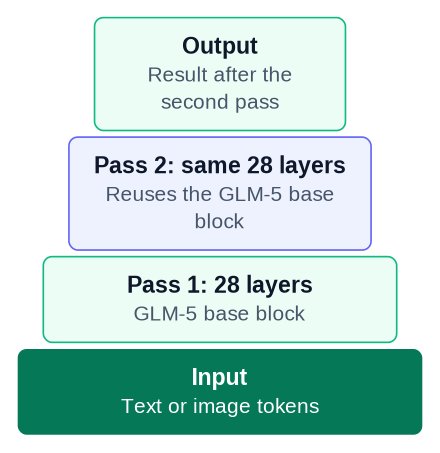
In GLM-5.4, the block being reused is the 28-layer stack from the GLM-5 base model, per MLQ. The data goes in, passes through those layers, loops back to the start, and passes through them again. Only then does the model produce its output. Zhipu claims this gives the model close to 2T-parameter intelligence, and right now that is only the company's claim. Think of rereading a hard paragraph twice with the same brain: you learn nothing new between the two reads, but the second read catches more. The same weights are used both times, so memory stays the same while the compute per token roughly doubles. The trade-off is more thinking per token without more stored parameters.
The idea itself is not new. Looping layers is an older research idea that academics have studied for years under names such as universal transformers, long before any company used it in a flagship coding and chat product. What is new is a company shipping it as its main model.
Zhipu first tried looping on a smaller 30B test model. There, it says, the biggest gains came in math, science reasoning and long-context tasks. Coding was not on that list, which is worth remembering for a model sold through a coding plan.
How Zhipu keeps looping from getting expensive
Three serving tricks limit the extra cost of the second pass, as MLQ describes them:
- Per-token gate: for each token (a small piece of text), a small switch decides how much of the second pass's result gets added back to what the first pass produced.
- Sliding-window cache: the model keeps only recent text in fast memory instead of everything it has read.
- Reused sparse attention indices: the second pass looks at the same parts of the text the first pass picked, so it skips choosing again.
Here is a simplified picture of one token's trip, based on Zhipu's description:
- The token is turned into a list of numbers the model can work with.
- It passes once through the GLM-5 base layers.
- The gate decides how much of the result to keep.
- It loops through the same layers again, reusing the attention choices from the first pass. Attention is the step where the model decides which earlier words matter most for the one it is reading.
- The model predicts the next token from the final result.
Zhipu also says looping cut average answer length by 10 to 14% on the GPQA-Diamond and MMLU-Pro tests, per MLQ. Nobody outside the company has checked that. Zhipu also admits a weakness: when you train it for longer with the same hardware, the looped model trails conventional ones.
No official benchmarks exist, and that matters for your choice
Without published scores, you cannot compare GLM-5.4 to other models on anything except the company's own words. The team says benchmarks will come later, MLQ reports. On the zai-org page, the newest models are still the GLM-5.3 family from August.
This matters more for coding than for chat. A coding agent calls the model again and again: read a file, plan, edit, run tests, fix. If each call takes two passes, small delays add up across a long task. A model that "thinks twice" can still be slower in practice, or even worse at your kind of code.
Reasons to try it now
- You can paste screenshots of UI bugs.
- It can hold a large project in context.
- Your weekly quota went up 50%, so a test run is cheap if you already subscribe.
What argues for waiting
- No official scores to compare against.
- No API, so you cannot plug it into your own app.
- No downloadable weights yet.
One unofficial test ranks it 7th of 19 and far slower
The only early result, from AICodeKing's KingBench 4, shows GLM-5.4 at 55.3%, 7th of 19 models (a middling result, not a win), but far slower than Google's Gemini 4 Neon, at 431 minutes against 109, as Winbuzzer reports. KingBench 4 is a coding test run by AICodeKing, the YouTuber behind the video above, and the source does not detail its tasks. The tester ran it before release.
| KingBench 4 | GLM-5.4 | Gemini 4 Neon |
|---|---|---|
| Total time | 431 minutes | 109 minutes |
| Steps used | 4.6x more | Baseline |
| Speed per step | Slightly faster | Slightly slower |
Source: Winbuzzer, November 23, 2026.
Each step was quick, but GLM-5.4 took far more of them. That is why the total time grew. If you want to know how Gemini 4 Neon itself compares to its sibling, see Gemini 4 Neon vs Carbon for coding.
Treat this as one data point, not a verdict. It is one tester, one benchmark and a pre-release build.
Credit costs are lower per token, quotas are bigger
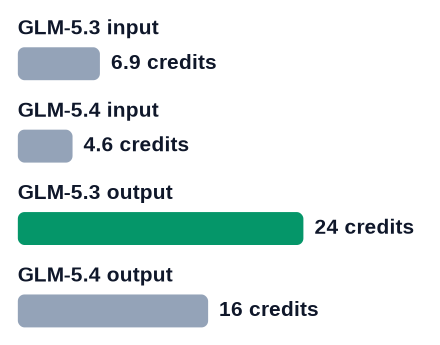
GLM-5.4 uses fewer credits per token than GLM-5.3, and subscribers got 50% more weekly quota, per TechNode. The quota increase applies to the V2 and V3 plans, and to team plan subscribers.
| Credits per 10K tokens | GLM-5.4 | GLM-5.3 |
|---|---|---|
| Input | 4.6 | 6.9 |
| Output | 16 | 24 |
Source: Winbuzzer.
The sources give these costs in credits, not dollars or rupees. Check your plan page to see what a credit is worth for you.
Here is the catch. Cheaper tokens do not mean a cheaper task if the model takes many more steps, as it did in that KingBench run. Say a bug fix needs a few thousand tokens on your current model. If GLM-5.4 needs several times as many steps, its lower price per token can disappear.
Try GLM-5.4 in your editor today
You switch to GLM-5.4 by changing one model name in your coding tool, according to Winbuzzer.
Get the Coding Plan
Subscribe, or use the plan you already have.
Set the model name
In most tools, enter
glm-5.4as the model.Use the long-context name in Claude Code
Enter
glm-5.4[1m]to get the large context window.Attach a screenshot in Cline
Paste an image of the bug along with your prompt.
Compare on one task
Run the same task on your current model and note time and credits.
# Most tools on the GLM Coding Plan
model: glm-5.4
# Claude Code, with the large context window
model: glm-5.4[1m]
If you need weights you can download today, look at Moonshot AI's Kimi K3.1 Pro. It also takes text and images, has a context of about 1M tokens and ships open weights, per Winbuzzer. For a smaller open model you can run at home, see Inkling 2 Mini on a laptop.
Should you switch to GLM-5.4 now?
Try it on a small side project now, but keep your main workflow on a model with published scores until Zhipu releases its own.
For a student on a budget who already pays for the Coding Plan, the bigger quota makes testing nearly free. Use it on practice projects and learn how it behaves. For a developer on a real job, speed matters more than price per token. A slow agent costs you hours, and my CRUD benchmark on AI coding speed shows how that adds up. If you need open weights, GLM-5.4 is not an option yet.
Three events would change this advice. Official benchmarks would let you compare it fairly. An API launch would let you build on it. Weights on Hugging Face would let you run it yourself, as the launch coverage says Zhipu plans.
Pick one real task from your current project, run it on GLM-5.4 and on your usual model, and write down the time and credits each took. Then check the zai-org Hugging Face page again in a week for official scores.


