OpenAI and Cisco release Shirudo: a security shield that blocks exploits before the patch arrives
Shirudo is an open-source Linux runtime from OpenAI and Cisco. It uses AI-written eBPF programs to block exploits on a running system while a real patch is still being prepared.
As of November 25, 2026, OpenAI's launch page and Cisco's newsroom both describe Shirudo, a Linux security tool released two days ago. The name sounds like another AI assistant. It is something different: it works inside the Linux kernel, the core of the operating system, where most AI products never run.
Shirudo is an open-source Linux runtime from OpenAI and Cisco that blocks exploits on a running system while a patch is still being prepared. Codex writes small eBPF programs called shields, and the system loads them without a restart. It is pre-release, so it is a learning tool today, not a production system. If you are early in your career, my note on how to stay ahead of AI as an early-career engineer gives the wider context.
Shirudo is a runtime, not a chatbot
The name means "shield" in Japanese. The tool is a runtime that works inside the Linux system, and its job is to block attacks on it. OpenAI and Cisco announced it together on November 23, 2026, on OpenAI's launch page and in Cisco's press release.
A runtime here means software that keeps running next to your programs and watches what they do. Shirudo does this with eBPF: small programs that run safely inside the Linux kernel, the core of the operating system. The kernel checks each eBPF program before it runs, so a broken one is rejected instead of crashing the machine.
The license is permissive. OpenAI's page says the project uses the BSD 2-Clause license, and the BPF programs are dual-licensed BSD/GPL. The code is public in the shirudo-dev/shirudo repository on GitHub.
How a shield blocks an exploit before the patch ships
A Codex-generated shield blocks the vulnerable code path in the live kernel, so the service keeps running while engineers prepare the real fix. OpenAI describes a controlled test in which a shield stopped a Java4Shell exploit attempt against a running Elasticsearch service, with no restart. I did not open the repo, so I cannot show a real shield or a real log line of a blocked attempt here; look for both in the quickstart. This is also where the claims are still untested in public: that one Java4Shell test is the only block I found described, the vendors ran it themselves, and I found no independent test, no data on legitimate traffic blocked by mistake, and no measure of how long a shield takes to draft.
The problem it targets is the waiting time. Attackers can try a public bug as soon as they read about it. The fix still has to be written and tested, then rolled out to every server. Restarting a busy search cluster is also costly, so teams often delay it.
Say an online store's product search runs on Elasticsearch, and a bug in it goes public on a Friday night. Without a shield, the team restarts in a hurry or stays exposed all weekend. With a shield, the risky path is closed and the patch can wait for Monday.
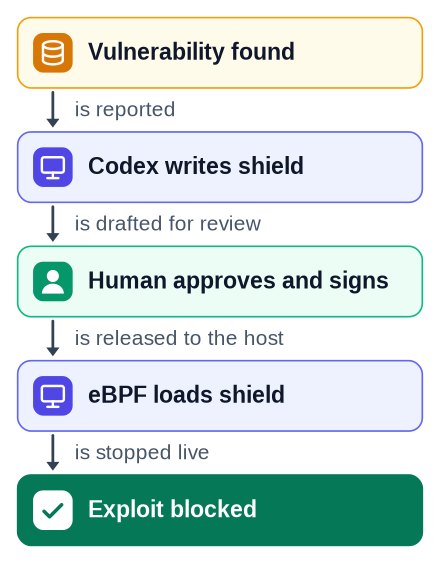
Here is the flow the vendors describe:
Vulnerability found
A bug in a running service becomes known.
Codex writes a shield
The AI drafts a small eBPF program that closes the vulnerable path.
A human approves and signs
An engineer reviews the shield and signs it before it can load.
eBPF loads it
The shield goes into the live kernel. The service does not restart.
Exploit blocked
Attack attempts hit the closed path and fail.
The four capabilities Shirudo claims
Cisco lists four capabilities: live protection, defense at machine speed, trusted deployment and hardware-backed verification. The table puts each one in plain words.
| Capability | In plain words | Hardware needed? |
|---|---|---|
| Live protection | Shields load into a running system with no restart. | No special chip, but it needs kernel support. |
| Defense at machine speed | AI drafts the shield, so protection does not wait for someone to write code by hand. | No. |
| Trusted deployment | Only approved, signed shields are allowed to load. | It relies on the verification row below. |
| Hardware-backed verification | A security chip on the machine confirms that the system and shields have not been tampered with. | Yes, a TPM security chip. |
A TPM (Trusted Platform Module) is a small security chip that stores keys and records what software has loaded. Most recent laptops have one, and common virtual machine tools can emulate it.
Shirudo is built on Cisco's Tetragon
SecurityWeek reports that Shirudo is an AI-focused rewrite of Tetragon, an eBPF tool owned by Cisco's Isovalent.
The pairing follows from what each side already has. Cisco owns a mature eBPF security engine through Isovalent. OpenAI brings Codex, its coding model. The three sources say little more about business reasons, so I won't guess at them.
What actually changes from Tetragon is who writes the rules. In Tetragon, a person writes the policies that decide what to watch and what to block. In Shirudo, Codex drafts those policies as shields and a person reviews them. Cisco places the project under the goal of safeguarding agentic AI, which is how its release is titled.
Pre-release limits and the safety warning
Shirudo is not production-ready: it needs specific kernel capabilities, extra kernel patches and TPM 2.0, according to SecurityWeek.
The bigger concern is safety. Amiram Shachar of Upwind told SecurityWeek that writing sensitive kernel code on the fly and deploying it at runtime is risky. A wrong shield could block a path your real users need. The kernel is the worst place for that kind of surprise.
Pros
- Protects a running service without a restart.
- Open source, so security teams can audit every line.
- AI-drafted, human-signed rules are easy to study in a lab.
Cons
- Needs patched kernels and a TPM chip.
- AI-written kernel code can be wrong in ways that are hard to spot.
- Pre-release, with no promise that things will stay stable.
The human signing step is what limits that risk. Codex can produce a shield fast, and speed is exactly the danger Shachar names. A signature means a named engineer read the shield, judged its effects and took responsibility before it reached the kernel.
Skills Shirudo makes more valuable for freshers
I expect eBPF, Linux hardening and exploit analysis to become more useful, because AI writes the shields but a human still has to judge and approve them. This is my opinion. No source counts jobs. These are usually not entry-level roles, so treat them as a goal for later.
Think about who signs a shield. That person must read eBPF code and understand what the vulnerable path does. They must also work out which normal features the block could stop from working. Codex cannot answer for an outage, but the engineer who signed can. I expect companies to value that judgment. The table below is my own illustration of how the work could split, not something the sources state.
| Task | AI does | You do |
|---|---|---|
| Writing a block rule | Drafts the shield | Read it line by line and fix it |
| Loading the protection | Loads it through eBPF | Approve and sign it first |
| After the block | Blocks the attempt, as the vendors describe it | Check that real users were not blocked |
I expect some routine work to shrink, though no source gives a number. Writing basic detection rules by hand is the task this kind of tool takes over. I wrote about the wider version of this shift in how to stay ahead of AI as an early-career engineer. For pay in India, the AI engineer salary skills matrix maps which skills raise it.
For a student in Pune or in Ohio, the path looks the same. Start with a first job such as Linux admin, SOC analyst or DevOps. That is my suggestion, not something a source or hiring survey confirms, so check current job postings in your own market. Learn Linux well first. After that, pick up eBPF and start reading real exploit write-ups.
Try Shirudo in a VM this week
If the quickstart works as the repo describes, you can run it in a virtual machine, watch a shield load and check whether it blocks the test exploit. I have not run it myself, and this is for people who already know Linux, not for a first-month learner. Use a VM only: this is for learning, never for a live server, because a bad shield on a real machine can block traffic you need.
Check the requirements
Confirm your VM can emulate a TPM 2.0 chip and run a kernel with the extra patches the project needs. Check the repo README for the exact kernel version. Expect this to take a few hours and some comfort with Linux.
Clone the repo
Get the code from GitHub.
Follow the VM quickstart
I did not open the repo's README, so check it first for the quickstart section and the exact commands; I cannot name a file or kernel version here. Use its virtual machine instructions, not a bare-metal install.
Load a shield
Read a sample shield's code first, then load it.
Confirm the block
Run the test exploit if the README provides one, and check the logs show it was stopped.
For a guided tour, OpenAI lists a deep-dive webinar on December 15 on its launch page.
Set up a Linux VM with emulated TPM support this weekend. Clone the Shirudo repo, run the quickstart and write down what each shield blocks. Then read the Tetragon docs to learn how eBPF policies work.


