Qwen4 Max Is Here: API-Only Flagship, Cheaper Tokens, and No Open Weights
Alibaba released Qwen4 Max publicly on November 16, 2026. The flagship model is API-only with no open weights, cutting token costs by 25% while delivering a 2.4-trillion-parameter mixture-of-experts design. Smaller open-weight versions are promised but undated.
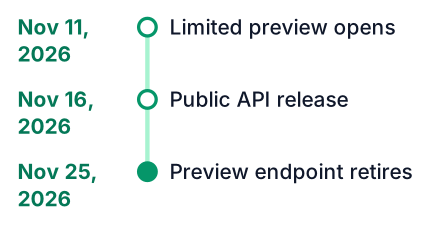
On November 11, Alibaba opened a limited preview of Qwen4 Max. Five days later, on November 16, it released the model publicly. The weights are not on Hugging Face, and Alibaba has not said when any Qwen4 weights will be, Decrypt reports. If you learned to run Qwen on your own laptop, that gap matters to you.
Qwen4 Max is Alibaba's new flagship, released November 16, 2026, and it is available only through an API. It has 2.4 trillion total parameters and a 1 million token context window. Alibaba says it cuts average task cost by about 60% (shattered.io). The open-weight versions will be smaller models, and Alibaba has given no sizes or dates yet.
What Alibaba released on November 16
Qwen4 Max is a mixture-of-experts model, so only a part of its 2.4 trillion parameters runs for each token. A mixture-of-experts model splits its parameters into many smaller groups, called experts, and a small router picks a few of them for each piece of text. The other experts stay idle, which makes each answer cheaper to compute.
For Qwen4 Max, the active part is 71 billion parameters per token, while Qwen 3.8 Max used 95 billion, according to shattered.io. So the new model does less work per token than the one it replaces, even though it is bigger overall.
The model takes images and video as input and answers in text. Reasoning is on by default, and you choose its effort level: low, high or xhigh. It also supports tool calling (the model asks your code to run a function) and structured outputs (answers that follow a JSON shape you define), per the same shattered.io report.
| Date (2026) | What happened |
|---|---|
| November 11 | Limited preview opens |
| November 16 | Public release |
| November 25 | Preview endpoint retires |
If you need a model you can download and run today, the Ripple 65B open-weight coding model is a closer fit.
Qwen4 Max pricing: QwenCloud vs OpenRouter
Alibaba lists Qwen4 Max at $1.50 per million input tokens and $4.50 per million output tokens, and OpenRouter lists it slightly lower, per Decrypt and OpenRouter's model page. Decrypt says the QwenCloud price is a 25% cut from Qwen 3.8 Max.
| Model and route | Input (per 1M tokens) | Output (per 1M tokens) | Cache read (per 1M tokens) | Source |
|---|---|---|---|---|
| Qwen4 Max on QwenCloud | $1.50 | $4.50 | $0.075 | Decrypt |
| Qwen4 Max on OpenRouter | $1.425 | $4.275 | $0.07125 | OpenRouter |
| Qwen 3.8 Max (previous model) | $2 | $6 | Not listed | Decrypt |
A cache read happens when the API reuses text it has already processed, like a long system prompt you send with every request. At these rates, cached input costs one twentieth of fresh input. Put your fixed instructions at the start of each request so they can be reused.
One caution: some early prices came from Bloomberg's reporting, and shattered.io notes that Alibaba had not confirmed them. Check the live price on the provider page before you budget a project. No source gives a rupee price yet, so everything here is in dollars. To see how OpenRouter pricing looked for another recent launch, read Gemini 4 Carbon on OpenRouter.
The 60% task-cost claim, in plain terms
The 60% saving is an Alibaba average over whole tasks, and it is bigger than the 25% price cut because the model uses 35% fewer tokens per task, according to shattered.io and Decrypt. These are Alibaba's own figures, not results from independent tests.
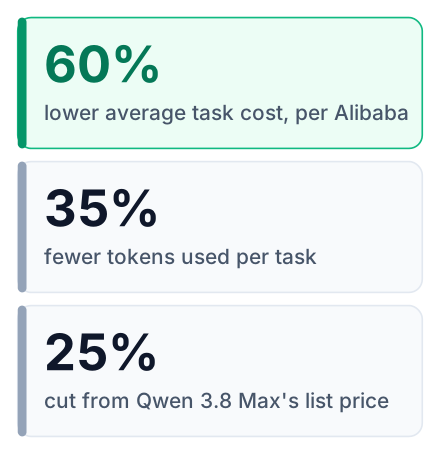
- 60%: lower average cost per task, as claimed by Alibaba (shattered.io)
- 35%: fewer tokens used per task (shattered.io)
- 25%: lower list price than Qwen 3.8 Max (Decrypt)
Here is why two cuts become one bigger cut. Task cost is the price per token multiplied by the number of tokens the task uses. Lower both, and the savings multiply.
Do the math yourself, though, and the numbers do not quite match. A price cut of a quarter plus a token cut of about a third gives a saving of roughly half, not 60%. The gap may come from which tokens were saved: output tokens cost three times as much as input tokens, so shorter answers save more. Alibaba has not published the breakdown, which is a good reason to test on your own tasks.
Alibaba also lists safety upgrades for code security, cyber misuse and CBRN (chemical, biological, radiological and nuclear) risk, per shattered.io. For how OpenAI is handling security with a dedicated model, see GPT-6 Cyber and what it means for students.
Where Qwen4 Max ranks on Arena
Independent Arena results put Qwen4 Max first among Chinese models on agent tasks, but 14th among all models, as Decrypt reports from the Arena leaderboards. Arena ranks models using real user sessions, not the vendor's own tests.
- Agent leaderboard: 5th among AI labs overall (Decrypt)
- Agent leaderboard: a 7.46% net improvement across 14,727 sessions (Decrypt)
- Code Arena: 6th in the world at 1,750 points (Decrypt)
- Code Arena, branding and reference-based design: 8th (Decrypt)
For a student, the Code Arena rank is the useful one. It says the model is strong at coding but not the leader. For coursework and practice projects, a cheaper or open model may do the job just as well.
What closed weights mean for developers who use Qwen
Because the weights are closed, you cannot run, fine-tune or host Qwen4 Max yourself, which breaks the main reason many developers picked Qwen. Fine-tuning means training a model a little more on your own data so it fits your task better.
That open habit is large. Decrypt's coverage cites an August report that counted 151,448 Qwen-derived models on Hugging Face, 4.7 times the number built on Meta's Llama (Decrypt). Every one of those existed because someone could download the weights.
An API-only model also ties you to one host. OpenRouter's page lists Alibaba Cloud International as the only provider, at 46 tokens per second, 2.13 seconds latency and 99.17% uptime. Those are workable numbers for a side project. If that one provider slows down or goes offline, though, there is no second host to switch to.
Say you are building a help-desk chatbot for your college, and the data includes student records. With Qwen4 Max, every record leaves your machine and goes to Alibaba's servers. With an open model, the same data could stay on a server you control.
Pros
- No GPUs to buy or rent; you pay per request
- A very long context window for whole codebases or long documents
- A lower price than the previous Qwen Max
- Reasoning effort you can turn down to save tokens
Cons
- One provider, with no fallback host
- No local or offline use
- No fine-tuning on your own data
- Your prompts and data go to a third party
Smaller open-weight Qwen4 models: what is promised
Alibaba says smaller Qwen 4 models will be open-weight, but it has published no sizes, licences or release dates, according to Decrypt. Here is how that splits:
- Confirmed: a statement of intent that smaller Qwen 4 models will have open weights.
- Unknown: how big they will be and when they will ship.
- Also unknown: the licence, which decides whether you may use a model in a paid product.
Do not plan a project around an open model that does not exist yet. A promise with no date can slip by months. Keep using the current open Qwen models for local work, and treat Qwen4 Max as one more paid API option.
How to try Qwen4 Max today
You can use Qwen4 Max through QwenCloud, Qwen Studio, QwenWork or Qoder, or through OpenRouter if you already use it. The preview endpoint retires on November 25, per shattered.io, so do not build anything on it.
Pick an access route
Choose OpenRouter if you want one bill across many models. Choose QwenCloud if you want Alibaba's own account and console.
Set the reasoning effort
Start at low. Move to high or xhigh only when answers come back wrong, because higher effort spends more tokens.
Run a small test and log the tokens
Read the usage field in the API response. It shows the input and output token counts for that call.
Compare against your current model
Multiply each token count by each model's price. For another price point, see Gemini 4 Hydrogen's price for students.
Your next step: run one real task from your own project through Qwen4 Max and note the input and output tokens. Then compare that cost with the model you use now. After that, bookmark the Qwen page on Hugging Face and check it for news of the smaller open-weight models.


