ChatGPT Wallet Lets AI Agents Pay With Your Card, Not Your Card Number
OpenAI's new ChatGPT Wallet gives Dots agents a payment layer that can buy things for you, without sharing your real card number with merchants. It launched on November 13, 2026, but only for US Pro subscribers. Every purchase still needs your approval via Face ID or a fingerprint.
On November 13, 2026, OpenAI gave its Dots agents a wallet. The wallet can buy things for you, and your real card number never reaches the merchant. Unlike the old attempt, the new design uses a payment token.
ChatGPT Wallet is a payment layer for Dots agents. It launches for US Pro subscribers aged 18 and older with eligible US-issued cards. It lets agents complete real purchases after you approve each one with Face ID or a fingerprint, using a payment token that hides your card details from both the agent and the merchant.
What ChatGPT Wallet does
ChatGPT Wallet is a payment layer that lets Dots agents complete real purchases on your behalf, after you approve each transaction with a security check. It is built with American Express, Mastercard, and Visa, and it is "the first wallet that lets agents pay without access to users' actual card details," per OpenAI's announcement. For more on how AI agents are changing developer workflows, see the forward deployed engineer role guide.
This is OpenAI's second attempt at checkout. The first, Instant Checkout, launched in September 2025 and was shut down in March 2026. The new design sends the agent to the merchant's site carrying a card-shaped credential instead of moving checkout inside ChatGPT, as ppc.land explains.
OpenAI says 1.2 billion people use ChatGPT each week, per the same announcement. Most of them will not be able to use Wallet at launch. Only a small group can.
Who gets ChatGPT Wallet now
At launch, ChatGPT Wallet is available only to US ChatGPT Pro subscribers aged 18 and older with a US-issued Amex, Mastercard, or Visa card. TechCrunch reports the option is initially available to "a limited number" of those subscribers, with a US billing address required, per TechCrunch. If you're wondering what plan fits your needs, see how many ChatGPT prompts per day.
Wallet is a feature of Dots, OpenAI's agent product. Dots launched on September 29, 2026, about six weeks before Wallet. It is not available on any cheaper plan.
| Plan | Dots | ChatGPT Wallet |
|---|---|---|
| Free | No | No |
| Go | No | No |
| Plus | No | No |
| Pro | Yes | Yes (US, 18+) |
The ChatGPT pricing page lists "Dot, your always-on agent" as a Pro feature. If you are in India and reading this, that means neither Dots nor Wallet is available on your current plan.
What ChatGPT Wallet costs
ChatGPT Wallet itself is free to use, but it requires a ChatGPT Pro subscription, which costs $200/month, because Dots is a Pro-only feature. The price depends on the tier, see the ChatGPT pricing page.
No transaction fees are mentioned in any of the sources. OpenAI does not say whether merchants pay a fee, or whether you pay anything beyond the subscription cost. If there is a fee, it is not public yet. For a broader look at AI costs, see GPT-6.1 Terra pricing for students.
For students in India, the $200/month figure is the single barrier. OpenAI does not list a rupee price in any of the pages I opened, so this is a dollar-only feature for now.
The purchase flow: 7 steps from agent to approval
A purchase works like this: add a card once, the dot shops, then you review and approve each purchase with a biometric check, and the payment network issues a token to the merchant. The full flow, per OpenAI's announcement, is:
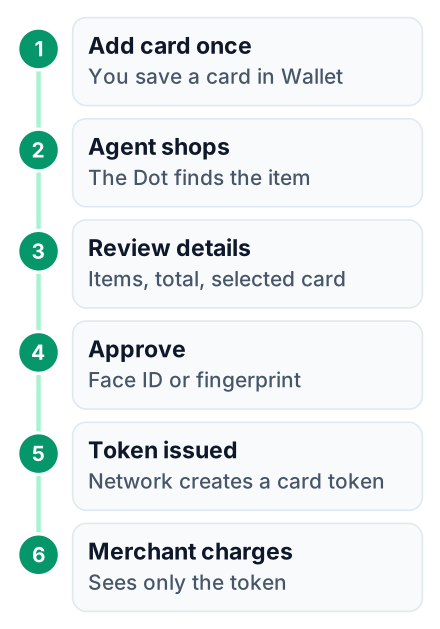
Add a card
You add a card to your Wallet once, in the ChatGPT app.
Send the dot shopping
Your dot browses and picks items based on your request.
Review the purchase
The dot shows you the items, the total, and the selected card.
Approve with a security check
You verify with Face ID or a fingerprint scan.
Network issues a token
The payment network provides a payment token: a card number, security code, and expiration date.
Charge goes to your card
The payment is charged to the selected card.
Details stay hidden
The merchant sees the token, not your actual card number.
How your card stays hidden
Your card number is never shown to the agent or the merchant because the payment network replaces it with a one-time payment token after you approve the purchase. The token carries the payment details the merchant needs, but your real card number, security code, and expiration date are never shared with the business or the agent, per ppc.land. This tokenization pattern is similar to what you'll see in modern API design, as covered in connecting a React frontend to an API.
Two protections survive the token system. Your card rewards still count, and you can still dispute transactions, because the charge appears on your normal card statement. OpenAI's announcement says the wallet "preserves existing card rewards and protections for eligible disputes." TechCrunch confirms both points in its report.
Every approval creates a record, so you have a log of what the dot bought and when. That matters because a misbehaving agent could otherwise spend silently using your stored card.
Full delegation is the next step
OpenAI plans to let you delegate purchases entirely by setting spending limits, purchase categories, and time periods for pre-approval. That roadmap is in the same announcement: "users will be able to delegate purchases entirely to their agent by setting spending limits, purchase categories or time periods, with pre-approval." To see how AI agents are being shaped today, check Claude Duet: Anthropic's proactive agent guide.
That is the shift to watch. Right now every purchase needs your biometric approval. Soon a dot might buy groceries under $50 on weekdays without asking. The wallet becomes a permission system, not a payment tool.
Why students should care even if they can't use it
Agentic payments are how the next wave of agent apps will complete real-world purchases, so understanding ChatGPT Wallet now prepares you to build them later. The pattern OpenAI has shipped is the reference architecture: approve first, tokenize second, delegate third. For a related build-it-yourself guide, see how to build an AI agent in Python step by step.
The market is moving in this direction already. Meta's Muse has over 10 million users and AI-assisted shopping is its top activity, per TechCrunch. Amazon, meanwhile, is the largest retailer to ban AI agents outright, the same report notes. Some stores welcome agent traffic; others block it. For more on competing agent products, see Meta Muse Wonder: what's new.
Pros
- Payment tokens are a real, current security pattern to learn.
- Wallet was built with Visa, Mastercard and Amex, so the model is industry-backed.
- The approval flow is a good UX case study for consent-heavy features.
Cons
- Pro-only pricing puts hands-on testing out of reach for most students.
- US-only launch excludes India and most of the world.
- It is a new product; the full delegation roadmap may change.
OpenAI also published a Commerce Partner Playbook for businesses covering product info, agent access, payments and risk, plugins, and WebMCP tools, per ppc.land and the announcement. That document is free and describes how merchants and agents are expected to interact. If you're exploring how AI systems integrate with real-world tools, see Claude Gmail connector setup.
If you're in the US on Pro, add a card to Wallet today and approve one small purchase to see the flow. If you're not, open the Commerce Partner Playbook and study the token model it describes, because the next agent app you build will likely need the same pattern. For more on building with AI, see Gemini 4 Argon for building projects.


