Ripple-65B: The Free 65B Coding Model Topping Terminal-Bench
Ricursive's Ripple-65B Preview is a free, open-weight coding model scoring 80.5 on Terminal-Bench 2.1. We break down what that benchmark means, the Apache 2.0 license, and how to run it locally.
As of 5 November 2026, Ricursive's Ripple page lists a 65-billion-parameter model at 80.5 on Terminal-Bench 2.1. The same page lists a 975-billion-parameter rival at 63.8. The smaller model is free to download. The 80.5 also comes from the people who built it. Is that a result you can trust, or a launch-day claim?
Ripple-65B Preview is a free, Apache 2.0 coding model you can download and run yourself. Ricursive Intelligence released it on 4 November 2026. Its 80.5 Terminal-Bench 2.1 score beats much larger open models, but the company measured it, and nobody has independently repeated it yet. For a student, it is a way to practise agentic coding without paying per token.
Ripple-65B Preview launched on 4 November 2026
Ricursive Intelligence released Ripple-65B Preview, a 65B dense Transformer pretrained from scratch on 12T tokens, and it is the general-purpose version of the model behind its chip-design platform.
The "B" in the name means billions of parameters, the numbers a model adjusts while it learns. "Dense" means the whole model works on every token. Some other designs switch on only part of the model at a time.
Per the model card, the context window runs up to 1M tokens. A context window is how much text the model can read at once, so a large codebase can fit in one request. The card offers two checkpoints: BF16, the larger higher-precision version, and NVFP4, a compressed version that needs much less memory. Both ship under the Apache 2.0 license.
Two terms come up in every story about this model. An open-weight model is one whose trained weights you can download and run on your own hardware. Agentic coding means an AI that plans and carries out steps on its own, such as editing files and running commands, instead of only suggesting code.
Ricursive is a Palo Alto startup co-founded by Anna Goldie and Azalia Mirhoseini, the creators of AlphaChip, an AI method for chip design. If you read our post on Mistral Large 4's open weights, the download-and-run idea here is the same.
The 80.5 Terminal-Bench score comes from Ricursive's own run
According to the company, Ripple-65B scores 80.5 on Terminal-Bench 2.1, the highest among U.S. open-weight models, but that number is the company's own run at BF16 and independent replication is still pending.
Terminal-Bench measures how well an AI agent finishes tasks inside a command-line terminal, the text window where you type commands. That makes it a direct test of agentic coding. Here are the five scores Ricursive published. The rival models' scores were also reported by Ricursive:
| Model | Size (parameters) | Terminal-Bench 2.1 |
|---|---|---|
| Ripple-65B Preview | 65B | 80.5 |
| Reflection Beam | 501B | 80.1 |
| Meta Muse Spark Open | 816B | 76.4 |
| Thinking Machines Inkling | 975B | 63.8 |
| NVIDIA Nemotron 3 Ultra | 550B | 56.4 |
Two things stand out. On those figures, only 0.4 points separate the top two models. Size also does not predict score in this table, because the largest model sits near the bottom.
Apache 2.0 lets you fine-tune it and keep what you build
Apache 2.0 is a permissive license, so you may modify the model, fine-tune it on your own data and use it in your own projects, with no usage fees.
Fine-tuning means training the model a little further on your own examples, so it picks up your style or your subject. The result is yours to keep, share or use at work. The main conditions are to keep the license and copyright notices and to state what you changed.
Ricursive also claims it spent $32M on training from scratch, about one-tenth the estimated cost of the previous open-weight leader. Treat that as a company claim, not an audited number.
Before you ship anything built on it, read the license text on the model card. Preview releases sometimes carry extra notes, and the card is where they would appear.
What to check before you try to run Ripple-65B on your own machine
Download the NVFP4 checkpoint from Hugging Face, which is the smaller 4-bit-style version, and run it on a local NVIDIA machine such as a DGX Spark, or on a rented GPU if you do not own one.
Ricursive says the model runs efficiently on local NVIDIA hardware. I would not assume it fits your gaming card, though. Check the memory needs before you spend money or a whole weekend.
Pick the NVFP4 checkpoint
It is the compressed version. The BF16 version needs far more memory (model card).
Check the memory notes
Read the hardware section of the model card for the memory needed by NVFP4 and by BF16, and compare it with the memory on your GPU. Ricursive's page gives no memory figure that this post could confirm, so read the number on the card before you download.
Download the weights
Use the command below. The files are large, so use a stable connection.
Start a local server
Load the model in an inference server, a program that loads the model and answers requests from other programs. Use the server and launch command the model card recommends, copied exactly as written there, because this post does not give a tested command.
Point a coding agent at it
Most coding agents and OpenAI-compatible clients have a base URL setting. Set it to the address your server prints, for example http://localhost:8000/v1 (the port depends on your server), instead of a paid API.
pip install -U huggingface_hub
huggingface-cli download ricursiveai/Ripple-65B-Preview --local-dir ./ripple-65b
# If the NVFP4 files sit in a separate folder, add --include with the
# folder name shown on the model card.
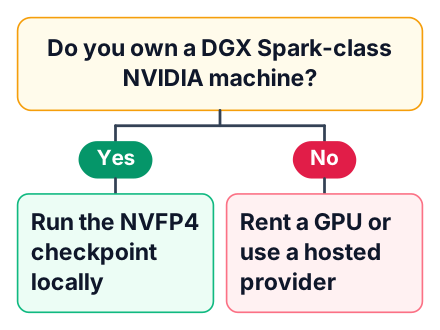
Not sure which route fits you? Use this:
| Do you own a DGX Spark-class machine? | What to do |
|---|---|
| Yes | Run the NVFP4 checkpoint locally. |
| No | Most laptops and gaming cards cannot run a 65B model. Use a hosted provider first. Rent a GPU only after you confirm on the model card that its memory is enough. |
What it costs: $0 to download, per-token fees if you use an API
Downloading costs nothing, and if your hardware is too small, hosted providers serve the model per token.
Ricursive names the providers serving it: Hugging Face, Together AI, GMI Cloud and OpenRouter, with Fireworks going live later on launch day. No provider price was verified for this post, and prices change. Check each provider's page for its per-million-token rate before you build on one.
Per-token pricing means you pay for the text going in and coming out, usually quoted per million tokens. A token is a small piece of text, often part of a word. A long agent run that reads many files uses far more tokens than one question. Token cost is also why models like Particle-1 compete on using fewer of them.
Renting a GPU is the third route. You pay by the hour instead of by the token, and the price varies by provider. It suits long experiments where per-token bills would add up.
Build agentic-coding projects without API bills
A free model lets you run agent loops that would be expensive on a paid API, such as a terminal agent that fixes failing tests, and your skills carry over if a subscription lapses.
For a student, the bigger change is access. You get a coding model you can download, fine-tune and build on without paying OpenAI or Anthropic for every token. Agents need this most, because one task calls the model over and over. We covered how agents are changing everyday developer work in our Octoverse 2026 post.
A test-fixing agent. Say you want an agent that runs your test suite, reads the failures, edits the code and runs the tests again. On a paid API, every retry costs money. On your own machine, you can let it loop overnight.
Cleaning up a repo with an agent. Say you want to tidy an old college or bootcamp project by removing dead files and fixing lint warnings. Have the agent make each change as a separate commit, then review them one by one.
Fine-tuning it on your own style. Say you want suggestions that match how you name things. Gather a few of your best projects, fine-tune on them, then compare the output with the base model.
Pros
- Free to download and run
- Private: your code stays on your machine
- Tunable on your own data
- No subscription that can lapse
Cons
- Needs a GPU with plenty of memory
- A preview release, so expect rough edges
- Setup takes time
- Score caveat: see the benchmark section (Runtimewire)
Should you drop your paid coding assistant for Ripple-65B?
No, keep what you use now and add Ripple-65B for practice, then run the same three tasks on both and compare the results yourself.
Your own test matters more than any leaderboard, because it uses your code. Pick three tasks from a real project, such as a failing test or a bug you already fixed. Give each tool the same prompt. Note which one finishes without your help, and how many tries it took.
A model this small leading much larger ones on an agentic test is remarkable. It is still one test, though. Watch for outside Terminal-Bench runs; Runtimewire's launch report is a good place to follow whether anyone repeats the result.
Open the Ripple-65B Preview page on Hugging Face today and read the license and the memory notes. Then pick one task from your own project and run it on Ripple-65B and on your current assistant to see which one finishes it.