These Skills Move AI Engineer Salary From ₹5 LPA to ₹50 LPA
Deep learning, NLP and cloud deployment raise an AI engineer's pay in India, from a ₹5 LPA start to a ₹20-50 LPA senior band. This matrix shows which skill to learn next for your salary.
Search for AI engineer salaries in India and you will see one job title with two very different numbers. GUVI's 2026 salary guide puts freshers at about ₹5 LPA and experienced engineers at up to ₹50 LPA. That is a 10x gap under the same title. Experience explains most of it, along with company and city. Skills are what employers ask for at each level.
Pay depends mostly on experience, and deep learning, NLP and cloud deployment are the skills employers ask for at each level in India. The average AI engineer earns about ₹12 LPA, and experienced engineers sit in a ₹20-50 LPA band, according to GUVI. The brackets below are pay by experience level, and pairing each skill with a bracket is my own opinion, not something the sources prove. City, company and how well you interview change the number too. The matrix near the end puts them side by side.
Python and ML basics set the ₹5 LPA starting point
Python plus core machine learning gets you hired at entry level, but it does not lift you above the starting bracket on its own. Scaler's 2026 salary report gives the starting salary of an AI engineer with 0-2 years of experience as ₹4-10 LPA, with an average near ₹7 LPA.
Machine learning jobs for freshers follow a similar pattern. GUVI lists the ML engineer average at ₹9.85 LPA, inside a range of ₹3.5-30+ LPA. That range is wide because it mixes people with only the basics and people who added the skills in the next sections.
By "ML basics" I mean the work you do with scikit-learn and pandas. You clean a dataset and split it into training and test parts. You train a regression or classification model, then measure how well it does on data it has not seen.
Every applicant in a campus placement queue now has this on their resume. Employers treat it as the entry requirement, and they do not pay extra for that. Skip it and you do not get hired at all. Stop there and you stay in the bottom bracket for years.
If you want the order to learn these skills in, read my 10-week roadmap for AI engineer freshers. This post is about pay, not learning order. It shows which skill is worth adding for a bigger salary.
Deep learning moves you toward the ₹12 LPA average
The average AI engineer earns about ₹12 LPA in GUVI's salary data. Freshers start lower. Deep learning is one skill employers ask for, and in my view building neural networks is how many people close that gap. GUVI also names deep learning among the top skills employers ask for.
Deep learning means training a model made of many layers of simple maths units, called a neural network. These models learn patterns from raw data like images or text. Classic ML usually needs you to pick out those patterns by hand first.
Say two candidates apply for the same role. The first one has a scikit-learn notebook that predicts house prices. The second trained a small image classifier in PyTorch. She can show the training curve and explain why accuracy stopped improving. She can also say what she changed to fix it.
The interviewer can ask the second candidate real questions, and she can answer them. In my experience, that conversation is what gets the higher offer. A certificate in deep learning does not create it. One trained model does.
Your one deep learning project should let someone see these things:
- The dataset you used and why you picked it.
- The model you built, with a short note on its layers.
- A training curve showing loss going down over time.
- One problem you hit, like overfitting, and what you tried.
- A results table on test data the model never saw.
The official PyTorch tutorials on the PyTorch website are a good free place to build this. Start with their image classification tutorial, then change the dataset to one you care about.
NLP and computer vision open specialist roles
Picking one specialty, text (NLP) or images (computer vision), gives you a narrower job title that employers pay more for than a general one. Both appear on GUVI's list of top AI engineer skills.
NLP (natural language processing) is teaching computers to read and write human language, like a chatbot or a spam filter. Computer vision is teaching computers to understand images and video, like reading number plates or spotting defects on a factory line.
A company hiring an "NLP engineer" is not comparing you with every Python developer. It is comparing you with the few people who have built text models. In my view, a smaller pool of matching candidates tends to push the offer up, though the sources give no figure for this.
Should you specialise early? Here is the honest trade-off.
Pros
- Your resume tells one clear story, which recruiters read faster.
- Fewer applicants have projects that match a specialist job post.
- Your second and third projects build on the first, so you go deeper.
Cons
- There are fewer specialist openings than general ones.
- Large service companies often hire for general roles first.
- If your specialty cools down, you rebuild part of your portfolio.
My view: specialise once you have one deep learning project done, not before. Pick NLP or computer vision, not both. Choose by the projects you would enjoy building on a weekend, because you will build several.
Cloud deployment turns a model into a product
Employers pay for models that run for real users, so knowing how to deploy on a cloud platform is what pushes pay into the experienced bracket. GUVI lists cloud tools and AI deployment as core skills for AI engineers.
Say your model works well inside a Google Colab notebook. Your manager asks you to put it behind the company's website by Friday. The notebook cannot do that. Someone has to turn it into a service that answers requests all day, and that person earns more.
Deployment usually follows four steps:
Train
Save the trained model as a file, outside the notebook, using a script you can run again at any time.
Package
Wrap the model in a small API and put it in a container. The getting-started guide on the Docker documentation site shows how.
Deploy
Run the container on AWS, Azure or Google Cloud, so it answers requests from a public URL.
Monitor
Log each prediction and watch for errors or slow replies. Retrain when accuracy drops on new data.
Many of these skills overlap with DevOps work. If the packaging and monitoring steps interest you more than the model itself, my post on the DevOps fresher career path in India covers that route.
The skills-to-pay matrix: from ₹5 LPA to ₹12 LPA to ₹50 LPA
This table pairs each skill with the pay bracket reported for the experience level where employers usually ask for it, so you can see which skill to add next. The figures come from Scaler and GUVI, linked in each row.
| Skill | What you can do with it | Typical level | Pay bracket |
|---|---|---|---|
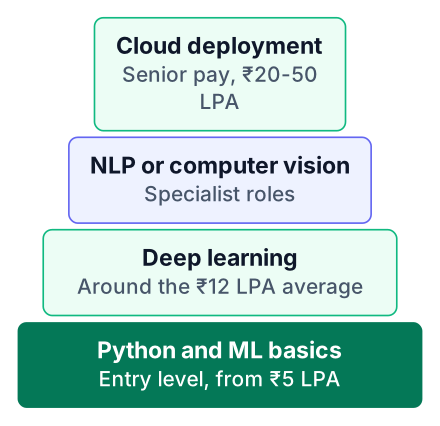
| Python and ML basics | Clean data and train classic models in scikit-learn | Entry (0-2 years) | ₹4-10 LPA (Scaler) |
| Deep learning | Build and train neural networks in PyTorch or TensorFlow | Average AI engineer | Around ₹12 LPA (GUVI) |
| NLP or computer vision | Build text or image models for one problem area | Specialist | My opinion: above the average. No single figure in the sources (GUVI) |
| Cloud deployment | Ship and monitor models on AWS, Azure or Google Cloud | Experienced / senior | ₹20-50 LPA is GUVI's pay for experienced engineers, not proven to come from this skill (GUVI) |
Read these brackets as ranges reported by salary sites, not promises. Your city, your company and how well you interview all change the number.
Sources also disagree on the middle. Analytics Vidhya puts India's average at ₹8 LPA and the US average at $114,121, lower in India than GUVI's figure. Use the matrix for the direction of the jumps, not as an exact price list.
Why the AI market keeps raising pay for these skills
Demand is growing quickly, so employers compete for people who have more than the basics. Scaler reports that India's AI market was USD 9.51 billion in 2024 and is projected to reach USD 130.6 billion by 2032, a growth rate of about 39% a year.
This matters for your salary in a specific way. Basic Python and ML are becoming common, so their pay stays flat. Skills fewer people have, like deploying a model that real users depend on, stay scarce for longer. Scarce skills are where the raises are.
If you are worried that AI tools will shrink developer jobs overall, I wrote about that separately in Is software engineering dead for Indian freshers?
Which skill should you learn first for your next raise?
Learn the skill one bracket above where you are now, not the most advanced one on the list. Jumping straight to cloud deployment with no trained model of your own leaves you with nothing to deploy.
Here is my pick by situation:
- Fresher with only Python: learn deep learning next. Build one trained model project before you apply for AI roles.
- One to two years of experience: pick NLP or computer vision. Build two projects in that area so your resume points one way.
- Mid-level, aiming for senior pay: learn cloud deployment. Take a model you already built and run it on AWS, Azure or Google Cloud with monitoring.
Freshers often ask which titles to search for at the start. Win in Life Academy's list of AI jobs for freshers in India covers the entry roles and what each one asks for. If you are still in school or just finished Class 12, start with my guide on becoming an AI/ML engineer after 12th.
Pick the one skill from the matrix that sits one bracket above your current level. This week, build one small project with it, for example train a PyTorch image classifier on a small dataset, save the loss curve, and push it to GitHub with a README. Then read the 10-week roadmap post to plan the learning order.


