Can a Fresher Become a DevOps Engineer? 2026 Salary & Roles
Yes, a fresher can become a DevOps engineer in 2026, but the job title splits into two tracks. Learn the fresher salary bands, the skills you need, and how to reach ₹16 LPA within three years.
Most salary articles quote a single average for a DevOps engineer in India, and that average describes nobody. Yes, a fresher can become a DevOps engineer in 2026, but the job title covers two separate tracks: CI/CD automation and Platform/SRE. One track (CI/CD) is about automatic build-and-deploy pipelines; the other (Platform/SRE) is about keeping large systems running reliably. Fresher pay runs roughly ₹4–9 LPA depending on the track and employer type, and the realistic climb to ₹16 LPA takes about three years of focused skill-building.
One number cannot capture a role that ranges from a ₹4 LPA fresher role in a services company to a ₹38 LPA platform engineer at a Global Capability Center (GCC). The real market splits into two tracks with different pay scales, and freshers who know which track they are entering negotiate from a stronger position. The split is roughly ₹4–6.5 LPA for CI/CD roles and ₹5.5–9 LPA for Platform/SRE roles, as detailed later.
The two tracks: CI/CD automation vs Platform/SRE
The DevOps role splits into CI/CD automation and Platform/SRE, and these two tracks pay very differently at every level. The median DevOps salary in India is ₹9.8 LPA, according to AmbitionBox data compiled by CareerSkillGuide from 29,400 reports between January and April 2026. That median looks clean, but the 25th percentile sits at ₹6.2 LPA while the 90th percentile reaches ₹28.5 LPA.
A fresher reading that median might expect to earn ₹9.8 LPA on day one. A senior engineer might expect the same number. Both would be wrong for their situation. The spread between percentiles is so wide that the average describes no single person's career.
The two tracks: CI/CD automation vs Platform/SRE
CI/CD automation focuses on build pipelines and scripting, while Platform/SRE focuses on production Kubernetes, infrastructure as code, and reliability. According to CareerSkillGuide, the CI/CD track peaks at ₹12–16 LPA at 4–6 years of experience, while the Platform/SRE track reaches ₹20–40 LPA in the same timeframe. The wide percentile spread—from ₹6.2 LPA at the 25th percentile to ₹28.5 LPA at the 90th—explains why a single average misleads.
| Dimension | CI/CD Automation | Platform/SRE |
|---|---|---|
| Core focus | Build pipelines, scripting, deployment | Production Kubernetes, reliability, infrastructure as code |
| Key tools | Jenkins, GitLab CI, Docker, Bash | Kubernetes, Terraform, Helm, ArgoCD and observability tools |
| Salary at 4–6 years | ₹12–16 LPA | ₹20–40 LPA |
| Entry difficulty | Lower | Higher |
The CI/CD track is the natural starting point for most freshers. The Platform/SRE track demands deeper production experience, which is why its ceiling sits so much higher.
Fresher salary bands in India: what to expect by track
Fresher CI/CD roles pay ₹4–6.5 LPA, while fresher Platform/SRE roles pay ₹5.5–9 LPA, with product companies on the higher end per CareerSkillGuide's fresher band data. The difference comes down to what you can prove you know before you join.
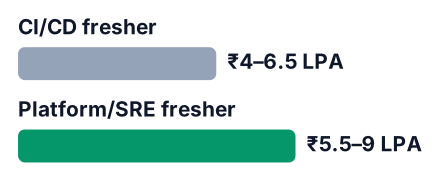
A fresher walking in with only Linux and Git basics lands at the bottom of the CI/CD band. A fresher who can show production-grade Docker and Kubernetes work in a project portfolio can argue for the Platform band, especially at a product company. The alternate salary analysis from SwitchToDevOps confirms the pattern: freshers in services companies earn ₹3.5–6 LPA, while product companies pay ₹5–8 LPA.
How salary grows from ₹5 LPA to ₹16 LPA in your first years
Adding production Kubernetes, Terraform, and observability skills lifts you from a junior CI/CD salary to the ₹15–24 LPA band within 3–5 years, according to CareerSkillGuide's tool-stack premium analysis. The journey from ₹5 LPA to ₹16 LPA is not about years of service. It is about which tools you add to your stack.
Year 1: CI/CD fundamentals
Linux, Git, Bash scripting, Docker, one CI tool. Fresher band: ₹4–6.5 LPA.
Year 2: Add cloud and Kubernetes basics
AWS or GCP fundamentals plus Docker and Kubernetes basics push you to ₹10–16 LPA at 3–5 years, a 30–40% premium, per CareerSkillGuide's tool-stack premium analysis.
Year 3: Production Kubernetes and IaC
Helm, ArgoCD, and Terraform depth moves you to ₹15–24 LPA, a 65–85% premium over the base, per CareerSkillGuide's tool-stack premium analysis.
CareerSkillGuide's tool-stack premium table shows the pattern clearly. Terraform, Ansible and deep AWS knowledge command a 70–90% premium at ₹16–26 LPA. A full SRE stack earns 110–140% more at ₹22–38 LPA. Multi-cloud and platform leadership skills push past that to ₹30–45 LPA.
What recruiters actually want from a fresher DevOps hire
Recruiters hire freshers who know Linux, Git, one scripting language, Docker, and one CI/CD tool, and who can show a project that uses them. The DevOps roadmap lists Python or JavaScript, AWS, Ansible, Terraform, Docker, Kubernetes, Jenkins, and Git as the core skill set. The job description guide adds networking basics and scripting in Python or Bash to the list.
Soft skills matter more than freshers expect. The roadmap explicitly names communication, collaboration, and problem-solving as part of the role. Picture a deployment that fails at 2am: the fresher who can explain to an on-call developer exactly which pipeline stage broke, and why, fixes it faster than the one who only knows which buttons to click.
Certifications like the AWS DevOps Engineer credential appear as nice-to-haves, not requirements, in the job description guide. A project that demonstrates the skills beats a certificate that only proves you passed an exam.
Build the CI/CD project that gets you the first interview
Build a simple app with a CI/CD pipeline using GitHub Actions or Jenkins, deploy it with Docker, and write a README that explains your choices. This project plan follows the skill priorities in the DevOps roadmap and gives you something concrete to discuss in interviews.
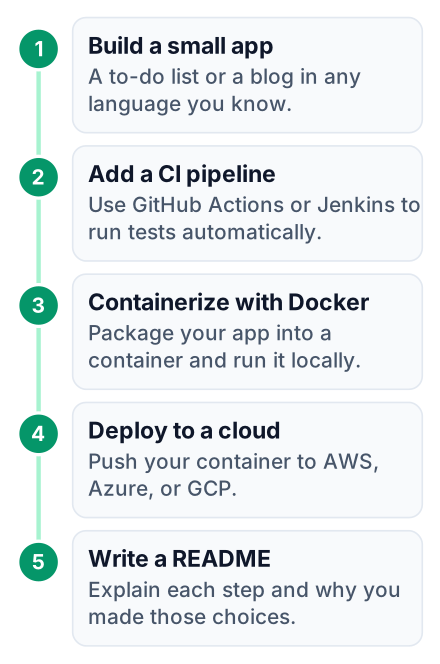
Pick a small app
A simple CRUD application with a public API. Nothing complex needed.
Containerize it
Write a Dockerfile, build the image, and run it locally to confirm it works.
Set up the pipeline
Use GitHub Actions or Jenkins to run tests and build the Docker image on every push.
Deploy it
Push the image to a container registry and deploy it to the AWS free tier (t2.micro is free for 12 months).
Document everything
Write a README that explains each choice: why Docker, why that CI tool, how the deployment works.
This single project touches Linux, Git, scripting, Docker, a CI tool, and cloud deployment. Those are exactly the skills the job description guide lists for fresher roles.
What salary figures differ across companies and cities
GCCs and product companies pay far more than Tier-1 IT services firms, and Bengaluru salaries run 14% above the national mean per CareerSkillGuide's company and city analysis. At 3–5 years of experience, a CI/CD engineer at a Tier-1 services firm earns ₹8–14 LPA, while the same role at a GCC pays ₹16–26 LPA.
| Company type | CI/CD track (3–5 yrs) | Platform track (3–5 yrs) |
|---|---|---|
| Tier-1 IT services | ₹8–14 LPA | ₹11–18 LPA |
| GCC (JPMorgan, Goldman, Walmart Global Tech) | ₹16–26 LPA | ₹22–38 LPA |
| FAANG | ₹24–40 LPA | ₹32–65 LPA |
City effects are smaller but real. CareerSkillGuide reports Bengaluru at 14% above the national mean, Hyderabad at 12%, Delhi NCR at 8%, Mumbai at 7%, and Pune at 4%. Chennai sits at the national average.
GCCs like JPMorgan, Goldman, and Walmart Global Tech hire across major cities and dominate the mid-senior market. If you are starting a fresher role at a services company, the GCC jump in year 3 or 4 is the fastest salary lever available. If you are exploring this career before college ends, the DevOps-after-12th guide covers the educational path in detail.
Common fresher mistakes that cap your salary growth
Learning tools without understanding the fundamentals, skipping scripting and ignoring production concerns keep freshers stuck at the lower band. The SwitchToDevOps analysis shows mid-level salaries at ₹12–20 LPA on the services side and ₹15–28 LPA at product companies, but freshers who plateau do not reach those bands.
- Tool-hopping without depth: Installing Kubernetes once does not make you a platform engineer. Production experience does.
- Skipping scripting: Bash and Python are the glue of every pipeline. Recruiters check for them explicitly.
- Ignoring production concerns: Monitoring, logging, and rollback strategies matter. A pipeline that only works on your laptop proves nothing.
- Applying without a portfolio: A public GitHub repo with a working CI/CD pipeline gives recruiters something to evaluate.
Freshers should broaden their applications beyond services companies to include GCCs and product firms where the salary bands run higher at every level.
Your first 90-day plan to enter the DevOps field
Spend 90 days on Linux, Git, Docker, and one CI/CD project, then apply to roles across services firms, GCCs, and product companies. This timeline follows the roadmap's skill order and gets you to job applications with a portfolio, not just a resume.
Days 1–20: Linux and Git
Work through terminal basics, file permissions, process management, and Git branching. Practice daily.
Days 21–40: Bash and Docker
Write scripts that automate simple tasks. Containerize a small app and run it locally.
Days 41–60: CI/CD and cloud
Set up GitHub Actions for the container project. Deploy it to a free cloud tier.
Days 61–75: Portfolio polish
Write the README, clean up the repo, and prepare a 5-minute walkthrough of the pipeline.
Days 76–90: Apply everywhere
Send applications to services firms, GCCs, and product companies. Tailor each resume to the job description.
Related guides on resume skills for freshers and developer skill paths round out your preparation.
The broader Indian salary picture in 2026, covered in our average salary guide, shows DevOps sitting comfortably above most entry-level tech roles. The SDE ladder comparison shows a similar climb structure, though DevOps offers a faster path to senior pay for freshers who pick the platform track early.
Pick one track, follow the 90-day plan, and by the end of this week start your first Docker container. That first step is the one that separates you from the freshers who keep reading articles.


