Why ChatGPT Is Bad at Math: 3 Prompts That Catch Its Mistakes
ChatGPT predicts the next word; it does not calculate. A wrong answer can look exactly like a right one. Here are the three prompts that catch its errors, with a JEE probability example to show how each one works.
Say you paste a JEE-style probability problem into ChatGPT and it replies with a tidy, confident working that ends in the wrong number. Nothing in the answer looks wrong, so you copy it into your notebook. Here is why that happens, and the three prompts that catch it.
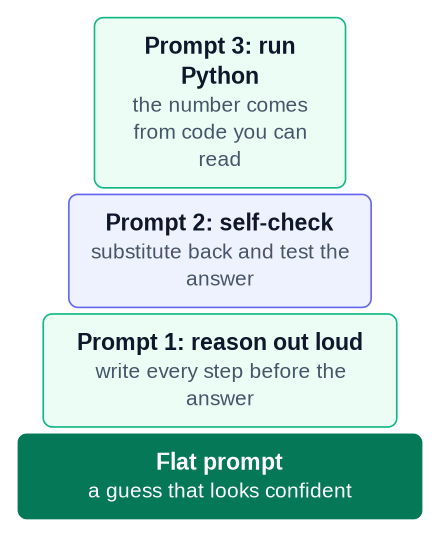
ChatGPT is bad at math because it predicts the next word; it does not calculate. It copies the shape of solutions it saw in training, so a wrong answer can look exactly like a right one. Three prompts catch some of this: ask it to reason step by step, make it check its own work, and make it run Python for the arithmetic.
ChatGPT predicts words, it does not calculate
A language model picks the most likely next word. Think of your phone keyboard suggesting the next word in a message. ChatGPT does the same thing at a much larger scale, one small piece of text at a time.
Calculators work in a different way. They follow fixed rules for adding and multiplying, so the same input always gives the same output. ChatGPT has no such rule inside the chat itself. It has seen millions of solved problems, and it writes what a solution usually looks like.
That is why DigitBin's guide for students warns that ChatGPT can make arithmetic errors on complex calculations and occasionally produces confident-sounding wrong answers. The confidence comes from the writing style, not from any checking. If you want to compare which tools handle this better, I tested several in my list of free and paid AI study tools.
Copied reasoning breaks when the question changes
Apple's researchers found that adding one clause that looks relevant but does not matter can drop accuracy by up to 65% across top models. Their GSM-Symbolic study concludes that these models cannot perform genuine logical reasoning. Instead, they replicate reasoning steps from their training data.
This matters a lot for JEE. Paper setters love to take a standard problem and twist one condition. They add a detail that changes nothing, or they change one word like "with replacement" to "without replacement". A student who understands the idea notices. A model that matches patterns often solves the problem it has seen before, not the one in front of it.
Even the best models still slip on basic questions
Google DeepMind launched Humanity's First Exam on Nov 24, 2026, because models can solve hard problems yet miss simple ones when asked repeatedly.
What fixes this is a checker, not confidence. Scientific American reported a Claude-assisted proof that was trusted only after it was verified mechanically in Lean. Your JEE practice needs the same habit.
Paste the problem flat and see the wrong answer
The baseline test: give one JEE-style problem with no extra instructions and record the confident wrong final number. I picked a Class 12 conditional probability problem because it contains exactly the kind of trap that pattern-matching misses.
Here is the flat prompt, followed by an example of the kind of reply that goes wrong. I wrote this reply to show the pattern, and newer ChatGPT versions may reason or run code and get it right, so if yours does, add an irrelevant clause or change "without replacement" and try again:
PROMPT:
A bag has 4 red balls and 6 blue balls. Two balls are drawn
one after another without replacement. Given that the second
ball is red, find the probability that the first ball was red.
EXAMPLE OF THE KIND OF WRONG REPLY (WRITTEN BY ME):
The probability that the first ball is red is 4/10 = 2/5.
The second draw happens after the first, so it cannot change
what the first ball was. Therefore the answer is 2/5.
The reply reads like a clean solution. It is wrong, because knowing the second ball is red does tell you something about the first draw.
Worked by hand, it goes like this. Fix the second ball as one of the red balls. The first ball then came from the other nine balls, and only three of those are red. That gives three out of nine, which is one third, not two fifths.
Prompt 1: Make it reason out loud
Asking for each step before the answer forces the model to write intermediate results it can build on, which the chain-of-thought paper by Wei and colleagues (2022) shows improves arithmetic and symbolic tasks. The paper used a few worked examples with written steps, and it found that this made models do much better on math word problems. Prompt 1 is a simpler version of that idea, because it asks for the steps but gives no examples.
Copy this prompt and paste your problem below it:
Before solving, name the concept from the JEE syllabus that
applies to this problem and explain why it applies.
Then solve it in numbered steps. Write every intermediate
value. Do not skip any step.
Give the final answer only in the last line, labelled FINAL.
Problem: [paste here]
The prompt has three parts, and each one does a job:
Name the concept
The model must say "conditional probability" or "Bayes' theorem" (a rule for updating a probability once you learn new information) before it starts, which may help pull it away from the simple "first draw only" pattern.
Number every step
Each value is written down, so you can spot the exact line where it goes wrong.
Answer last
The final number comes after the working, so it is built on the steps instead of guessed first.
On our ball problem, a reply following this prompt should name conditional probability, though I have not pasted a real transcript here, so run it yourself and compare. It then works out the chance that both balls are red, divides by the chance that the second ball is red, and lands on one third. Step-by-step working still has a limit, though. If one middle value is wrong, every step after it carries the error forward, and the reply looks just as neat.
Prompt 2: Force a self-check
Making the model list three ways its answer could be wrong, then test each one, may catch slips that step-by-step working leaves behind, though I have not tested this on a large set of problems. This adapts an idea from DigitBin's student prompts: "Find any errors in my method and explain what went wrong." Here you point that request at the model's own method.
Now check your solution. Do not repeat it.
1. List three specific ways your answer could be wrong.
2. Test each one. Check a simple extreme case, and check by substitution
   (for example, change one quantity to its smallest
   possible value and see if your answer still makes sense).
3. Substitute your final answer back into the problem.
4. If any test fails, fix the solution and give a new FINAL.
Run this after the flat reply, and the extreme-case test is where it bites. Suppose the bag had only one red ball. If the second ball is red, the first cannot be red, so the answer must be zero. The flat method still gives a non-zero answer, which exposes it. The fixed method gives zero, which passes.
One warning: the model can still agree with its own mistake. It may "check" its answer by repeating the same wrong logic. That is why the prompt says "Do not repeat it" and asks for an extreme case, and why the next prompt exists.
Prompt 3: Make it run Python for the arithmetic
When the model runs code, the number comes from a computer, so you can read the code and check it yourself. Use this prompt:
Write Python code that solves this problem. Use the fractions
module or sympy so the answer is exact, not a decimal.
If possible, count every outcome directly instead of using
a formula. Run the code, then show me both the code and the
printed output.
Problem: [paste here]
For the ball problem, good code lists every possible ordered pair of draws and counts them:
from fractions import Fraction
from itertools import permutations
balls = ['R'] * 4 + ['B'] * 6
pairs = list(permutations(range(10), 2))
second_red = [p for p in pairs if balls[p[1]] == 'R']
both_red = [p for p in second_red if balls[p[0]] == 'R']
print(Fraction(len(both_red), len(second_red)))
# Output: 1/3
Counting every case removes the formula from the picture, so there is nothing for the model to misremember. Counting only works while the outcomes are few enough to list, so it stops being practical for large problems or continuous probability. The code can also be wrong, and a wrong program prints a wrong exact answer, so test it on a smaller version of the problem first. If your version of ChatGPT cannot run code, copy the code into any Python editor on your laptop or an online one, and run it yourself.
| Run | What you ask | What you get | How you check it |
|---|---|---|---|
| Flat prompt | Just the problem | A neat answer that may be wrong | Only by solving it yourself |
| Prompt 1 | Concept, numbered steps, answer last | Visible working | Read each step for the first wrong line |
| Prompt 2 | Three ways it could be wrong, extreme case | A tested or corrected answer | See if the extreme-case test makes sense |
| Prompt 3 | Python code, run and shown | An exact computed result | Read the code, run it yourself |
Common mistakes when using ChatGPT for JEE practice
The biggest mistake is trusting an answer because it sounds sure, so always check the final number against the answer key or your own working. The other mistakes are about how you use the tool, not how it answers.
Do this
- Asking it to explain a concept you got wrong in a mock test.
- Asking it to find the error in your own working.
- Using the line from DigitBin's prompt list: "Do not give me the answer. Walk me through what concept applies here."
- Checking its arithmetic with Python every time.
Avoid this
- Letting it solve problems you have not tried first.
- Skipping the answer key because the working looked clean.
- Opening it during a timed mock test, where the real exam gives you no help.
- Copying its steps into your notes without reading them.
Your next step: take one JEE problem you already solved wrong last week. Paste it flat into ChatGPT, then run the same problem through all three prompts above. Compare each answer against your answer key and note which prompt caught the error first.


