Anthropic's Record IPO in 2026: What It Means for a Fresher in India
Anthropic's shares opened at $111.50 on November 19, 2026, in the largest IPO in history. The IPO does not change what makes a fresher hirable, but it shows big AI labs have money to hire and spend on compute.
Say you are a final-year student in Pune with a few projects on GitHub and no offer yet. On November 19, 2026, Anthropic's shares opened at $111.50 on the Nasdaq, about 34% above the $83 IPO price. You may wonder whether any of that money reaches you, or whether it should change what you study this month. Be warned up front: the reports give no Indian salaries, no India hiring numbers and no open roles, so this post can only tell you what the IPO does and does not change for you.
Short answer for a fresher in India: no, do not change your plan. Anthropic's record IPO does not change what makes a fresher hirable, but it does show that AI labs have very deep pockets. Anthropic raised a record amount, and the table further down breaks the numbers out. Most of it is already promised to chip and cloud partners, not to new hires. Skills you can prove still matter most.
Anthropic IPO: what launched and when
Anthropic sold 1,127,000,000 Class A shares at $83 and closed the deal on November 20, with trading on the Nasdaq under ANT starting November 19, according to its own closing announcement. The underwriters, the banks that run the sale, also bought their full option of extra shares.
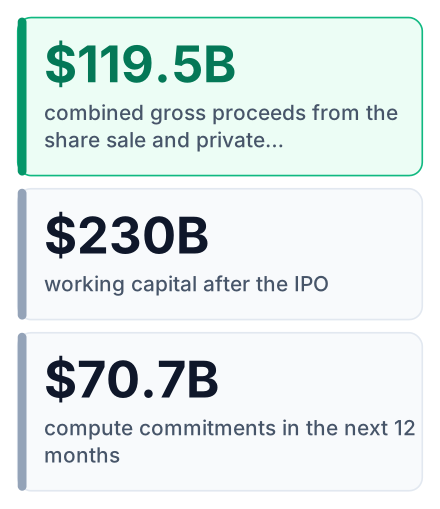
The public sale brought in about $93.5 billion in gross proceeds, with about $91.6 billion going to Anthropic, the announcement says. Alongside it, a private placement of about $26 billion in Class N shares went to AMD, Broadcom, Google, Micron, Microsoft, NVIDIA, plus TSMC. Together the two parts make the combined proceeds of about $119.5 billion. A private placement is a sale straight to chosen buyers, outside the public market.
That list matters for you. The buyers are the companies that make the chips and the memory, and the cloud servers AI runs on. They paid to stay close to one of their biggest customers.
The first-day jump put the company's value near $1.5 trillion, The Verge reports. If you read our comparison of Gemini 4 Neon and Carbon for coding, this is the money side of the same race between labs.
Where the money goes: $230B in cash and $70.7B of compute
About a third of the cash is due for compute in the next 12 months, TechCrunch's breakdown shows, and the commitments through 2030 are bigger than the cash, which, in my opinion, is why the company may still need engineers who can build and run that infrastructure. Here are the numbers that tell you where it goes.
| Number | What it measures | Source |
|---|---|---|
| About $230 billion | Working capital after the IPO | TechCrunch |
| $70.7 billion | Compute and infrastructure commitments in the next 12 months | TechCrunch |
| $451.6 billion | Compute and infrastructure commitments before the end of 2030 | TechCrunch |
Read the first two rows together. The yearly compute bill is a large share of the cash in hand, and the multi-year commitment is far larger than the cash. This is spending already promised to chip and cloud partners. It is not a hiring budget.
My opinion, not a reported fact: compute does not run itself. Every new data centre needs people who write scheduling code and keep long training jobs alive, and someone has to fix them when they fail in the middle of the night. So the IPO looks neutral to slightly positive for hiring: the cash is real, but most of it is already promised to hardware, and no source lists open roles.
What the IPO changes for AI-engineer jobs
A funded lab has room to keep hiring for infrastructure and safety work, though no source lists open roles. The Verge's report includes CEO Dario Amodei's comments on keeping safety central after the listing. Here is the trade-off as I see it, and the points below are my opinion, not reported facts.
Pros
- Opinion: a public company's cash gives it more room to hire than a lab waiting on its next private round, though much of that cash is committed to compute.
- Opinion: rival labs may feel pressure to match pay, which could keep salary floors high across the field.
- Opinion: steady funding for safety engineering, which the CEO tied to the company's direction in The Verge's report.
- Opinion: public shares could be paid to staff, which may help the lab compete for people.
Cons
- Results reported every quarter, with investors judging each one.
- Cost pressure on teams whose work does not show up in revenue soon.
- Hiring that can slow quickly if one quarter disappoints.
One honest limit: the sources do not list open roles or pay, in India or anywhere else. If you see a post claiming a salary figure for Anthropic in India this week, ask where it came from.
Public markets bring quarterly numbers and cost discipline
As a public company, Anthropic must now report results every quarter, so hiring will follow what the business can afford. The Verge reports revenue of $16.3 billion and a net loss of $80.7 billion in the first half of 2026, mostly an accounting charge.
An accounting charge is a cost written down on paper, often linked to share values. No cash leaves the bank for it. A loss that is mostly an accounting charge is not, by itself, a sign of layoffs.
It does mean the company will watch costs. Investors read every report, and a lab that spends heavily on compute has less room for teams that move slowly. My guess is that expensive experiments will need clearer reasons from now on.
That is a guess, and I am labelling it as one. None of the three reports say how hiring plans will change.
What the IPO does not change for a fresher in India
A fresher is still hired for real projects, skills an interviewer can check and basic system design, whichever lab is on top. Say you are applying to TCS through a campus drive, to Infosys, and to a small AI startup in Bengaluru. Each interviewer will ask what you built and why it works.
Founder payouts are a headline, not a hiring signal. TechCrunch reports that the seven founders cashed out about $1.95 billion in total, about $280 million each. That money goes to people, not to open roles.
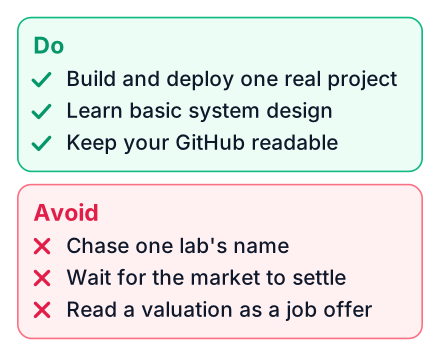
| Do | Avoid |
|---|---|
| Build and deploy one project people can open in a browser | Chasing a lab name on your resume before you have shipped anything |
| Learn system design basics: caching, queues, databases | Waiting for the market to settle before you start |
| Keep your GitHub readable, with clear READMEs | Filling your profile with half-finished tutorial copies |
If you are worried the field is closing, read whether software engineering is dead for Indian freshers in 2026. For a longer plan, see how to become an AI/ML engineer after 12th.
Build your next 30 days around skills you can show
Pick one project that calls an AI model through an API, deploy it, and write down what you learned. I covered the wider habit in how an early-career engineer stays ahead of AI. Here is the short version as steps.
Choose a small problem
Pick something a friend or classmate faces, like summarising long lecture notes. Keep it small enough to finish in a few weekends.
Build it with an AI API
Read the Anthropic API docs or another provider's docs. Send one request, read the response, then add your own logic around it.
Deploy it
Put it on a free hosting tier so anyone can open the link. A project that only runs on your laptop is hard for an interviewer to check.
Write a README on what broke
List the errors you hit and how you fixed them. In my experience, interviewers ask about this more than about features.
Apply with the link
Put the live link at the top of your resume, above your college name.
Common mistakes after a big AI headline
The usual mistake is to read a record number as a job offer and change your plan around it. Watch for these:
- Treating valuation as hiring. A share price measures what investors expect. It does not tell you which teams are recruiting.
- Switching stacks every week. Moving from one framework to another after each launch leaves you with nothing finished.
- Ignoring fundamentals. Data structures and basic networking still decide most technical rounds.
- Trading study time for stock news. Stock news is a loud distraction. Say you spend an evening checking chip share prices after Anthropic's debut; that is an evening your project did not get. Attention moves fast, and your project should not move with it.
This week, pick one small problem, build it with an AI API, deploy it and put the link on your resume.