Gemini 4 Neon vs Carbon: The Cheaper Coding Model Is Winning
Google's Gemini 4 Neon costs far less than Carbon but ranks first on a public coding leaderboard. Here is what the benchmarks and prices mean for a student's API budget.
On November 18, 2026, Google released Gemini 4 Neon. Two days later, one public leaderboard ranks it first for coding agents, ahead of a Google model that costs more to run. On November 20, I opened that leaderboard and the DeepMind launch page to check the numbers myself. The question for a student paying their own API bill is simple: can the cheaper model do Carbon's job?
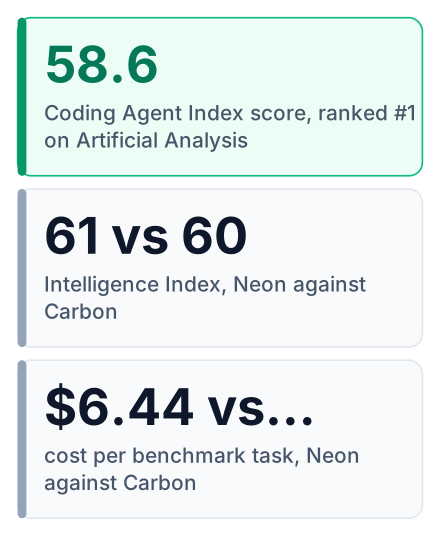
Gemini 4 Neon is the coding model to move your agent budget to. It costs $3 per 1M input tokens and $15 per 1M output tokens. On the Artificial Analysis leaderboard it holds the top Coding Agent Index score of 58.6, and it scores 61 against Carbon's 60 on the Intelligence Index. It also costs less per benchmark task. Per-token price is what you pay, so check both numbers.
Gemini 4 Neon launched November 18 at $3 and $15
Google released Gemini 4 Neon on November 18, 2026, as the mid-priced coding model in the Gemini 4 family, with a 1M-token context window and cached input at $0.15 per 1M tokens, according to the DeepMind launch page. That cached price is a 95% discount on normal input. It matters for coding agents, because they send the same files and instructions again on every turn.
Neon sits between the cheaper Hydrogen and the flagship Carbon. The OpenRouter model page describes it as a step up from Hydrogen that aims for Carbon-quality results at higher speed and lower cost. If you are coming from the bottom of the family, my Gemini 4 Hydrogen price breakdown shows what you gain by moving up a tier. If you are coming from the top, the Carbon pricing post covers what the flagship costs.
Neon vs Carbon: scores and cost per task
On the Artificial Analysis leaderboard, Neon scores 61 on the Intelligence Index against Carbon High's 60, and costs $6.44 per benchmark task against $7.76. The settings are not the same. Neon's 61 was measured at its xhigh thinking level, and Carbon's 60 at High.
| Measure | Gemini 4 Neon | Gemini 4 Carbon |
|---|---|---|
| Price per 1M input / output tokens | $3 / $15 | Higher; see the Carbon pricing post |
| Coding Agent Index | 58.6 (first place) | Below Neon |
| Intelligence Index | 61 (at xhigh) | 60 (at High) |
| Cost per benchmark task | $6.44 | $7.76 |
A one-point lead is small. Read the Intelligence Index result as "about equal," not "clearly better." The cost gap is the stronger result.
Google's own figure is bigger. The DeepMind launch page says Neon has 32% lower cost per task than Carbon at its default high thinking level. That comparison comes from the vendor, while the leaderboard is an outside test, so trust the leaderboard figure more.
Coding benchmarks: Terminal-Bench, FrontierCode and security
DeepMind reports Neon at 65.2% on Terminal-Bench 4.1 and 46.2% on FrontierCode 2.0, plus 90.5% on SEC-bench Pro and 76% on AutoBaxBench hard tier, where it writes more secure code than Carbon, all on the DeepMind launch page. Google ran these tests itself, and no outside group has repeated them yet.
| Benchmark | What it checks, in plain words | Neon score |
|---|---|---|
| Terminal-Bench 4.1 | Can the model finish real jobs by typing commands in a terminal? | 65.2% |
| FrontierCode 2.0 | Can it solve hard coding problems? | 46.2% |
| SEC-bench Pro | Can it handle security tasks such as finding and fixing weak code? | 90.5% |
| AutoBaxBench (hard tier) | Is the backend code it writes safe to deploy? | 76% |
The security results matter most for students. Beginners rarely spot an unsafe database query or a leaked secret in generated code. According to DeepMind, Neon writes more secure code than Carbon at every difficulty level. That is still a vendor claim, and you should review every login form and API route yourself.
Four thinking levels let you control cost
Neon has four thinking levels (low, medium, high, xhigh), so you can spend less on easy edits and more on hard bugs. The OpenRouter model page lists all four, and DeepMind's coding results use high, the default.
| Level | Use it for |
|---|---|
| low | Renaming variables, writing comments, small format changes |
| medium | Writing one function or one test from a clear description |
| high | Normal agent work: changes across a few files, fixing a failing test |
| xhigh | A bug you have already failed to fix twice, or a design question |
Thinking tokens are billed as output tokens. A higher level makes the model think longer, so each request costs more at the same per-token price. Here is a simple rule: start every task at medium. Move up one level only when the answer is wrong.
Per-token price is what you pay, not cost per task
A student pays per token, so "cost per benchmark task" is a guide to relative cost and not your bill. The leaderboard figure combines each model's price with the number of tokens it used on the leaderboard's own test tasks. Your tasks are different.
Say you are building a final-year project, a college club site in Pune or a class scheduler in Ohio. You run an agent that reads a handful of files and changes one of them. Your bill depends on how much the agent reads, how long it thinks and how much it writes. A model that thinks more on your kind of task can cost more than the table suggests. A short task with heavy file reading leans on input and cached input prices instead.
Even so, the direction is clear. Neon charges less per token than Carbon, and it also used less money per task on an outside test. Both measures point the same way. That makes Neon the default for frequent coding and agent work, with Carbon kept for the rare job where it proves better.
Pros
- Agent loops that run many times a day, where every saved token adds up
- Large codebases, thanks to the long context window and cheap cached input
- Security-sensitive code, if DeepMind's results hold up for you
Cons
- Simple edits where a cheaper tier does the job just as well
- Free-tier API use, because Neon's API access is on the paid tier
If you are only choosing among the cheaper tiers, read my Gemini 4 Neon vs Flash comparison for coding. To send easy requests to a cheaper model on their own, see how to cut Gemini API cost with a routing classifier.
How to try Gemini 4 Neon today
You can use Neon now through the Gemini API paid tier in AI Studio and Android Studio, Google Antigravity, or the Gemini app on Google AI Pro and Ultra, according to the DeepMind launch page. Here are the routes, from least setup to most.
Gemini app
If you already pay for Google AI Pro or Ultra, pick Neon in the app and paste in a bug. No setup needed.
Google Antigravity
On the same paid plans, use Neon inside Google's coding environment to work on a real project.
AI Studio or Android Studio
Turn on billing for the Gemini API, then call Neon from your own code. You pay per token from here on.
OpenRouter
Use one API key to test Neon next to other models from the same code.
The OpenRouter model page lists Neon with a context of 1,048,576 tokens and up to 65,536 completion tokens per request. On the OpenRouter rankings page it shows as new and trending, with 138B tokens in the week.
Should you switch from Carbon to Neon?
Switch your high-frequency coding and agent work to Neon, and keep Carbon only if your own tests show it does better on your tasks. Leaderboard scores change as models get updated and retested. Check the Artificial Analysis leaderboard again before you commit a semester's budget.
Pick three real coding tasks from your own projects, run them on Neon and on Carbon at the same thinking level, and write down the result and the token cost of each. Use that, not the leaderboard, to decide where your budget goes.


