Why the Best AI Models Still Fail Easy Questions: DeepMind's New Test
Google DeepMind's new benchmark, Humanity's First Exam, tests whether AI gets easy questions right every time — not just once. The top models score 96-98% on single tries but average 85.6% when repeat questions are counted.
Say you paste a picture from your notes into an AI chatbot and ask a simple question about it. The answer is correct. Later you ask the same kind of question in slightly different words, and this time the answer is wrong. A new test from Google DeepMind shows how often this happens. The best models look close to perfect on easy questions, until the question comes back in another form.
Google DeepMind launched Humanity's First Exam (HFE) on November 24, 2026, a benchmark of 544 easy prompts that checks whether AI answers stay correct every time. The top five models score 96-98% on one try, but land between 70.0% and 90.7% on the strict repeat score, when the same task is repeated in related forms. For students, that means an AI answer is a draft to check, not a fact to copy.
What Google DeepMind launched on November 24
HFE is a public Kaggle benchmark from Google DeepMind with 544 elementary text and image prompts across 20 foundational capabilities.
Oran Kelly is the lead of the project at Google DeepMind, according to the official launch post. It runs on Kaggle, Google's data science site, with a public leaderboard anyone can read. A community competition stays open until December 15.
Prompts come in groups, not as loose items. Emergent reports that the 544 prompts form 136 families of four variants each, and 316 prompts (58.1%) include an image. If you want background on the model at the top of the board, our post on GPT-6.2 Astra Pro explains that model family.
HFE tests easy tasks: counting, colors and false premises
The tasks are ones a child can do, such as counting objects, naming colors, and noticing when a question contains something false.
One public example on the BenchLM leaderboard page shows a neon sign. The model must list the color of the third letter of each word. A person does this in seconds by looking. A model has to find each word, count letters and read colors correctly, all in one answer.
The task types look like this:
- Counting: how many objects of one kind appear in a picture.
- Colors: what color a specific part of an image is.
- False premises: a question that assumes something untrue, which the model should point out instead of answering.
Most of the test stays private. Only 112 of the 544 prompts (28 families) are public, under a CC-BY-4.0 license. The rest are held out, which makes it harder for a company to train a model on the exact questions.
Single-try scores flatter the models
A model that gets a question right once may get a close variant wrong, and HFE counts a whole family of related prompts as failed if any one attempt is wrong.
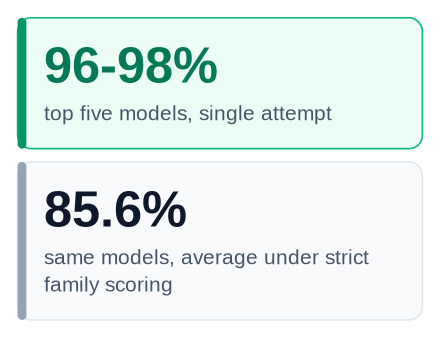
The scoring rule is called "family pass^4". Each family has four versions of a task, and each version is tried four times. That makes 16 related attempts, and one mistake in those 16 fails the group. This strict rule is why near-perfect single scores fall to that much lower average.
Why would a model change its answer at all? A language model picks each word by probability, so the same question can produce different outputs. Our post on log perplexity explains how those word choices are measured.
Think about how you use a chatbot during a semester. You do not ask one question. You ask hundreds, worded in many ways. A high one-try score tells you little about the one question you happen to ask before a deadline.
Where the models rank on the launch leaderboard
GPT-6.2 Astra leads at 90.7%, ahead of GPT-6.2 Sol at 87.5% and Gemini 4 Neon at 85.6%, on the BenchLM HFE leaderboard.
| Model | HFE score (family pass^4) |
|---|---|
| GPT-6.2 Astra | 90.7% |
| GPT-6.2 Sol | 87.5% |
| Gemini 4 Neon | 85.6% |
| Gemini 4 Carbon | 79.2% |
| Claude Opus 5.5 | 70.0% |
| Source: BenchLM, Humanity's First Exam leaderboard, November 2026 | |
Do not read this table as a strict order. The 95% confidence intervals run from about ±4.7 to ±8.1 points. A confidence interval is the range where the true score probably sits. The gap between the top two models is smaller than that range, so they could swap places on a different set of prompts.
The bigger gaps are more meaningful. The distance from the top model to the bottom of this list is wide enough that it will not disappear from random chance. Even the leader still fails some families of tasks a child would pass.
Seeing is the weak spot: most errors involve images
Reading images causes most wrong answers, so a chart or diagram from your course is where AI is least safe to trust.
The two outlets give slightly different numbers. iClarified says visual perception accounts for 73% of wrong answers. Emergent reports about 74% are image-interpretation failures. Either way, about three in four mistakes come from looking at pictures, not from reasoning about text.
This matters for how students use AI every day. Say you screenshot a velocity-time graph from a physics chapter and ask for the slope. Or you paste a circuit diagram from an electronics lab, or a photo of terminal output. In each case, the model first has to read the picture correctly. If it misreads one value, every step after it is wrong, and it will still sound confident.
A safer habit: type the numbers or the code into the chat as text instead of sending a screenshot. You remove the step where models fail most.
Check an AI answer yourself with a repeat test
Put the same question to the chatbot two or three times with slightly different wording, and trust the answer only if it stays the same and matches your textbook.
This is a quick habit, not a scientific benchmark. It copies the idea behind HFE at a small scale.
Start
Put your question to the chatbot once, for example a maths word problem about two trains leaving different stations.
Reword
Change the wording: swap the order of the facts or use different names for the stations.
Ask again in a new chat
Open a fresh chat so the model cannot copy its earlier answer.
Compare
Look at whether the final answers match. If they differ, at least one is wrong.
Check the source
Confirm against your textbook (NCERT in India, your assigned course text in the US) or official docs like the Python documentation for the language you are using.
The same test works for code. Ask a model what a short Python loop prints, then run the loop yourself. Running it takes less time than arguing with the chatbot, and the output is the real answer.
Do
- Type values as text instead of pasting screenshots.
- Run code before you believe what an AI says it prints.
- Ask the model to show its steps, then check each one.
Don't
- Copy an AI answer into an assignment after one try.
- Trust a confident tone as a sign of a correct answer.
If you are choosing which assistant to study with, our comparison of the best AI study tools, free and paid covers the options. The repeat test works with every one of them.
Try HFE on Kaggle: the next step
The free public Kaggle dataset lets you watch a frontier model stumble on a question that is easy for a person, as Emergent's launch report describes.
Pick one task from the public set, like the neon sign. Answer it yourself first. Then give it to the AI tool you use for homework, and ask again in reworded form. You will see the reliability problem with your own eyes, which teaches more than any score.
If you find a prompt that trips a model, you can submit it. The three-week Kaggle competition runs through December 15 and offers prizes for prompts that make models fail, and the official launch post has the exact prize terms.
Open the free HFE public dataset on Kaggle (the official launch post points to it), try one prompt on the AI tool you study with, and from now on treat every AI answer on homework as a draft you verify.


