Enter Google's Humanity's First Exam Hackathon on Kaggle: A Free Portfolio Project
Google DeepMind's Kaggle hackathon on Humanity's First Exam closes December 15, 2026. Entry is free, and you can turn a few everyday prompts into a portfolio piece for AI-engineer interviews — no GPU or training needed.
As of 27 November 2026, Google's own blog page for Humanity's First Exam says a three-week Kaggle competition runs through December 15, and anyone can enter. Most students will scroll past it as benchmark news. I think it is a free portfolio project.
Google DeepMind's Humanity's First Exam hackathon on Kaggle is a free way to show you can test AI models, not just use them. You submit everyday prompts that top models still get wrong. What you hand in is a small test set with a results table, about a weekend of work. It becomes a portfolio piece you can discuss in an AI-engineer interview.
What Google launched on November 24
Humanity's First Exam is a set of 544 simple text and image prompts across 20 basic skills, and it measures whether a model answers correctly every time, not once.
Google DeepMind put it on Kaggle on November 24, in a project led by research scientist Oran Kelly. The team calls it a "floor" measurement. Most benchmarks ask how hard a problem a model can solve. This one asks how often a model fails at easy things a child could do.
I covered the benchmark itself in my post on Google's Humanity's First Exam benchmark. This post is about the hackathon attached to it, and why you should enter.
Top models fall from 96-98% to 85.6% on repeat tests
One question, four small changes, and the model must get all four right to score. That scoring exposes failures that a one-try score hides, as the emergent.sh report on the results shows.
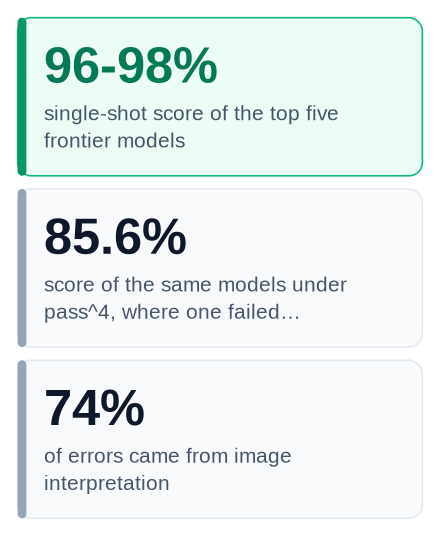
Here is how that scoring works. Each question comes in four versions with small changes, like a different word or a cropped image. The model earns the point for that family only if it gets all four right. One wrong version, and the whole family scores zero. The report calls this "pass^4".
Most of the failures came from reading images, not from text. That matters when you pick your prompts, below. Every figure in the table comes from a third-party report, not Google's page, so treat the numbers as reported and check them against the official Kaggle page. The two numbers that matter for your project are the drop from a single-try score to the all-four-right score, and the share of errors that came from images.
| Number | What it measures | Source |
|---|---|---|
| 96–98% | Top five frontier models, single-shot score | emergent.sh |
| 85.6% | Same models under family pass^4 scoring | af.net |
| 136 | Families of four prompt variants | emergent.sh |
| About 74% | Share of errors that came from image interpretation | af.net |
AI evaluation is the skill interviewers look for
Teams building with AI need people who can show where a model breaks and prove it with repeatable tests, and few candidates can.
This is my opinion, not a survey result. Calling a model API is now a weekend skill. Knowing whether the answers can be trusted is the harder part, and it is the part that keeps a product from embarrassing its users.
Say an interviewer asks how you would know a chatbot is reliable. Two candidates answer.
- The first says, "I used the API in my project and the answers looked good."
- The second says, "I built a set of test questions, wrote four versions of each, ran them, and tracked which ones failed."
The second answer shows a method. It also shows you know a single correct reply proves very little. Domain benchmarks work the same way, as I explained in my post on MedChemBench. If you want to see where this skill sits in pay terms, read my breakdown of AI engineer salary by experience.
Enter the Kaggle hackathon for free
You need a Kaggle account and a few everyday questions, with no model training and no GPU.
Open the competition
Start from the link on Google's blog post, which points to the competition page, and sign in to Kaggle from there. Creating an account costs nothing. Google's post is the source for the competition, so copy the exact competition title and rules from the page you land on and keep them open while you work.
Read the example prompt
Google's sample asks a model to "List the color of the third letter of each word in the neon sign in order, separated by a semicolon." Notice how plain it is.
Write simple prompts
Pick tasks any adult could do in seconds, each with one clear right answer.
Test them on frontier models
Run each prompt on the free tiers of the chat apps you already use. Note every wrong answer.
Check a small rewording
Change one word, or crop the image a little. Keep the prompt only if the model still fails.
Submit before the deadline
Upload your best prompts on the competition page. The submission format, the number of prompts allowed, whether all four variants are required and the judging criteria are set by the official rules page, so read it first and shape your test set to match before you build anything.
One third-party report says the prize pool is $50,000 in Kaggle swag, not cash, and that winning prompts feed into future versions of the benchmark. I could not confirm either point on Google's page, so check the rules before you count on them. You do not need to win for this to be worth doing: the test set and results table are the portfolio piece, whatever the judges decide.
Pick prompts that models fail on repeat tries
A good entry is a simple question with a clear right answer that a model gets wrong once its wording or image changes slightly.
| Weak prompt | Strong prompt |
|---|---|
| Obscure trivia nobody knows | An everyday task anyone can check |
| One version only | Four small variants of the same task |
| A vague answer open to debate | One answer you can mark right or wrong |
Focus on images. The af.net report points to image reading as the main weak spot. These ideas work whether you live in Pune or Phoenix. To make variants, crop or rotate the photo in any photo app, or change one word in the question. I have not verified which free chat tiers accept images, so check that before you choose this route:
- Read a bus or train timetable photo and give the second departure after noon.
- Count the cups on a crowded table.
- Add up the items on a shop receipt.
- Name a letter at a set position on a street sign.
Turn your entry into a portfolio piece
A short write-up with your prompts, your variants, the failure rate you saw and what you learned is a concrete project an interviewer can read in five minutes.
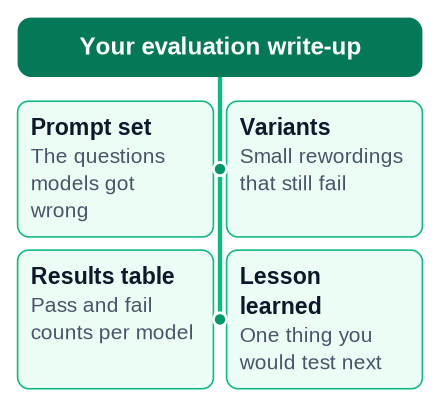
Put it in a GitHub repo, built in layers:
- The prompt set: each base question, with the image file if it has one.
- The variants: the small changes you made to each question.
- The results table: which model, which variant, right or wrong.
- The README: one lesson in plain words, such as "the model read the timetable fine until I rotated the photo."
Pros
- Free to enter, with no hardware needed.
- Proves you can test a model, which is rarer than using one.
Cons
- No guarantee of winning.
- Prizes are reported as swag only, which is unconfirmed.
Here is an example, not a run I did. Prompt: "Read the timetable photo and give the second departure after noon." Variants: the original photo, a cropped photo, a rotated photo, and the question reworded to "second departure after 12:00." Illustrative results for one model: right, right, wrong, right. One wrong variant means the family scores zero.
Be honest about its limits. This project supports your story in an interview. It does not replace data structures, a working backend, or the basics of how models produce text.
Talk about it in an AI-engineer interview
Describe it as a reliability test: what you tested, why a single correct answer misleads, and what you would do next.
Here are things you could say:
- "I wrote everyday image questions, made four versions of each, and counted a question as passed only if every version was right."
- "A model can answer once by luck. Repeating the test with small changes showed me where it was guessing."
- "Next, I would turn these prompts into a regression test, so every model update gets checked against them."
This prepares you for two common questions. "How do you evaluate an LLM?" is one. "What is a regression test?" is the other: a fixed set of checks you rerun after every change to catch anything that broke.
Today, open the Google blog post, read the example prompt, and write three everyday questions with four small variants each. Test them on one frontier model and keep a results table, then submit before December 15, 2026.