What Is Prompt Engineering in 2026? Skills, Salary, and Career Paths
Prompt engineering is the skill of writing clear instructions that get accurate answers from AI tools. The standalone job title is shrinking, but the skill is growing more valuable as a complement to engineering and product roles.
In 2023, news stories spread about "prompt engineers" earning huge salaries. Then the job title started disappearing. By 2026, the skill behind that title is more valuable than the title ever was.
Prompt engineering is the skill of writing clear instructions that get accurate, useful answers from AI tools like ChatGPT. It is not a lifelong job title, but a high-leverage skill you pair with engineering, product, or domain expertise to stay relevant as AI evolves.
Prompt engineering means writing instructions AI can follow
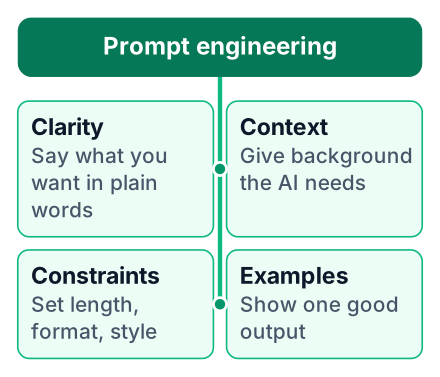
Prompt engineering is the practice of crafting requests to an AI so it gives you accurate, useful results, by adding context, role, constraints, and examples, as explained in the Coursiv guide to prompt engineering. Without those elements, the AI guesses what you want. With them, it has a clear map.
Here is the key fact to understand: large language models work on probabilities, not human understanding. They predict the next most likely word based on patterns in their training data. The word "bank" could mean a river edge or a place for money. Your prompt tells the model which meaning to use.
A weak prompt gives the model nothing to work with. A strong prompt gives it everything. Compare these:
Weak prompt:
"Write about databases."
Strong prompt:
"You are a database instructor for beginners.
Explain what an index is in 150 words.
Use an analogy someone new to coding would understand.
Do not use technical jargon.
Format the answer as one paragraph."
Both prompts ask about the same topic. The second one tells the model the audience, the length, the tone, and the format. That is the whole job of prompt engineering: giving the model enough direction to do what you actually want.
Why the prompt engineer job title is vanishing
The standalone 'prompt engineer' title is shrinking because models got easier to steer, tools automated the manual part, and the work isn't a full-time job, according to Shifttotech's analysis of prompt engineer salaries in India. The numbers tell the story clearly. Job postings with "prompt engineer" in the title have declined sharply from their peak.
Meanwhile, prompting as a required skill in other roles has risen significantly, according to the GPT Prompts career guide. The work of writing good prompts did not disappear. It became a normal part of every AI-related role.
Three forces caused this shift. First, models became easier to steer. A 2023 model needed careful phrasing; a 2026 model understands plain requests. Second, tooling ate the manual part. Platforms now have built-in prompt builders and templates. Third, the work simply is not 40 hours a week. Once you write good prompts for a task, they mostly keep working. A company cannot justify a full salary for a few hours of weekly work.
What prompt engineering pays in India and the US
In India, prompt-engineer roles pay roughly ₹3–25 LPA depending on level, and in the US, $75,000 to $175,000+, with top AI-engineering roles going higher, as reported by Shifttotech and the GPT Prompts career guide.
Those ₹1–3 crore figures from 2023 need context. They came from a few roles at US frontier labs like Anthropic, which paid $175,000–$335,000. Those were senior engineering roles, not just prompt-writing work. The typical Indian prompt engineer never saw that money.
Here is how the salary picture breaks down, with Indian figures from Scaler's 2026 pay guide and US figures from GPT Prompts:
| Level | India (₹ LPA) | US (USD) |
|---|---|---|
| Entry-level | ₹3–5L | $75,000–$95,000 |
| Mid-level | ₹6–12L | $95,000–$140,000 |
| Senior | ₹12–25L+ | $140,000–$175,000+ |
Bengaluru offers the highest average in India at ₹6.11L. That figure comes from Scaler's salary breakdown. The sample of dedicated prompt-engineer roles in India is shrinking, so treat these ranges as a floor for what you could earn if you add this skill to a broader role.
Core skills that make you a strong prompt engineer
The core skills are designing prompts, testing them systematically, structuring outputs, and reducing hallucinations, with Python and API knowledge pushing salaries higher, according to Scaler's skills guide. These are not writing skills. They are engineering skills applied to language.
Prompt design means knowing when to add context, set a role, or give examples. Testing means running the same prompt multiple times to see if the output is consistent. Structuring outputs means asking for JSON or a specific format so another program can read the result. Reducing hallucinations means adding constraints like "only answer from the provided text."
The salary climbs when you add Python, API integration, evaluation methods, and RAG (retrieval-augmented generation, which lets the model pull from your own documents before answering). These skills let you build systems, not just write prompts. That is where the market is moving.
Focusing only on prompting
- Fast to learn, fast to start
- Useful in any role that touches AI
- Low barrier to entry
Pairing prompting with technical skills
- Higher salary ceiling
- More job openings
- Work that scales beyond a single prompt
How to learn prompt engineering as a student
Learn by doing: practice on free tools, study prompt patterns like zero-shot and few-shot, then build a project that uses AI to solve a real problem, as recommended by Coursiv's practical guide. You do not need a paid course. You need a free account and a habit.
For independent evidence of this skill's growing value, see the GPT Prompts career guide which tracks industry demand.
Start with the three core prompt patterns. Zero-shot means asking without examples. Few-shot means giving the model a few examples in your prompt before asking it to do the task. Chain-of-thought means asking the model to reason step by step before giving its final answer.
Pick a tool
Open a free AI tool like ChatGPT or Claude. You will use it daily.
Study the patterns
Practice zero-shot, few-shot, and chain-of-thought prompts on the same task. See how outputs differ.
Build a project
Make a study assistant that summarizes your notes, or a chat app that answers questions about your favorite topic.
Test it
Run the same prompt a few times. Notice when the output is inconsistent.
Document your prompts
Save the ones that work. Note what made them effective. This becomes your portfolio.
For a deeper look at how AI models use the information you give them, read how ChatGPT knows your name. Understanding that mechanism makes your prompts sharper.
Career paths that pair prompting with a real job
The best career move is to pair prompting with engineering, product, or domain expertise, because that is where the demand is moving, according to the GPT Prompts career analysis. Chasing the standalone title is a dead end. Building a career where prompting is one of your tools is the smart path.
Here are the roles where prompting matters right now:
- AI engineer — builds systems that use models, where prompt design is part of the pipeline.
- AI product manager — decides how AI features work for users, and writes prompts to test them.
- Applied-AI specialist — takes a model and makes it work for one industry, like healthcare or finance.
- Software engineer — integrates AI into apps, where prompt quality affects the whole product.
- Data analyst — uses AI to query and summarize data, where a good prompt gets the right answer.
Each of these roles pays more than a standalone prompt-engineer job because each pair the skill with something the market already values. The highest-paying tech jobs in India for 2026 all sit in these combined spaces, as shown in our salary guide. The same logic holds in the US.
Now take the five steps above, but start with only the first one: open a free AI tool and write one prompt for a problem you have this week. Do that today. The rest is practice. Then read the overlap post on software engineer vs prompt engineer to decide where to focus.