Claude Helped Prove the Riemann Hypothesis: What It Means for Students
Claude and mathematician Levent Alpöge produced a machine-checked proof of the Riemann hypothesis. The human supplied the idea; the AI did the grinding — and that split is the real lesson for students.
As of 27 November 2026, the Lean FRO and the Mathlib Initiative have both said they have full confidence in a proof of the Riemann hypothesis that Claude helped write. Yet no complete human-readable version of that proof exists. The headlines say "AI solved the hardest problem in math." What happened is more useful to you than that.
Claude did not solve the Riemann hypothesis alone: Anthropic mathematician Levent Alpöge supplied the key idea and the direction, and Claude did the long step-by-step work and wrote the Lean code. Two groups checked that code on 21 November 2026. What this means for you: use AI to check your work and test small cases, but write the first attempt yourself and be able to explain it, because you may be tested without the AI beside you. A worked example is further down.
Riemann hypothesis in plain words
The Riemann hypothesis is a 160-year-old guess about where certain special numbers (the zeros of the zeta function) sit, and those zeros control how prime numbers are spread out. Primes are numbers like 2, 3, 5 and 7 that only divide by 1 and themselves. They look random, but they follow a deeper pattern.
A zero of a function is an input that makes the output exactly zero. Picture a long road that goes up and down. The zeros are the exact spots where the road touches sea level. Riemann guessed that all the important zeros of his function lie on one straight line. If that is true, mathematicians can predict primes far more precisely. That is a big if.
That prediction matters because so much of number theory assumes it. It is one of the Clay Millennium Prize problems, with a $1m bounty. This is a very different test of AI from the exam-style benchmarks we covered in our post on Humanity's First Exam. A benchmark has known answers. This problem had none.
What was announced on 20 and 21 November
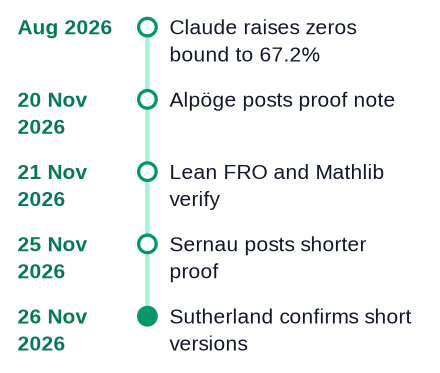
Alpöge posted his note on 20 November 2026, and on 21 November the Lean FRO and Mathlib Initiative said they had full confidence the proof is correct, according to the Guardian. Their exact words were: "We have full confidence that Alpöge's proof of the Riemann hypothesis is correct."
The proof covers more than the classical hypothesis. It also proves a generalized version of the same claim, which needed some of the hardest math there is to reach, and that is why experts took the news so seriously.
Senior mathematicians reacted strongly. James Maynard called it "a historic milestone," and Clay president Martin Bridson called it "an announcement of historic significance" (Wikipedia).
Who did what: Alpöge and Claude
Alpöge brought the core idea of moving methods from the Weil conjectures over to the integers, while Claude turned small test-case insights into full proofs (Wikipedia). The Weil conjectures are older, already-proven results about a simpler kind of number system. Alpöge's bet was that their methods could work for ordinary whole numbers too.
Here is the headline version next to the honest one:
| Part of the work | Alpöge | Claude |
|---|---|---|
| Main idea | Carry Weil conjecture methods to the integers | Not credited with the main idea (Wikipedia) |
| Direction | Chose the problem and guided the work (Scientific American) | Worked under his direction (Guardian) |
| Toy cases | Found insights in small settings | "In tens of cases" carried them to a full proof (Wikipedia) |
| Formal version | Checked the plan | Wrote about 17 million lines of Lean (Wikipedia) |
| Time together | About six weeks (Guardian) | |
Lean, the tool in that table, is a programming language where you write a proof as code. You may have seen Alpöge say the prose proof runs to over 250,000 pages. That was a joke, so do not repeat it as fact.
The idea itself is deep. Terence Tao said the proof uses some of the hardest math there is (Wikipedia). Few people can follow every part of it. According to Scientific American, the AI did not choose the problem, and Alpöge steered the work from the start.
Why Lean made fast checking possible
Lean is software that checks every logical step by machine, so two groups could verify the proof in about a day instead of waiting years for human referees. You do not have to trust Alpöge or Claude. You trust the small Lean checker, the one piece of software that decides whether each step is accepted.
This is why a 17-million-line proof was not a problem. A human could never read it. A computer can read all of it, and it never gets tired at line ten million.
Here is what a tiny piece of Lean looks like. It states that adding zero to any whole number changes nothing, and asks Lean to prove it:
theorem add_zero_example (n : Nat) : n + 0 = n := by
  simp
Shorter versions followed. On 25 November, Anthropic researcher Luke Sernau published a more efficient proof at 300,000 "readable" and 76,000 "compact" lines, under the Apache license. On 26 November, Andrew Sutherland finished testing both and confirmed they are correct.
The earlier result: 41.6% to 67.2%
In August 2026 Claude raised a different number, the proven share of zeros known to obey the hypothesis, from 41.6% to 67.2%, which is a separate and smaller result. Many posts mix the two up. One raises a lower bound; the other claims the whole thing.
The work ran over two sessions in Claude Code, used 31M output tokens and coordinated about 60 subagents (smaller AI workers that each take one piece of the task). Alpöge and Ralph Furman validated the result.
Scott Aaronson frames this as one result in a wave of AI math work, alongside OpenAI's proofs about VP≠VNP and matrix multiplication. Science outside math is seeing similar claims, as in our post on GPT-6 and protein design.
Limits: what we still do not know
No complete human-readable account exists yet, mathematicians are still working through the proof, and the AI did not choose the problem (Scientific American). A machine check tells us the proof is correct. It does not tell us why it works in a way people can learn from.
What Claude did well
- Turned small insights into long, complete arguments
- Produced a proof a machine could check
Still done by humans
- Picking the problem and the main idea
- Explaining the proof so others understand it
Use AI for the mechanics, not the thinking
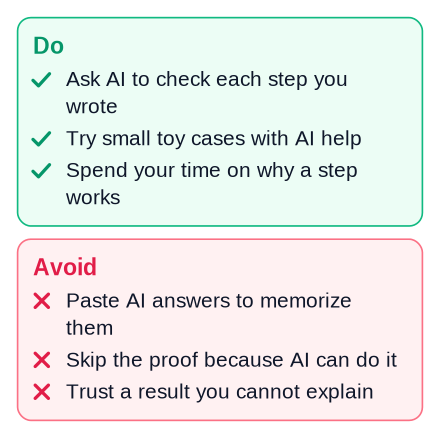
Students should let AI check algebra and test small cases while they build the understanding needed to direct it, and not use it to copy answers. Alpöge could only steer Claude because he already knew where to look.
Say you wrote a function to find the largest number in a list, and one test keeps failing. Asking the AI for the finished code feels fast. You will then meet the same bug in a coding interview, with no AI beside you. A better split: you write the function, the AI writes the test cases, and you explain in your own words why the failing test fails. For example, your function starts with max_val = 0, the AI's test largest([-5, -2, -9]) expects -2, and the run prints AssertionError: 0 != -2. Your one-sentence explanation: starting at 0 beats every number in an all-negative list, so start from the first item instead.
| Do | Don't |
|---|---|
| Write your attempt first, then ask the AI to find the broken line | Paste the question and copy the answer |
| Ask it to test the claim for small values of n | Memorize a proof you cannot explain |
| Ask why a step works, then explain it back in your own words | Accept a step because the AI sounds sure |
If you are deciding whether a paid coding assistant is worth it for this kind of work, read is Claude Code worth it for students.
One result is not all of math, even a famous one
No, this is one result from one case where an expert guided the model for weeks, and it does not show AI can set research goals on its own. The Guardian's report describes Claude as helping, not leading.
Watch for two things next. The first is a readable write-up that human mathematicians can follow and teach. The second is whether other experts, with other problems, get similar help from these tools.
This week, pick one short proof from your own course. Try it yourself first. Then ask an AI to check your steps and test a small case, and write down in one sentence why the key step works.