Kimi K3.1 Pro's open weights are released with cyber ability removed
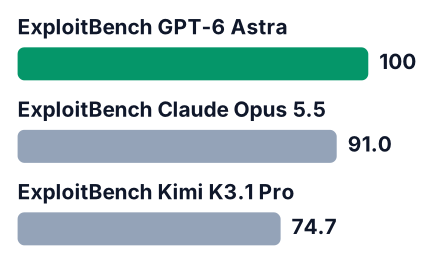
Moonshot released Kimi K3.1 Pro's open weights with cybersecurity capability deliberately reduced. The checkpoint scores 74.7 on ExploitBench versus 100 for GPT-6 Astra, while coding stays strong at 81.0 on xdev-bench-hard. Students reach the model via API, not the 1.56 TB download.
Moonshot released Kimi K3.1 Pro's open weights today, and they shipped with the hacking ability deliberately dialed down. On coding, the released checkpoint scores 81.0% pass@3 on xdev-bench-hard, near Claude Opus 5.5, per the vendor's tech blog. That drop is deliberate: Moonshot says it removed cyber data from training. For a student, the real story is that a 1.56 TB model is out of reach, so the tradeoff only matters if you use the API.
Kimi K3.1 Pro's open weights arrive with cybersecurity capability deliberately reduced. Moonshot removed cyber data from mid-training and RL, so the released checkpoint scores 74.7 on ExploitBench against 100 for GPT-6 Astra. You likely won't run the 1.56 TB download yourself; you reach the model through the Kimi API at $2 per million input tokens, or via Kimi Code.
What changed in the open release
Moonshot released the Kimi K3.1 Pro weights today with cybersecurity capability deliberately reduced from the full model, per the vendor's tech blog. The release is the first in a new K3.1 series, and the weights sit on an ungated Hugging Face repo as 96 safetensors shards totaling about 1.56 TB.
The model itself is a 2.8T parameter mixture-of-experts with 104B active parameters, 896 experts (16 selected plus 2 shared) across 93 layers, and a 1,048,576-token context window. It handles text and images through a MoonViT-V2 vision encoder. The weights use MXFP4 precision with MXFP8 activations, trained through quantization-aware training, according to the Hugging Face card.
Moonshot positions the safety cut as deliberate. The company states it removed cyber data from both mid-training and reinforcement learning so the open release carries less offensive capability than the full model.
What the cyber-capability numbers show
The released checkpoint scores 74.7 on ExploitBench and 20.7 on ExploitGym, far below GPT-6 Astra's 100 and 42.4, as reported on the vendor blog. It also trails Claude Opus 5.5's 91.0, so the drop is not specific to one competitor.
| Benchmark | Kimi K3.1 Pro (open) | GPT-6 Astra |
|---|---|---|
| xdev-bench-hard (pass@3) | 81.0 | 90.5 |
| ExploitBench | 74.7 | 100 |
| ExploitGym | 20.7 | 42.4 |
ExploitBench measures a model's ability to find and exploit real-world vulnerabilities. ExploitGym tests similar skills in a simulated environment. The Orca report notes these numbers reflect the deliberate removal of cyber training data, not a model that failed to learn.
The coding scores tell a different story. On xdev-bench-hard, Kimi K3.1 Pro hits 81.0 pass@3, within striking distance of Claude Opus 5.5's 90.5 (and GPT-6 Astra also scores 90.5 on this benchmark, per the vendor table) and ahead of several other frontier models.
Strong at coding, weak at science
Kimi K3.1 Pro is strong at agentic coding but weak at program synthesis and science, so treat the benchmark sheet as a mixed report card, per the vendor's own figures. The model excels at tasks that involve modifying existing codebases: Terminal-Bench 4.0 at 65.7 and SWE Marathon at 51.7 show solid agentic performance.
But the release stumbles where it must generate code from scratch or reason about scientific problems. Program Bench sits at 31.5, and Terminal-Bench-Science drops to 38.1, both far below the coding-agent numbers. The Orca analysis describes the profile as a specialist in software engineering rather than a generalist.
For your projects, this means Kimi K3.1 Pro fits tasks like fixing bugs, refactoring, and navigating a repo. It is a weaker fit for writing novel algorithms from a blank page or answering research questions. Test it against your actual workload instead of trusting the headline coding score.
Can a student run the 1.56 TB download?
No, the 1.56 TB of open weights need a cluster with two B300 GPUs, far beyond a student workstation, according to the Hugging Face card. VRAM is the constraint: a model this large must sit entirely in GPU memory to run, and consumer cards cap out at 24 GB.
The Orca breakdown puts the practical requirement at a two-node B300 or GB300 cluster, which costs far more than any student setup. You also need storage fast enough to load 1.56 TB of weights and enough RAM to hold the activations during inference.
This is the gap between "open weights exist" and "open weights run on my laptop." The download is real and ungated, but it is a data-center artifact. If you want to test the model, the API is the realistic path.
How to actually use Kimi K3.1 Pro
You reach Kimi K3.1 Pro through the API at $2 per million input tokens, or via Kimi Code and the Kimi app, which needs a Plus subscription, as Unite.AI reports. The API charges $2 per million input tokens and $10 per million output tokens, and the model is also listed on OpenRouter so you can pay per request without a Moonshot account.
Open Kimi Code
Call the model in your editor (like VS Code) with
/modeland pick k3.1-pro from the list.Use the Kimi app
Select the k3.1-pro model in the chat interface, available with a Plus membership.
Call the API directly
Send prompts at $2 per million input tokens and get a 1M-token context window for Pro and up.
That 1M context is the practical draw for students. You can paste an entire codebase or a full textbook chapter into a single prompt, which makes the model useful for large review tasks without chunking.
Open weights are not open source
The custom license lets you use Kimi K3.1 Pro internally, but it gates model-as-a-service reselling at $20M+ group revenue, according to the Orca report. The license is marked other on Hugging Face, not OSI-approved, which means it does not meet the legal definition of open source.
The practical difference for a student building a product: you are fine. Using the weights for your own app, research, or coursework is free. The restriction only kicks in if your whole group's revenue passes $20 million and you want to resell the model as a service. At that scale, you would hire a lawyer anyway.
But the label matters. "Open weights" means you can download and inspect the files. "Open source" means the license grants full rights to modify, redistribute, and sell without gates. For you, this means you can use it freely for learning and even your own app. Just don't assume you can sell it as your own service. That is the practical difference.
What the tradeoff means for your projects
Moonshot's removal of cyber capability shows that open weights are a curated product, so you should check a model's license and safety cuts before building on it, as the Orca analysis emphasizes. The vendor made a safety decision, documented it, and shipped the result as the official release. That is honest engineering, and it is also a warning.
What the download does not include is as important as what it does. Security data was stripped from training, so a model's benchmark sheet is a claim about a specific checkpoint, not a promise about every future release. Before you depend on an open-weight model, read its card on Hugging Face: check the license, the training-data notes, and the stated safety cuts.
This pattern shows up beyond Moonshot. Other open releases have shipped with different safety postures, and the tradeoff is the same: you get capability, but you also inherit the vendor's curation choices. That is acceptable when you know what you are running, and risky when you assume a model's scores tell you everything it can do. If your project involves security, you need to be extra careful: the model's removed cyber knowledge could be a problem for security-related code generation. Consider a dedicated path like penetration testing, where you learn the skills the model lacks.
For a practical check, you can compare Kimi K3.1 Pro against the other open releases we have covered, such as Mistral Large 4, or the Muse Spark line that runs on a Mac Studio. Each one makes a different tradeoff between capability, size, and safety, and the right choice depends on your hardware and your task. And when you read the agentic coding numbers, remember the broader shift documented in the GitHub Octoverse report: agents now write a large share of pull requests, which changes how you should evaluate a model's coding skills.
Try Kimi K3.1 Pro through the Kimi app or the API, and read the license page on the Hugging Face card before you plan to build on it.


