Particle-1 Token Efficiency: Cheaper Coding or Just Fewer Tokens?
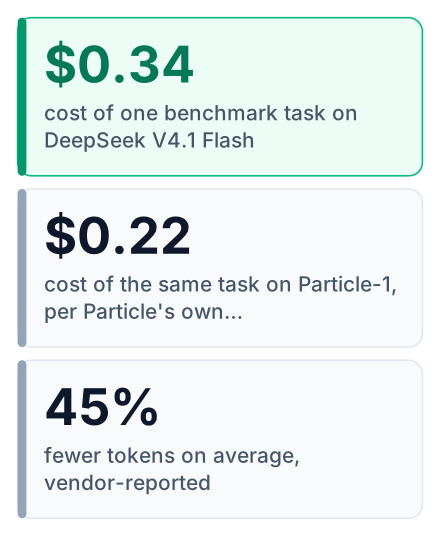
Particle-1, a tuned DeepSeek V4.1 Flash, claims 45% fewer tokens on coding tasks, cutting cost per task from $0.34 to $0.22. But price per token is higher, and the numbers are unverified. Here's what you should check before switching.
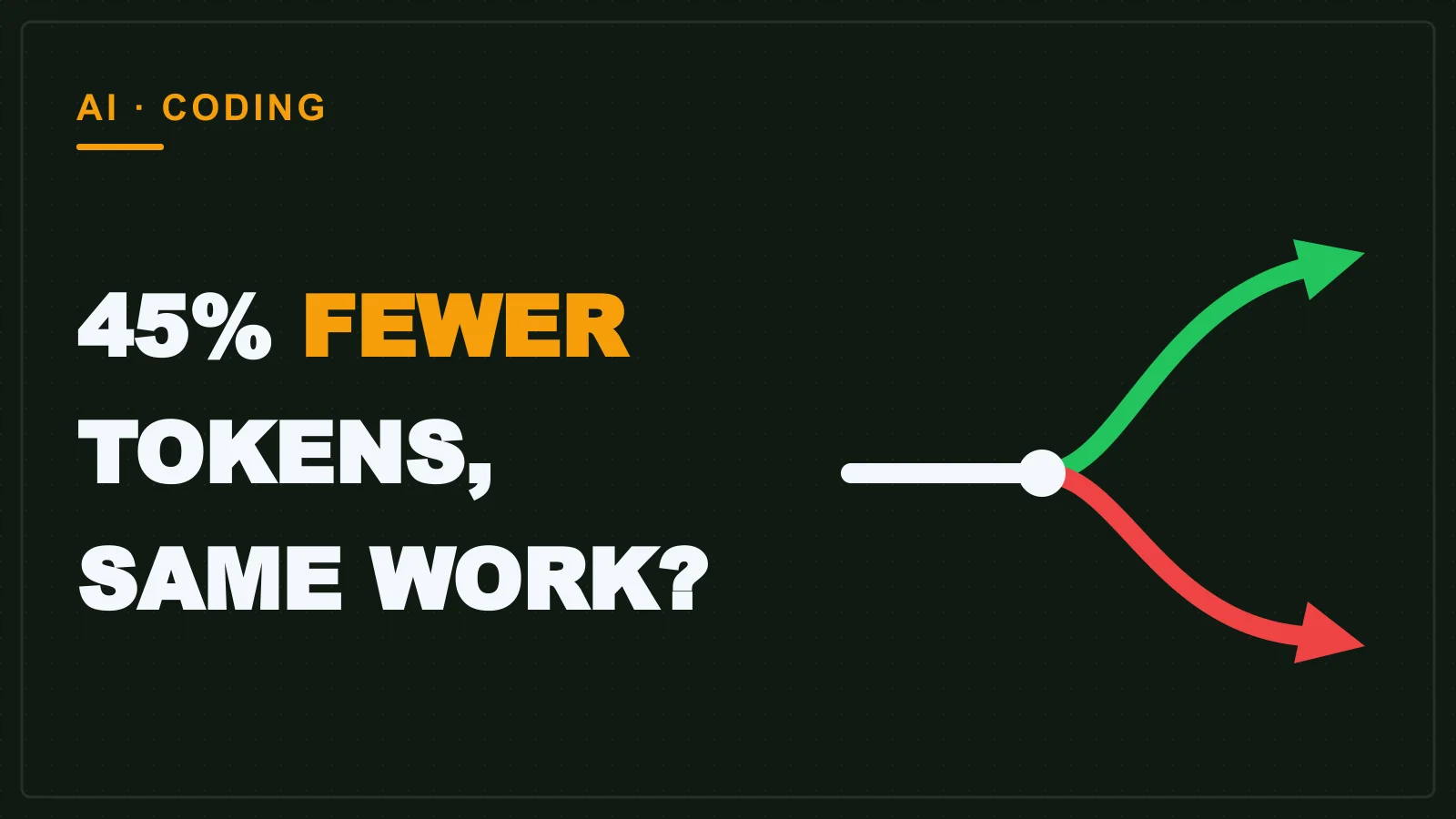
As of November 3, 2026, Particle's launch post claims its new model finishes a coding task for about $0.22. DeepSeek V4.1 Flash, it says, costs about $0.34 for the same work. Then you open OpenRouter, and Particle-1's price per token is higher than DeepSeek's own off-peak rate. Which number will you actually pay?
Particle-1 is DeepSeek V4.1 Flash trained to use about 45% fewer tokens on coding tasks, which Particle says cuts cost per task from about $0.34 to $0.22. The figures come from Particle's own launch post, and no outside lab has rerun them. Your real saving depends on where you buy and when.
Particle-1 is DeepSeek Flash trained to think less
Particle-1 is not a new base model: it is DeepSeek V4.1 Flash with a small rank-64 LoRA adapter (about 1.25% of parameters) added by post-training, according to Particle's launch post.
Particle is the new company of Suhail Doshi, the co-founder of Mixpanel. It released Particle-1 on October 28, 2026.
A LoRA adapter is a small add-on layer that changes how a model behaves without retraining the whole model. Here, the adapter teaches DeepSeek to spend fewer tokens on reasoning and on tool calls during software tasks. A tool call is when an agent runs a command or opens a file.
You cannot download it. As of October 29, CellCog found no Particle-1 repo on Hugging Face, so the API is the only way in. That is different from an open-weights release like Mistral Large 4, which you can run on your own machine.
The 45% token cut and what it does to cost per task
Across four coding benchmarks, Particle reports 28.4% to 52.2% fewer output tokens, with accuracy inside the base model's confidence range (72.57% vs 71.15% pooled). The four benchmarks are Terminal-Bench 2.1, ReactBench, ADE Bench and DeepSWE 1.1.
A token is a small piece of text, often part of a word, and every model charges by the token. Output tokens are written one at a time, so fewer of them also means a faster answer.
Agents feel this more than chat does. An agent loops: it reasons, calls a tool, reads the result, then reasons again. Each loop costs tokens, so a model that thinks less per loop saves money on every round.
| Model | Cost per task |
|---|---|
| Particle-1 | $0.2211 |
| DeepSeek V4.1 Flash | $0.3368 |
| GLM 5.3 Flash (for reference) | $0.6523 |
Price per token: OpenRouter vs DeepSeek direct
OpenRouter lists Particle-1 at $0.25 input and $1.00 output per 1M tokens, which is above DeepSeek's own off-peak $0.15 and $0.60, so the saving depends on where and when you buy.
Here is the catch. Particle-1 uses fewer tokens, but each token costs more than DeepSeek's night rate. CellCog's math shows that if you buy DeepSeek direct off-peak, the per-token gap largely cancels the token saving. At peak hours, DeepSeek costs more per token than Particle-1, and the saving comes back.
One news feed showed a much lower price for Particle-1. The two pages opened for this post, CellCog and explainx, agree on the figures in the table. Open the live OpenRouter listing before you build on any of them.
Both pages bill in dollars, so this works the same for a reader in Pune or in Phoenix. If you pay from India, your bank converts the bill to rupees at its own rate. The same check applies to any dollar-priced model, such as GPT-6.1 Terra.
Caveat one: the numbers are Particle's own
Every benchmark result comes from Particle's own tests, and no outside lab had rerun them when the launch coverage was published.
A rerun would take the same tasks and settings, then count tokens and passing tests again. It would also catch quiet choices, like which tasks were left out or how many times each one ran.
The accuracy claim needs a careful read too. A confidence interval is the range where a model's true score probably sits. When two ranges overlap, the test could not tell the models apart. That means "not shown to be worse." It does not mean "proven equal."
My position: treat the token cut as a strong lead, not a fact. Wait for an independent rerun before you trust it for anything important.
Caveat two: fewer tokens can mean skipped checking
A model that spends fewer tokens may be stopping early, so it can skip the step where it reruns tests or rereads its own code.
Checking is expensive in tokens. Running a test suite prints output the model must read. Rereading a file sends the whole file back in. If you train a model to use fewer tokens, these steps are an easy place to cut.
Say you ask an agent to fix a failing test. A careful run edits the code, runs the full suite and reads every result. A cheaper run edits the code, sees that one test pass and stops. Both look like success on the first read, but only one checked that nothing else broke.
Pros
- Cheaper runs when you pay peak or OpenRouter prices
- Faster answers, since the model writes less
Cons
- The model may check its own work less often
- Bugs can slip past tests the benchmark never ran
This risk is growing. According to GitHub's Octoverse 2026, developers start more than 40% of pull requests with an agent as of September 2026, up from 17% in March. More agent code means more code that nobody checked line by line. Read our breakdown of the Octoverse report for the full picture.
Test Particle-1 on your own edge cases
The cheapest honest check is to run the same few hard tasks on both models and compare the total bill and whether the tests really pass. Since the API is the only route, a few dollars of OpenRouter credit is enough to start.
Pick hard tasks
Choose three tasks where your agent usually struggles, like a messy refactor or a bug in code you did not write.
Run both models
Send each task to DeepSeek V4.1 Flash and to Particle-1 with the same prompt and the same tools.
Read the token counts
Open your usage dashboard and note the input and output tokens for every run.
Run the tests yourself
Do not trust an agent that says "all tests pass." Run the suite in your own terminal.
Check the live price
Open the model's listing before you decide, because published prices have not always matched.
Should you switch to Particle-1 now?
Try it for side projects and experiments now, but keep your current model for work where a missed check would cost you.
On a small budget, the rule is simple. If you code at night and can buy DeepSeek direct, stay there. If you use OpenRouter or work at peak hours, Particle-1 is worth a test.
For a portfolio project that recruiters will read, keep your current model until someone else reruns the benchmarks. If you pay a flat monthly plan, like the ones in Claude Max 5x vs 20x, a per-token saving changes nothing for you.
This week, pick three coding tasks where your agent usually struggles, run them on both models through OpenRouter, and compare the bill and the passing tests. Check the live OpenRouter price first, then post what you found in the comments.


