Best Free SQL Courses for Beginners in 2026: Honest Comparison
Compare the truly free SQL courses for beginners in 2026 — from Udacity's deep dive to quick Hindi-English YouTube courses. Practice matters more than the course name.
Say you finish a free SQL video tonight and feel ready. Tomorrow an interviewer asks you to join three tables and count the rows per customer. Watching a course alone does not train you to write queries under pressure, and that gap is where many beginners freeze.
Start with Udacity's free SQL for Data Analysis if you want depth, or a free YouTube course from Apna College or CodeWithHarry if you want a fast first look. Every course here is free to start, but some hide paid parts. Practice on real queries matters more than the course name.
Free SQL courses compared: cost and interview value, by language
One table shows what is actually free, which language each course teaches in, and how much each helps in an interview. The cost details come from mltut's 2026 list of free SQL courses and Coursera's free SQL catalogue. The practice and language details come from the W3Schools SQL tutorial and the EbookFoundation list of free Telugu courses. The last column is my own judgment, not a measured score. The Hindi-English and Telugu rows especially are rough guides, not tested ratings.
| Course | Where it is from | Cost | Teaching language | Interview value (my opinion) |
|---|---|---|---|---|
| Udacity SQL for Data Analysis | US | Fully free | English | High |
| Coursera: UC Davis SQL for Data Science | US | Free to audit | English | Medium |
| Coursera: IBM Databases and SQL for Data Science with Python | US | Free to audit | English | Medium |
| Coursera: Scrimba Intro to SQL | US | Free to audit | English | Low to medium |
| DataCamp Introduction to SQL | US | Free first chapter only | English | Low (a sample) |
| Kaggle Intro to SQL | US | Fully free with an account | English | Medium |
| W3Schools SQL tutorial | Online | Free tutorial, paid certificate | English | Medium, as practice |
| Apna College SQL course | India | Free on YouTube | Hindi-English | Low to medium |
| CodeWithHarry SQL Tutorial | India | Free on YouTube | Hindi-English | Medium for basics |
| Telugu-language SQL courses | India | Free | Telugu | Varies by course |
I rate interview value by one question: does the course make you write joins and grouped counts yourself, or does it only show them? Watching is useful. It is not the same skill as typing a query under pressure. To make a rating checkable, open each course's syllabus and see whether it covers joins and GROUP BY, then window functions. High means it covers all of these.
If you already picked a Python course, keep it. My list of free Python courses that build job-ready projects covers the project side. SQL is different: data and backend interviews test it with live queries on a shared screen.
Udacity SQL for Data Analysis
This is the most substantial course that is completely free, and it teaches the kind of joins and window functions interviewers ask about. According to mltut's review, it is a beginner course of about 4 weeks with no certificate, and its practice runs on the Parch & Posey database. mltut is a third-party list, so confirm the price and content on Udacity's own course page before you enroll.
Parch & Posey is a made-up paper company with accounts and orders, plus the sales reps who handle them. That matters. You practice on tables that relate to each other, which is exactly what a "join three tables" interview question looks like.
A window function, if the term is new, runs a calculation across a group of rows while keeping every row visible. Ranking each customer's orders by date is a typical example. Many free courses skip it, and it shows up often in data analyst screens.
Pros
- Real depth, up to window functions
- No payment at any stage
Cons
- No certificate to show
- Slower than a single video, since you read and practice
It suits readers aiming at US data analyst roles. ZipRecruiter put the average US SQL data analyst salary at $87,573 a year in April 2026, as reported by mltut. For India, salaries depend heavily on city and role, so I would rather point you to a specific local case like this data engineer fresher salary breakdown for Chennai than quote a national average.
Apna College SQL Complete Course
Apna College is the quickest way into SQL if you learn best by watching someone type queries, and it explains in Hindi-English. The course is a free video on their YouTube channel. I have not watched it end to end, so check its length and chapter list on the video page before you start.
Check the video's chapter list for table creation, SELECT, filtering with WHERE, simple joins and grouping, which are the usual topics at this level. The teacher types every query live, which helps when you are still learning where the commas go.
Pros
- No signup, just press play
- A teaching style many Indian students already know from school coaching
Cons
- No graded practice, so nothing checks your answers
- Stops before the harder interview topics like window functions
Treat it as a first week tool. Pause the video after each command and type it yourself in a free editor. If you only watch, you will recognise queries but not write them.
CodeWithHarry SQL Tutorial for Beginners
CodeWithHarry's SQL tutorial is aimed at beginners who want each command explained before moving on, though I have not timed it, so check its length on YouTube first. It is also a free full course on YouTube, taught in Hindi-English.
- Pros: patient explanations, good for absolute beginners, free with no account.
- Cons: the length can feel slow if you have seen SQL before, and there is no built-in practice.
It fits first-year college students starting from zero. For interviews it covers the basics well, but you will need separate practice on joins. After the joins part, read my guide to DML commands in SQL so that inserting and updating rows feel natural too, and deleting them as well.
Telugu-language SQL courses
If Telugu is your first language, free SQL courses exist in it, and learning in your own language can make the first week much easier. The EbookFoundation list of free Telugu courses names these:
- Edusoft Learning Systems: "SQL commands and PL/SQL in Telugu"
- Telugu Programmer: "SQL Tutorial for beginners in Telugu"
- VLR Training
- Deekshitha Tech Talks: "SQL Full Course in Telugu"
To be honest, I did not rate each of these, and quality varies between them. Try the first lesson of two before you commit. Pick the one where you can follow the screen clearly.
Interviews and official docs are in English, so plan the switch from the start. Here is a simple way to combine the two:
Learn one idea in Telugu
Watch one lesson, for example on WHERE or JOIN, until the idea makes sense.
Write it in English
Jot down two lines in English notes saying what the command does.
Run it on an English site
Open the W3Schools editor and type the same kind of query yourself.
Say it out loud
Explain the query in English, as if to an interviewer. This is the step most people skip.
Coursera courses you can audit for free
Coursera lets you watch the videos and read the lessons for free, but quizzes and the certificate need payment. "Audit" simply means you join the course to learn, without paying for grades or a certificate. Three SQL courses in Coursera's free SQL catalogue stand out for beginners, with details confirmed in mltut's list:
- UC Davis, SQL for Data Science: 14 hours, rated 4.6 out of 5.
- IBM, Databases and SQL for Data Science with Python: 20 hours, rated 4.7 out of 5, with no prerequisites.
- Scrimba, Intro to SQL: 4 hours, beginner level, rated 4.4 out of 5, in 4 modules, per its Coursera course page. Practice uses a retro car store database.
The IBM course is the one I would pick if you also want Python, since it connects the two. Scrimba is the shortest and gentlest way to test whether SQL clicks for you.
Pros
- University and company-backed material
- Clear structure, week by week
Cons
- Graded quizzes are locked when auditing
- No certificate unless you pay
Auditing gives you no certificate. Your projects have to carry the proof instead, so save every query you write in a GitHub repository from day one.
DataCamp Introduction to SQL
DataCamp is only free for its first chapter, so treat it as a sample and not as a full course. mltut notes that the course runs 2 hours, Chapter 1 takes 60 to 90 minutes, and the rest needs a paid subscription.
That first chapter is still useful. You type SQL in the browser and get instant feedback, which tells you quickly whether you enjoy this kind of work. It is a poor choice if you need to finish a course without paying.
W3Schools and Kaggle for practice
These two are not full courses, but they give you a place to run queries every day for free. The W3Schools SQL tutorial has an online editor, exercises, a quiz and code challenges, and covers MySQL, SQL Server, MS Access, Oracle and PostgreSQL. Its certification is paid; the practice is not.
Kaggle's "Intro to SQL" takes about 3 hours and is fully free with a free account, according to mltut. It runs on real public datasets, which is good preparation for building your own small project later.
Here is the hook's interview question cut down to two tables, so you can check the basics first. Paste it into the W3Schools editor, which loads a sample shop database:
SELECT Customers.CustomerName, COUNT(Orders.OrderID) AS OrderCount
FROM Customers
JOIN Orders ON Customers.CustomerID = Orders.CustomerID
GROUP BY Customers.CustomerName
ORDER BY OrderCount DESC;
Line by line, this is what happens:
- SELECT picks the customer's name and counts their orders, naming that count OrderCount.
- FROM Customers starts from the customers table.
- JOIN … ON matches each order to its customer using the shared CustomerID column.
- GROUP BY puts all orders of one customer into one group, so COUNT works per customer.
- ORDER BY … DESC shows the customers with the most orders first.
Once it runs, add a third table yourself: join Employees to see which employee handled each order. If you want a short written explanation of joins, the W3Schools SQL tutorial has a joins lesson you can read in a few minutes. Later, when queries get long, my beginner's guide to stored procedures shows how to save and reuse them.
Which should you pick?
Pick by what you need now: depth, speed, your own language, or a certificate, then spend the saved time on practice queries. Use this decision table to find your starting point:
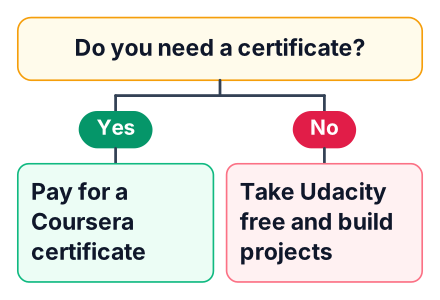
| If this is you | Start here | Then practice on |
|---|---|---|
| Hindi-speaking student: quick start, or slower and fuller | Apna College, or CodeWithHarry for a slower pace | W3Schools editor |
| English-speaking beginner in any country who wants free, hands-on practice | Kaggle Intro to SQL or Udacity SQL for Data Analysis | Kaggle public datasets |
| Telugu-speaking student | One Telugu course from the list | W3Schools, in English |
| US career-changer aiming at data analyst jobs | Udacity SQL for Data Analysis | Kaggle public datasets |
| Anyone who also wants Python | IBM course on Coursera (audit) | Kaggle |
| Anyone unsure if SQL is for them | DataCamp chapter one or Scrimba | W3Schools |
My opinion: no free course by itself lands an interview. A small project does more. Take one public dataset, write a set of queries that answer real questions about it, and put them on GitHub with a short README. An interviewer can open that link and see you write joins, which a course badge cannot show.
Pick one course from the table today, finish its first lesson tonight, and write ten of your own SQL queries on a free public dataset this week.


