What Is the Average Salary in India? The Real Numbers for 2026
The official average salary in India covers only a minority of workers and says little about developer pay. Here is the actual data, what each number measures, and how to use it to negotiate your own offer.
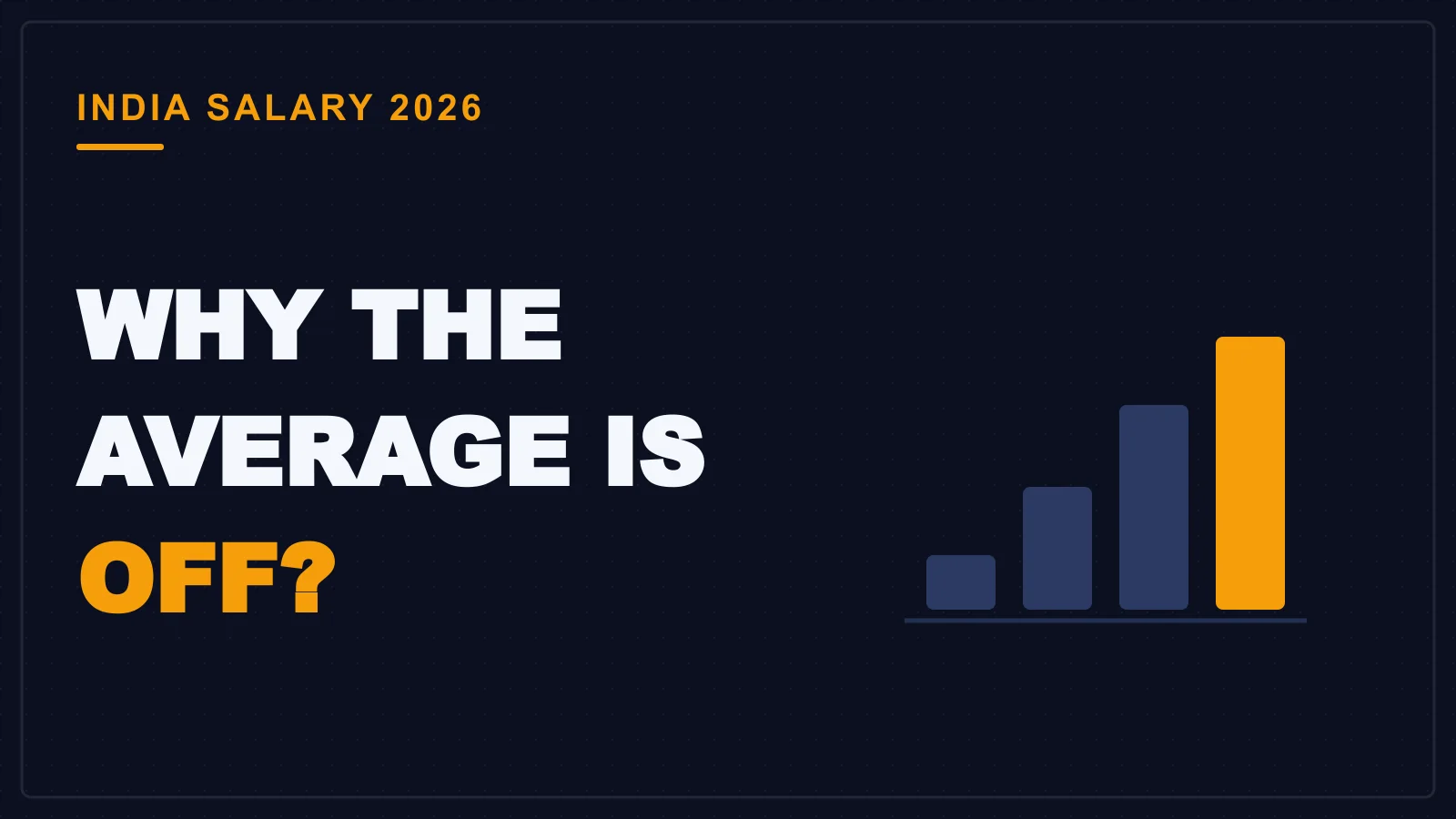
In India's latest Periodic Labour Force Survey, 56.2% of workers are self-employed and only 23.6% hold a regular salaried job. Most of the rest are casual workers, paid by the day or by the task. A headline about "the average salary in India" has to squeeze all of these people into one number. So whose pay is that number actually describing?
There is no single average salary in India, only several averages that measure different groups of people. The all-India figures describe workers far from tech, while developer pay depends on company type and city, and on what is inside the CTC. Pick the number that matches your own situation and ignore the rest.
What does the average salary in India actually measure?
The official all-India figure covers regular salaried workers only, the minority from that survey, so it says little about a developer's offer. In the PLFS report for 2025, a regular salaried worker earned ₹21,285 a month on average. Men averaged ₹24,217 and women ₹18,353.
The other two groups earn less. According to the same PLFS data, self-employed workers averaged ₹12,144 a month and casual workers ₹11,550.
Think about who sits inside the salaried figure. A school peon, a bank clerk, a factory supervisor and a hospital nurse all count. Very few of them write software, and their pay is set by local wage rates.
The number is real and useful. It just answers a question about the country, not about your offer letter.
Four averages, four different groups of people
Each commonly quoted "average" counts a different group, so comparing them to each other, or to your offer, is meaningless. Here is what each number covers, with its source in the row.
| The number | What it measures | Who it is useful for |
|---|---|---|
| ₹21,285 a month, about ₹2.6 LPA | Average pay of regular salaried workers in every sector (PLFS, via Wikipedia) | Anyone trying to understand pay across the whole country |
| About ₹9.5 LPA | Average software engineer salary across all experience levels (AmbitionBox, as cited by Simpliaxis) | A rough check on how tech pay compares with general pay |
| ₹3.5–6 LPA | Fresher pay at IT services companies (Simpliaxis) | Freshers with offers from service firms such as TCS or Infosys |
| ₹15–30 LPA | Fresher pay at top product companies (Simpliaxis) | Freshers aiming for product companies |
The salaried average sits far below the developer one because it spreads across every sector, and most sectors pay much less than software.
₹9.5 LPA sits just below the top 13% of households
Set against all Indian households, a developer salary near that average sits just below the top band, according to NSE household data quoted on Wikipedia. This is a rough comparison, since it sets one person's salary against the income of a whole household, which may have two or more earners. Even so, it changes how "low" an average developer salary feels.
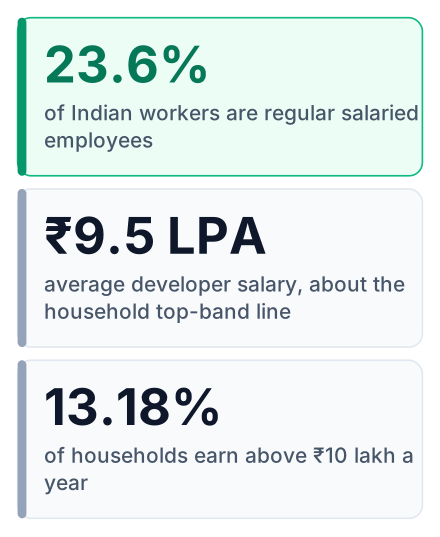
The National Stock Exchange's 2026 draft prospectus splits households by yearly income like this, as reported on Wikipedia:
- Under ₹3 lakh: 34.10% (source)
- ₹3–8 lakh: 31.52% (source)
- ₹8–10 lakh: 21.20% (source)
- Above ₹10 lakh: 13.18% (source)
The developer average sits just under the top line, not above it.
A second reference point makes the gap clearer. India's per-capita net national income for 2025-26 is ₹2,08,090 a year. That means the country's total income divided by every person, children included.
None of this is a reason to accept a low offer. It only shows that "low" always needs a comparison group, and the right group for you is other developers in your situation.
The mean hides a long tail; the median is closer to a typical offer
A few very high salaries pull the developer average up, so the median of about ₹8.2 LPA, and your own bracket, tell you more than ₹9.5 LPA. The mean is all salaries added up and divided by the number of people. The median is the middle salary when everyone is lined up from lowest to highest.
The brackets explain the gap. In the table below, from Simpliaxis, 63% of software engineers earn under ₹10 LPA (28% plus 35%). A thin tail at the top earns far more, and that tail drags the mean upward while the median barely moves.
Here is how the same source spreads the developer workforce across salary brackets:
| Salary bracket | Share of software engineers |
|---|---|
| Under ₹5 LPA | 28% |
| ₹5–10 LPA | 35% |
| ₹10–20 LPA | 22% |
| ₹20–35 LPA | 10% |
| ₹35+ LPA | 5% |
| Source: Simpliaxis, which cites AmbitionBox and other salary-reporting sites, with no stated year | |
The fresher gap in the earlier table shows the same pattern at entry level. Service and product companies hire freshers into completely different bands, so one average across both describes almost nobody. If you want to see how pay climbs with each level, my breakdown of SDE-1 vs SDE-2 vs SDE-3 roles and salaries walks through it. Newer roles have their own bands too, as in this look at AI engineer fresher salaries.
Treat every number in this section as a third-party estimate. These come from salary websites where people report their own pay, not from official statistics.
Tier-1 cities pay 35-50% more than tier-2
Where you work moves the number more than most students expect: Simpliaxis reports that tier-1 hubs pay 35-50% more than tier-2 cities. But a higher city salary is not the same as more money left at month end.
Tier-1 means the large tech hubs, such as Bengaluru and Hyderabad. Tier-2 means smaller cities with a growing tech presence, such as Indore or Coimbatore. The 35-50% figure is one source's range, not a measured gap, and none of the sources used here give Kolkata or West Bengal numbers, so check local listings for your city.
My view is simple. Compare city offers after rent and daily travel, not before. A bigger number in Bengaluru can shrink fast once you pay for a flat near the office and a long commute. A smaller number in your home city, living with family, can leave you with more savings.
City pay also varies inside the same role. This post on DevOps fresher salaries in Chennai shows how one city's numbers look up close.
CTC is not what reaches your bank account
The LPA in an offer letter is the company's yearly cost for you, and the monthly amount you receive is smaller. CTC means "cost to company": everything the company spends on you in a year. In-hand pay is what lands in your account each month after deductions.
A CTC usually bundles several parts:
- Fixed pay: your basic salary and allowances, paid every month.
- Variable pay or bonus: paid only if you or the company meet targets.
- Provident fund (PF): the employer's share goes into your retirement account, not your pocket.
- Insurance: health or life cover the company pays for.
- Joining or retention bonuses: one-time payments, sometimes with a condition to stay.
Say you get two offers with the same CTC. One has a large variable bonus and a one-time joining bonus. The other is almost all fixed pay. In your second year, the joining bonus is gone and the variable bonus may never arrive, so the second offer pays you more every month.
Always ask for the written salary breakup before comparing two offers. For a worked example with a real employer, see how the Infosys fresher CTC turns into in-hand pay.
Should you negotiate from an average at all?
No: build your own range from your role, company type, city and CTC breakup, then negotiate from that range. A national or industry average describes a crowd, and a recruiter will happily use the lowest one against you.
Name your company type
Decide whether the offer is from an IT services firm, a product company or a startup. Each hires into a different band, as the source data above shows (Simpliaxis).
Pick your city tier
Note whether the job is in a tier-1 hub or a tier-2 city, and adjust your expectations for that.
Get the CTC breakup in writing
Separate fixed pay from variable pay, PF and one-time bonuses before you compare anything.
Set a floor and a target
Take a fresher offered ₹6 LPA at a services company. That sits at the top of the ₹3.5–6 LPA services range, so a floor of ₹5 LPA and a target of ₹6.5 LPA are realistic, while the ₹15–30 LPA product range is a different market and not a fair target. Compare the fixed part, not the CTC total. Your floor is the lowest offer you would accept; your target is what you ask for first.
There is a fair counterpoint. An average works as a quick sanity check, to see if an offer is wildly off. It fails as an anchor, because it was never measuring you.
Before your next interview or offer, write down three things: your company type, your city tier and the CTC breakup in writing. Use them to pick the matching bracket and set a floor and a target.
Which "average" did you see first, and what did it make you expect?


