ChatGPT is merging Chat, Work and Codex into one usage limit
From December 2026, ChatGPT's paid plans share one token pool across Chat, Work and Codex. Instant chat stays free. Here is how to check your allowance and plan before the switch.
As of 25 November 2026, OpenAI's help page on ChatGPT and Codex usage limits has a new section for paying users. It says the way your plan gets used up will change in December. If you pay for ChatGPT to study or to code, the page says Chat, Work and Codex will share one allowance, but it does not publish how big that allowance is.
From December, Chat, Work and Codex draw from one shared token allowance on Plus, Pro and Business. Instant chat does not count against it. Check Settings → Usage for your remaining allowance and reset time. If you hit the cap, you can wait, upgrade or buy credits. OpenAI expects most users to see no change; only the heaviest users may hit limits sooner. The size of the shared pool is unpublished, so this post cannot give you your new limit. The one figure OpenAI gives is that Plus users can send as few as five Astra messages in Work or Codex within a five-hour window, depending on the task. That is a floor for heavy tasks: one long multi-file Codex job could use much of a Plus window.
What OpenAI is changing in December
OpenAI is merging the Chat and Work tabs into one interface, and the shared meter arrives with it, TechCrunch reports. The combined interface began rolling out on 24 November 2026 to a small group of Pro subscribers.
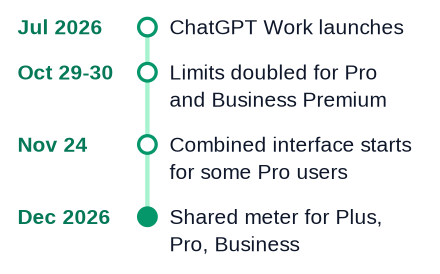
The wider switch comes later. OpenAI's support page says shared limits reach Plus and Pro, along with Business, more broadly in December. A small group sees the changes earlier, so OpenAI can collect feedback.
Here is the old setup in plain words. Chat was for everyday back-and-forth: a question, an answer, a follow-up. Work was for longer jobs with many steps, where ChatGPT acts as an agent. Crypto Briefing notes that Work launched in July 2026, powered by models such as GPT-5.6, and that OpenAI wants a simpler experience by January 2027. Codex is the coding tool. If you want to know which models sit behind Work today, my post on GPT-6.2 Astra Pro explains them.
How the shared token meter counts your usage
Usage is measured in tokens, and one pool now covers ChatGPT and Codex instead of separate allowances, Decrypt reports. A token is a small piece of text, often part of a word, that the model reads or writes. Your question uses tokens, and the answer uses more.
Longer work burns more of them. A reasoning model "thinks" before it answers, and that thinking costs tokens too. A Work task runs many steps. A Codex session reads your files and writes code. All of that comes out of the same pool.
The size of that pool is unknown. OpenAI has not disclosed how large the combined allowance will be, Decrypt notes. The one hint so far: OpenAI's usage guide estimates Plus subscribers can send as few as five Astra messages in Work or Codex within a five-hour window, depending on the task. That is a floor for heavy tasks, such as a long multi-file coding job, not a promise for every task. A short question to a reasoning model should use much less.
| Mode | Counts toward shared meter? | Typical student use |
|---|---|---|
| Instant chat | No | Defining a term, rewording notes, a quick syntax check |
| Reasoning chat | Unconfirmed: OpenAI's page does not say, check Settings → Usage | Working through a hard maths proof or a tricky algorithm |
| Work | Yes | A multi-step research task, like comparing internship options |
| Codex | Yes | Fixing bugs across a project repo, writing tests |
Instant chat does not use the shared allowance
Instant model conversations do not count toward the shared allowance, and you can keep using Instant even after you run out, per OpenAI's help page. Instant is the fast model that answers straight away, while a reasoning model pauses to think first. The model picker at the top of the chat shows which one is selected. That makes Instant your free lane. OpenAI's page confirms Work and Codex share the pool. It does not say whether reasoning chat counts, so treat that as unconfirmed and check Settings → Usage after a session.
Say you are revising for a data structures exam, at a college in Pune or a community college in Ohio. You ask what a hash collision is. You paste a messy paragraph of notes and ask for a cleaner version. Both are Instant jobs, and neither touches your meter.
Then you open your semester project, and a bug spans four files. That is a reasoning or Codex job. It needs a model that can hold the whole problem in view.
Be honest with yourself about the limit here. Instant is a lighter model. It answers fast, but it can miss steps in a long proof or a bug with many causes. Use it for small, clear questions, and do not expect it to replace the heavier models.
Check your remaining usage in Settings → Usage
Settings → Usage shows your combined remaining allowance and when it resets, so you can see your own numbers before the December switch, per OpenAI's help page. It takes under a minute.
Open ChatGPT
Use the web app or the desktop app, signed in to your paid account.
Open Settings
Click your profile name or picture, then choose Settings.
Open Usage
Pick the Usage section from the Settings menu.
Read your remaining usage and reset time
Record how much allowance is left and the exact time it refills.
Note what you ran today
Write down which tasks used reasoning chat, Work or Codex.
The possible risk: a reasoning afternoon may shrink your Codex evening
Because the pool is shared, hours of Work or Codex use can leave less allowance for a coding session later the same day, and reasoning chat may do the same if it counts, as Crypto Briefing points out for Codex and Work. The announcement does not spell this out for students. I think it is the change most likely to catch people, though OpenAI has not confirmed it.
Say you spend a Saturday afternoon on an assignment. You use a reasoning model to check each answer, and the chat runs for hours. In the evening you open Codex to push your portfolio project forward. Under the old setup, Codex had its own room. Now the afternoon already took a share of it, and you may get less done before the reset.
Most people will not feel this. An OpenAI spokesperson told TechCrunch that most users should not face more frequent resets. A small fraction of the heaviest users may hit limits sooner.
Some subscribers also have extra room already. OpenAI doubled usage limits for Pro and Business Premium users on 29 and 30 October 2026, Crypto Briefing reports. Plus users did not get that boost.
What nobody can tell you yet is the effect plan by plan. OpenAI has not published it. Treat any confident claim online about "your exact new limit" with suspicion until OpenAI does.
What to do if you hit the cap
OpenAI lists three options when the shared allowance runs out, Decrypt reports: wait for the reset, upgrade your plan, or buy credits for eligible features. Each one fits a different kind of student week.
Pros
- Waiting costs nothing extra.
- Upgrading gives you more room every cycle.
- Credits let you pay only in the weeks you need more, like exam or deadline weeks.
Cons
- Waiting can block you in the middle of a bug or a task.
- Upgrading raises your monthly bill, so check the current price of each plan first.
- Credits only cover eligible features, and small top-ups can add up.
While you wait, Instant keeps working. You can still define terms and tidy notes until the meter refills. For how ChatGPT is handling payments more broadly, see my post on the ChatGPT wallet and agent payments.
Plan your allowance before December
Sort your own tasks into free Instant work and shared-meter work now, then decide whether habits or credits are the cheaper fix. A plan this short is enough:
- Check Usage today, before the switch, so you have a starting point.
- Label each task you do as Instant or shared before you send it, and treat reasoning chat as shared until Usage shows otherwise.
- Save Codex for work that needs it, like multi-file bugs and tests.
- Decide on credits only after you have seen a real week of numbers.
You will also see strong opinions online. Responses to Sottiaux's announcement on X were largely negative, Decrypt reports. My view: the anger makes sense for heavy users, but most students should measure first and react second.
If Codex is the tool you lean on most, it is also fair to compare it with other coding tools. My post on whether Claude Code is worth it for students covers that choice.
Open Settings → Usage today, write down your remaining allowance and reset time, and note this week which tasks used Instant and which used reasoning, Work or Codex. Then decide before December whether to change habits or buy credits.


