Infosys Fresher Interview Experience: Questions by Profile (2026)
Infosys runs one combined technical and HR interview, and the questions depend on your profile. SE candidates face OOP and small programs, while DSE and SP candidates get data structures and harder coding problems.
How do you swap two numbers without a third variable? An SE candidate was asked exactly that. The PrepInsta pages that collect real Infosys fresher interview reports show the same pattern across profiles: the profile you get decides which questions you face. Each profile below rests on one reported interview, so read them as examples, not as a trend across many candidates. A DSE candidate was asked to merge two sorted arrays in C. An SP candidate was asked to write bubble sort and state its complexity.
Infosys runs one combined technical and HR interview, and the profile you qualify for sets the questions. Pass the InfyTQ Certification round with a reported 65% for the SE interview (PrepInsta's figure, so confirm it on the official Infosys InfyTQ page). Pass the Advantage round, the second and harder online round, for the DSE or SP interview. Expect 40 to 60 minutes on WebEx, covering your coding rounds, core concepts, your project and a few HR questions. The SE report is titled 2024 and the others are undated, so as of November 2026 treat them as one to two years old, and the format may have changed.
Check which profile you qualify for first
Your score in the two online rounds decides whether you get the SE interview or the DSE/SP interview, so check this before you plan any practice. Both rounds belong to InfyTQ, Infosys's certification track for students.
According to PrepInsta's InfyTQ summary, the track is open to pre-final-year students from all branches. PrepInsta reports that you must be an Indian citizen, and that there is no minimum percentage. These are PrepInsta's figures, not Infosys's, and the page does not say whether the 65% applies to your total score or to each section, so confirm the current cutoff and eligibility on the official Infosys InfyTQ page before you plan around it.
The ladder has two steps. Clearing the Certification round alone gets you the SE (System Engineer) interview. Clearing the Advantage round as well gets you the DSE (Digital Specialist Engineer) or SP (Specialist Programmer) interview. The sources I read do not explain what decides DSE versus SP. Those profiles pay more, and our Infosys fresher salary breakdown shows the gap in in-hand terms.
| Profile | Round that qualifies you | Interview focus | Reported sample question |
|---|---|---|---|
| SE | Certification round, 65% cutoff (source) | OOP, DBMS basics, small programs | Swap two numbers without a third variable (source) |
| DSE | Advantage round, 65% cutoff as reported by PrepInsta (source) | Data structures, polymorphism, coding | Merge two sorted arrays in C (source) |
| SP | Advantage round, 65% cutoff as reported by PrepInsta (source) | Databases, SDLC, harder coding | Write bubble sort and state its complexity (source) |
Clear the Certification round
Round one is 3 hours with no sectional timing, so you can spend your time where you are weakest. PrepInsta lists its parts: 10 MCQs in your chosen language (Java or Python), 2 hands-on coding questions and 10 MCQs on DBMS.
The coding questions take the longest. Plan the rest of the paper around them:
Scan the whole paper
Read both coding problems first. Your mind keeps working on them while you answer the MCQs.
Clear the easy MCQs fast
Answer the language and DBMS questions you know at once. Mark the rest and move on.
Code the easier problem
Get a solution that passes the sample input, then handle edge cases.
Attack the harder problem
A partial solution that passes some test cases beats an empty editor.
Return to marked MCQs
Spend whatever time is left on the questions you skipped.
Pick Java or Python and stick with it. In the SP interview report, the interviewer asked the candidate to recall the coding-round questions. Write yours down the same evening, while you still remember them.
Clear the Advantage round for DSE and SP
This round is 3 hours of 3 competitive-coding questions, and clearing the same cutoff is the gate to the higher-paying profiles. These are DSA problems, closer to contest questions than to the Certification round's coding tasks.
The DSE and SP reports I read include merging sorted arrays, bubble sort and a hash map question. Those make a sensible base for practice, with string problems alongside.
Common mistakes in this round:
- Spending most of the time on question one. If you are stuck for a long stretch, move to the next problem and come back.
- Skipping edge cases: an empty array, a single element, duplicates or very large values.
- Ignoring the constraints. They tell you whether a nested loop will time out.
- Testing only the sample input before you submit.
Know the interview format before the call
Most reports describe a single combined technical and HR round on WebEx, so plan for one call rather than a separate HR slot. Length varied by report: one SP interview ran about an hour, and a DSE interview took 40 to 45 minutes.
The order was similar across the reports:
- Your introduction
- Recall of your coding-round questions
- Concept questions for your profile
- Your project
- HR questions
The result comes by email a few days later, according to the SE interview report.
Pros
- One call, then you wait for the email. No second round to schedule.
- You can carry confidence from the technical part into the HR part.
Cons
- No second chance to recover from a weak start.
- A shaky HR answer can undo a strong coding answer in the same call.
Practice these coding questions
The reports describe small, classic coding problems. Each example below is labelled either as reported for a profile or as my addition, so you can tell which is which. If any C syntax is unclear, check it against your own course notes or a C textbook, then compile each example yourself and run it on a few inputs before the call.
Merge two sorted arrays (DSE)
This one is adapted from the full C solution in the DSE interview report.
void merge(int a[], int n, int b[], int m, int out[]) {
    int i = 0, j = 0, k = 0;
    while (i < n && j < m) {
        if (a[i] <= b[j])
            out[k++] = a[i++];
        else
            out[k++] = b[j++];
    }
    while (i < n) out[k++] = a[i++];
    while (j < m) out[k++] = b[j++];
}
Run on {1, 3, 5} and {2, 4}, it fills the output with {1, 2, 3, 4, 5}. Interviewers check that you walk both arrays with two pointers in one pass, which is linear in the total length.
That DSE candidate was also asked to write code that implements a hash map. Be ready to explain the parts. Start with a table of buckets, then add a hash function that turns a key into a bucket index. Each bucket holds a linked list to handle collisions.
Bubble sort (SP)
void bubbleSort(int arr[], int n) {
    for (int i = 0; i < n - 1; i++) {
        int swapped = 0;
        for (int j = 0; j < n - 1 - i; j++) {
            if (arr[j] > arr[j + 1]) {
                int t = arr[j];
                arr[j] = arr[j + 1];
                arr[j + 1] = t;
                swapped = 1;
            }
        }
        if (!swapped) break;
    }
}
The SP candidate had to state the O(n²) time complexity, and the swapped flag lets you add that already-sorted input finishes in one pass.
Swap two numbers without a third variable (SE)
a = a + b;
b = a - b;
a = a - b;
Interviewers reported this one for SE. I would also mention that addition can overflow and that the XOR version avoids that.
Check if a number is prime (SE)
int isPrime(int n) {
    if (n < 2) return 0;
    for (int i = 2; i * i <= n; i++)
        if (n % i == 0) return 0;
    return 1;
}
I added this one myself, and it is not a question from the SE report. I would stop at the square root of n instead of looping all the way to n, and say why.
One harder case: an SP candidate was given the Traveling Salesman problem. Nobody expects a perfect answer there. Explain that brute force tries every order of cities, and that the number of orders explodes as you add cities. You can add that dynamic programming stores answers to smaller sub-problems so the work is not repeated. This is rare, so a clear brute-force explanation is enough.
Revise the concept questions per profile
Concept questions differ by profile: SE leans on OOP and DBMS basics, DSE on data structures and polymorphism, SP on databases and SDLC.
| Profile | Concept questions reported | Source |
|---|---|---|
| SE | Four pillars of OOP; types of inheritance in C++; what DBMS is; normalization | SE report |
| DSE | Linear vs non-linear data structures; method overloading vs overriding; linked lists | DSE report |
| SP | HashMap vs Hashtable; ACID properties; the 6 types of SQL joins; pointers in C++; SDLC; Iterative Waterfall vs Waterfall | SP report, InfyTQ summary |
Short model answers for the ones that trip people up:
- Overloading vs overriding: overloading means the same method name with different parameters, decided at compile time. Overriding means a subclass redefines a parent method, decided at runtime, and only overriding needs inheritance (DSE report).
- ACID: atomicity means a transaction is all or nothing. Consistency keeps data valid, isolation stops parallel transactions from clashing, and durability keeps committed data after a crash (SP report).
- HashMap vs Hashtable (general Java knowledge, not from the reports): Hashtable is synchronized and rejects null keys and values. HashMap is not synchronized, allows one null key, and is faster in single-threaded code.
For the linear vs non-linear question, our guide to types of data structures gives examples you can quote. If joins feel shaky, work through a free SQL course for beginners before the call.
Prepare your project and HR answers
Interviewers spend a large share of the time on your project and on short HR questions, and those need a rehearsed answer more than any algorithm does.
The DSE candidate got two pointed project questions: "What shortcomings does your project have?" and "Will it still be relevant in 10 years?"
HR questions reported across profiles:
- Your greatest achievement and your role model (DSE report)
- Strengths and weaknesses, where you see yourself in 5 years, why Infosys (SE report)
- What qualities make you suitable for Infosys (SP report)
- Handling a conflict in your team, relocation, and what you know about Infosys, including its CEO (InfyTQ summary)
For the shortcomings question, say it like this:
- Name one real gap. "It has no automated tests" is honest and specific.
- Explain why it exists. Time, scope or what you did not know yet.
- Say how you would fix it. This turns a weakness into proof that you think ahead.
The interviewer usually starts from whatever your resume puts first. Our post on writing a junior developer resume with no experience shows how to lead with your strongest project.
Common mistakes to avoid in the Infosys interview
Most reported stumbles come from not being able to explain code or projects you listed yourself, not from hard questions.
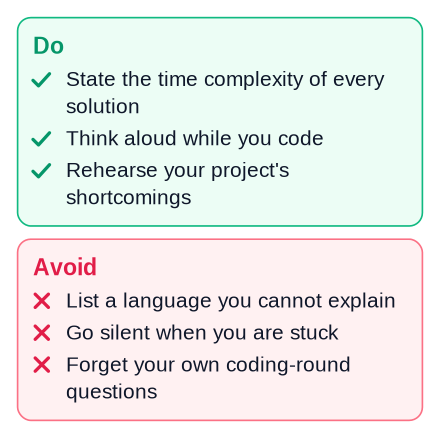
- Don't forget your own coding-round questions. Do write them down right after each round.
- Don't finish code and stop talking. Do state its time complexity without being asked.
- Don't list a skill you cannot explain. If C++ is on your resume, expect a pointers question.
- Don't guess in silence. Do think aloud, so the interviewer can follow your logic and give hints.
Your two-week practice plan
This week
Write the merge-sorted-arrays, bubble sort, prime-check and number-swap programs from memory in your chosen language. Say each one's complexity aloud.
Next week
Write your one-minute introduction, your project answer and an answer to each HR question above.
Then
Run one mock interview with a friend over video call, with screen sharing on, the way WebEx will be.


